Превключване към принт
 Прочети повече







































 За произведения на изкуството или репродукции, чийто размер е над 105 см (приблизително 41 инча) във всяка страна, рамката ще бъде изпратена в разглобен вид като комплект за сглобяване. Този метод гарантира безопасна доставка и предотвратява повреди по време на транспортиране.


A Poetic Tapestry of Script and Spirit
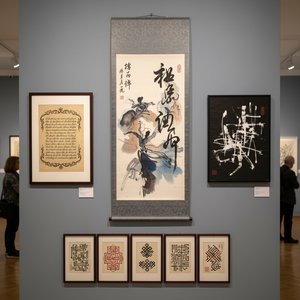
In the delicate interplay of ink and emerald, Geetāshtak emerges as more than a mere visual artifact; it is a profound meditation on the written word and its rhythmic soul. Created in 1926 by the legendary Bengali polymath Rabindranath Tagore, this piece serves as a bridge between the literary and the visual, where the boundaries of poetry and painting dissolve into one another. The artwork presents an intricate oriental script, flowing across the surface with a grace that suggests the very cadence of a song. Set against a lush, deep green background, the composition achieves a striking balance, allowing the fine details of the calligraphy to breathe while enveloping the viewer in a sense of tranquil, verdant depth.
The technique employed here reflects Tagore’s unique position as a pioneer of contextual modernism. Rather than focusing on representational imagery, the artist utilizes the aesthetic power of the script itself to evoke emotion. The meticulous attention to detail in each stroke suggests a rhythmic, almost musical quality—fitting for a work titled Geetāshtak, which hints at a collection of songs or verses. This approach invites the observer to look beyond the literal meaning of the characters and instead feel the movement, the weight, and the spiritual resonance of the ink as it dances upon the page.
Historical Resonance and Modern Elegance
To understand Geetāshtak is to understand the cultural renaissance of early 20th-century India. During a period when artists were seeking to reclaim their heritage while embracing modern sensibilities, Tagore stood at the forefront, blending traditional Indian aesthetics with a global, modernist vision. This piece captures that precise historical tension—the reverence for ancient script and spiritual tradition paired with a minimalist, almost abstract focus on form and color. It is a testament to an era where art was used to express a profound sense of identity and cosmic connection.
For the discerning collector or interior designer, this reproduction offers a sophisticated focal point that transcends mere decoration. The emerald tones provide a calming, organic energy, making it an ideal addition to spaces designed for contemplation, such as libraries, study alcoves, or serene living areas. Because the work relies on the evocative power of texture and tone rather than overt subject matter, it integrates seamlessly into both classical and contemporary interiors. It serves as a conversation piece that whispers of ancient wisdom and poetic beauty, bringing a touch of timeless, scholarly elegance to any curated environment.
Въпроси и отговори
На кой етап от кариерата на Rabindranath Thakur съответства датата от 1926 на „Geetāshtak\n\n“?
Датираната с 1926 г. творба „Geetāshtak\n\n“ принадлежи към Late Period на развитието на Rabindranath Thakur.
„Geetāshtak\n\n“ на Rabindranath Thakur светла или тъмна творба ли е?
Възприеманата яркост на „Geetāshtak\n\n“ на Rabindranath Thakur е brilliant. Тя може да бъде съобразена със светлината в предназначеното за нея пространство.
Мога ли да прегледам „Geetāshtak\n\n“ на Rabindranath Thakur, преди да поръчам?
Предварителен преглед на „Geetāshtak\n\n“ на Rabindranath Thakur можете да видите на страницата за преглед на произведението Преглед на произведението.
 Преглед в реален мащаб
 Изпрати
 Сподели
 Детайли
 Ръководство

 Изтегляне
 Подобни артикули
 Рентгенова снимка
 Слайдшоу
 Q&A
Q&A Статистика