

 Преглед в реален мащаб
 Сподели
 Сподели
 Подробности
 Ръководство

 Изтегляне
 Подобни артикули
 Рентгенова снимка
 Слайдшоу
 Статистика
Idilio campero


 Разгърни целия текст
Жикле / Художествен принт
Giclée печат или принт върху платно с музейно качество, бързо производство и гъвкави опции за завършен вид. ( Поръчайте ръчно рисувано репродукция на този колекционерски предмет Превключване към дигитално изображение)




P118B $10

P118H $10

P118W $10

P438Z $10

P508JH $12

P508YH $12

P805H $10

P805Z $10

P919BZ $10

P919G $10

P919XJ $10

P959ZH $10

P968JZ $12

W106C $8

W218G $10

W218JH $8

W218Y $10

W307PJ $10

W316G $10

W316PJ $8

W316Y $10

W398PJ $8

W4111J $10

W500HY $15

W500JH $15

W692G $12

W849H $8

W940BG $15

W953PJ $8




Изберете от нашите предварително зададени размери, които съответстват на оригиналните пропорции на произведението.

Можете да въведете собствени размери, за да паснат на конкретна рамка или пространство. Ако избраният от Вас размер не съвпада с пропорциите на оригиналното изображение, ние ще изрежем произведението или ще разширим изображението с огледален или едноцветен ръб. Дигитален макет ще бъде изпратен за Ваше одобрение преди започването на производството.
Моля, имайте предвид, че предпрегледът на екрана не отразява реалното изрязване или разширяване. Само макетът ще покаже точно финалната композиция.
Въпреки че са налични персонализирани размери, препоръчваме да изберете размер от предварително дефинирания списък, за да запазите оригиналните пропорции.
Доставка по целия свят () в рамките на 2 седмици вместо стандартните 4/5 седмици. (26 Септември)

Безплатна експресна доставка по целия свят

Висококачествено ленено платно

Пълно застраховане на доставката

Гаранция за възстановяване на митнически такси

Гаранция за пълно съответствие на цветовете

Политика за връщане в рамките на 100 дни (само при дефекти)

100% Гаранция за връщане на сумата

Отстъпка при поръчка на повече произведения
 Опцията със стъкло е налична само за размери под 110 см

Idilio campero
Жикле / Художествен принт
Размер на репродукцията
-


Крайна цена
$ 80
A Pastoral Symphony in Brushstrokes
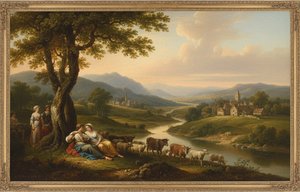
In the evocative masterpiece Idilio campero, painted in 1935, the Uruguayan master Pedro Figari invites us into a nostalgic realm where time seems to slow to the rhythm of the countryside. The painting presents a breathtaking tableau of rural life, centered around a majestic, sprawling tree that serves as both a physical and emotional anchor for the composition. Beneath its protective canopy, two figures share a quiet moment of intimacy, their presence framed by the soft, atmospheric light that characterizes Figari’s late period. This central vignette is not merely a depiction of a landscape, but a profound meditation on connection and the enduring peace found within the natural world.
As the eye wanders from the central figures, it discovers a lively, breathing ecosystem of movement and life. In the middle ground, horses graze peacefully, adding a sense of depth and pastoral authenticity to the scene. The presence of other figures—scattered subtly across the canvas—imbues the landscape with a gentle vitality, suggesting a community that exists in perfect harmony with the land. Each person, positioned with deliberate care, contributes to a narrative of shared existence, turning a simple landscape into a rich tapestry of social and natural interaction.
The Soul of Uruguayan Modernism
To understand Idilio campero, one must understand the unique spirit of Pedro Figari. A polymath who transitioned from law and politics to the canvas in his sixties, Figari brought a deep, intellectual empathy to his work. His style is a captivating blend of post-impressionist influence and a deeply personal, almost dreamlike memory. He did not merely paint what he saw; he painted the essence of what he remembered about the gaucho culture and the traditional customs of Uruguay. This technique creates a soft, blurred edge to reality, where forms emerge from a hazy, luminous atmosphere, making the painting feel less like a photograph and more like a cherished, fading memory.
The technique employed in this work relies on a masterful use of light and texture to evoke emotion. The brushwork is fluid and expressive, eschewing rigid lines in favor of organic shapes that mimic the undulating terrain of the pampas. For collectors and interior designers, this piece offers an unparalleled emotional depth; it possesses a warmth that can transform a room, providing a focal point that is both sophisticated and deeply comforting. It is a work that does not demand attention through aggression, but rather captures it through a quiet, irresistible charm.
A Timeless Addition to the Modern Collection
For those seeking to curate a space filled with character and historical resonance, Idilio campero stands as an exquisite choice. The painting’s palette—earthy, warm, and harmonious—complements a wide variety of interior aesthetics, from classic traditionalism to contemporary minimalist settings. It serves as a window into a lost era, offering a sense of tranquility and a connection to the roots of Latin American modernism.
Owning a high-quality reproduction of this work allows for the preservation of Figari's legacy within a private collection or a curated design project. The piece functions not just as decoration, but as a conversation starter—a soulful tribute to the beauty of simplicity and the enduring magic of the pastoral idyll. It is an invitation to pause, to breathe, and to reconnect with the serene rhythms of life that Figari so lovingly immortalized on canvas.
Биография на художника
A Life Imbued with Uruguayan Essence
Pedro Figari, a name now inextricably linked to the vibrant heart of Latin American modernism, was far more than simply a painter; he was a complex and deeply engaged intellectual – a lawyer, a writer, a politician, and ultimately, an artist who dedicated his entire life to capturing the very essence of Uruguay. Born in Montevideo in 1861, Figari’s artistic journey wasn't one of immediate, deliberate pursuit. Initially drawn to the structured world of law, he earned his degree in 1886, a profession that profoundly shaped his understanding of society’s intricacies and injustices – experiences which would later find powerful expression through his art. His early career as a defense attorney for the marginalized and impoverished exposed him to the raw realities of life, fostering within him a deep empathy and a keen awareness of social dynamics. This formative period, marked by encounters with hardship and injustice, simmered beneath the surface until it finally erupted in a torrent of creative energy. A marriage in the same year led to travels in France, a pivotal moment that introduced him to the burgeoning world of post-impressionism – an encounter that subtly influenced his artistic direction without fundamentally altering his core vision. However, it was in 1921, at the remarkable age of sixty, that Figari truly embraced painting, unleashing a creative force that would redefine Latin American art and cement his place as a leading figure.From Legal Chambers to Artistic Visions
For decades prior to 1921, Figari skillfully balanced his demanding legal and political commitments with sporadic artistic endeavors. He was deeply involved in Uruguayan public life, serving as a respected member of Parliament, directing the Escuela Nacional de Artes y Oficios (National School of Arts and Crafts), and contributing significantly to intellectual discourse through his insightful writings on law, education, aesthetics, and even utopian ideals – reflecting a mind constantly engaged with the complexities of human existence. This diverse background wasn’t a distraction from his art; rather, it profoundly enriched it, providing him with a unique perspective shaped by legal reasoning, political engagement, and a deep understanding of social structures. His legal training instilled in him an acute observational skill and a sensitivity to the nuances of human interaction, while his literary pursuits honed his ability to articulate complex ideas with clarity and precision. The move to Buenos Aires in 1921 proved to be a catalyst for this transformation. It was there that he shed the constraints imposed by earlier, academically-influenced styles – styles rooted in traditional European techniques – and began to forge a truly unique artistic voice, one deeply connected to his Uruguayan roots. He abandoned meticulous realism, opting instead for a more intuitive approach—painting not what he *saw*, but what he *remembered*. This deliberate reliance on memory wasn’t simply a technical choice; it allowed him to distill the essence of his experiences, imbuing his work with a profoundly personal and nostalgic quality – a feeling that resonated powerfully with viewers.A Pioneer's Palette: Style and Subject Matter
Figari’s artistic style is immediately recognizable for its vibrant color palettes, bold brushstrokes, and seemingly naïve simplicity. He wasn’t interested in creating illusions of depth or photographic accuracy; instead, he treated his canvases as studies in color and form, reconstructing Uruguayan scenes from the fragmented recollections of his memory. His subjects were drawn almost exclusively from the world he knew intimately – the gauchos (cowboys) roaming the vast pampas grasslands, lively carnival celebrations brimming with music and dance, the quiet rituals and daily life of Montevideo’s black community, and the intimate beauty of colonial patios bathed in golden light. These weren't merely picturesque depictions; they were poignant reflections on Uruguayan identity, social customs, and a disappearing way of life – a sense of nostalgia for a rapidly changing world. He captured fleeting moments—a dance in progress, a gathering of friends, a street scene teeming with activity—with an immediacy that felt both timeless and deeply rooted in place. His technique, often employing *impasto* (thickly applied paint) with visible brushstrokes, further emphasized the expressive power of color and texture, creating paintings that pulsated with energy and emotion – works that seemed to breathe with life.Influences and Artistic Development
Figari’s artistic development wasn't a linear progression but rather a complex interplay of influences. While his early training in law provided him with a rigorous analytical mind, it was his exposure to post-impressionism in France that fundamentally shifted his approach to painting. He admired the bold colors and expressive brushwork of artists like Van Gogh and Gauguin, but he resisted adopting their more overtly emotional style. Instead, he synthesized these influences with his own unique perspective, creating a distinctly Uruguayan aesthetic. His early works, often characterized by meticulous detail and academic precision, gradually evolved into looser, more intuitive compositions – reflecting his growing confidence in his artistic vision. The influence of indigenous art and folklore is also evident in his work, particularly in the use of vibrant colors and symbolic imagery. He was deeply interested in preserving Uruguayan cultural heritage, and his paintings often served as a celebration of national identity.Legacy and Enduring Influence
Pedro Figari’s legacy extends far beyond his individual artistic achievements. He is remembered not simply as a painter but as one of the first Latin American artists to successfully forge a distinctly regional style – prioritizing feeling and essence over strict realism. His work continues to inspire artists and art lovers alike with its vibrant energy, emotional depth, and unwavering commitment to capturing the spirit of Uruguay. He demonstrated that true modernity wasn’t about imitating European trends but about finding one's own voice—a lesson that resonated throughout Latin America and beyond. He died in 1938, leaving behind a rich body of work that stands as a testament to his artistic vision, intellectual curiosity, and enduring love for his homeland – paintings that are not merely representations of Uruguayan life but *are* Uruguay itself, its colors, its rhythms, its soul, preserved on canvas for generations to come.
Педро Фигари
1861 - 1939 , Уругвай
Бързи факти
- Artistic Movement Or Style: Латинскоамериканска модерност
- Artists Or Movements Influenced By This Artist: ['Пост-импресионизъм']
- Artists Who Influenced This Artist: ['Godofredo Sommavilla']
- Date Of Birth: 29 юни 1861
- Date Of Death: 24 юли 1938
- Full Name: Pedro Figari Solari
- Nationality: Уругвайски
- Notable Artworks:
- Tertulia
- Rincón De Negros
- Place Of Birth: Montevideo, Уругвай
Свързани статии

Evocations of Place: A Historical Journey Through Landscape Art
Explore the rich history of landscape art with OriginalUniqueArt. Discover renowned artists, movements like Impressionism & Romanticism, and expert guidance for collecting timeless pieces. Find your perfect serene escape today!

Idyllic Visions: Exploring the Pastoral Scene in Art History – From Arcadia to Modern Interpretations
Explore the captivating history of pastoral art from classical Arcadia to modern masterpieces. Discover key artists like Millet & Cole at OriginalUniqueArt. Find serene landscape paintings for your home.
Idyllic Visions: Exploring the Pastoral Tradition in Western Art – Themes, Techniques & Enduring Appeal
Explore the rich history of pastoral art from classical Arcadia to contemporary interpretations. Discover key artists, themes & collecting tips at OriginalUniqueArt.

Топ 10 шедьовъра на Романтичния пейзаж: Изкуство за вашия дом от OriginalUniqueArt.com
Открийте 10 шедьовъра на Романтичния пейзаж – Фридрих, Търнър и други! Разгледайте историите зад картините, техниките и емоциите. Репродукции с музейно качество от OriginalUniqueArt.com. Вдъхновете се за вашия дом!

Топ 25 шедьовъра на Джон Констабъл: Английски пейзажи за вашия дом | OriginalUniqueArt.com
Открийте топ 25 шедьовъра на Джон Констабъл – английски пейзажи, романтизъм и красотата на природата. Репродукции с музейно качество за вашия дом! Разгледайте пълната колекция онлайн на OriginalUniqueArt.com.
