Представи си го
 Изпрати
 Сподели
 Детайли

 Изтегляне
 Подобни
 Рентгенова снимка
 Слайдшоу
St Mennas
 Oil On Canvas
- WallArt
- Mannerism (Late Renaissance)
 1560
1560 247.0 x 122.0 cm
 Galleria Estense
 Прочетете повече
Жикле / Художествен принт
Giclée печат или принт върху платно с музейно качество, бързо производство и гъвкави опции за завършен вид. ( Превключване към ръчно рисувана картина Превключване към изображение)




P118B $10

P118H $10

P118W $10

P438Z $10

P508JH $12

P508YH $12

P805H $10

P805Z $10

P919BZ $10

P919G $10

P919XJ $10

P959ZH $10

P968JZ $12

W106C $8

W218G $10

W218JH $8

W218Y $10

W307PJ $10

W316G $10

W316PJ $8

W316Y $10

W398PJ $8

W4111J $10

W500HY $15

W500JH $15

W692G $12

W849H $8

W940BG $15

W953PJ $8




Изберете от предварително зададените размери, които съответстват на оригиналните пропорции на произведението.

Можете да въведете собствени размери, за да паснат на конкретна рамка или пространство. Ако избраният от Вас размер не съвпада с пропорциите на оригиналното изображение, ние ще изрежем произведението или ще разширим изображението с огледален или едноцветен ръб. Дигитален макет ще бъде изпратен за Ваше одобрение преди започването на производството.
Моля, имайте предвид, че предпрегледът на екрана не отразява реалното изрязване или разширяване. Само макетът ще покаже точно финалната композиция.
Въпреки че са налични персонализирани размери, препоръчваме да изберете размер от предварително дефинирания списък, за да запазите оригиналните пропорции.
Доставка по целия свят () в рамките на 2 седмици вместо стандартните 4/5 седмици. (10 Август)

Безплатна експресна доставка по целия свят

Висококачествено ленено платно

Пълно застраховане при доставка

Гаранция за възстановяване на митнически такси

Гаранция за цветова точност

60-Дневен период за връщане (Само при дефекти)

100% Гаранция за връщане на парите

Предложение за отстъпка при поръчка на едро
 Стъклото е налично само в размери под 110 см

St Mennas
Жикле / Художествен принт
Размер на репродукцията
-


Обща цена
$ 80
Описание на колекционерския предмет
The Enigmatic Saint: Unveiling “St Mennas”
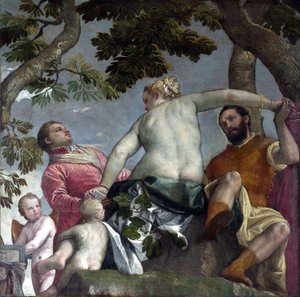
Paolo Veronese’s “St Mennas,” painted around 1560, isn't merely a depiction of a biblical figure; it’s an immersive theatrical experience rendered in oil on canvas. This monumental work, currently residing within the Galleria Estense in Modena, Italy, transports the viewer to a vibrant, almost operatic scene brimming with opulent detail and profound symbolism. Veronese, a master of Venetian Renaissance painting, elevates the story of St Mennas – a Roman soldier who embraced Christianity after being martyred for his faith – into a grand narrative that speaks volumes about faith, power, and the enduring allure of the human form.
The painting immediately captivates with its scale and lavishness. Veronese, known for his dramatic compositions and extravagant use of color, doesn’t shy away from creating a scene overflowing with figures, rich fabrics, and architectural splendor. The dark background serves as a brilliant foil to the luminous figure of St Mennas himself, drawing our attention to his commanding presence and the intricate details of his armor and attire. It's a deliberate choice that emphasizes both the saint’s importance and the grandeur of the occasion.
A Symphony of Color and Light: Veronese’s Technique
Veronese’s mastery lies not just in composition but also in his unparalleled command of color and light. He employs a technique known as “coloristic painting,” prioritizing vibrant hues and their interplay over strict realism. The reds, golds, and blues dominate the scene, creating an atmosphere of intense drama and celebratory fervor. Notice how he uses chiaroscuro – the contrast between light and dark – to sculpt the figure, highlighting his musculature and armor while casting subtle shadows that add depth and volume. The brushstrokes themselves are loose and expressive, contributing to the painting’s overall sense of movement and energy.
The artist's meticulous attention to detail is equally remarkable. From the intricate patterns on the fabrics to the gleaming surfaces of the armor, every element is rendered with painstaking precision. Veronese was a master of illusionistic painting, creating the impression of three-dimensionality through careful manipulation of perspective and color. This technique, particularly evident in the architectural background – which appears almost impossibly vast – further enhances the painting’s dramatic impact.
Symbolism and Context: A Portrait of Faith
“St Mennas” is more than just a portrait; it's a complex allegory laden with symbolic meaning. The figure of St Mennas, clad in Roman armor and holding a shield emblazoned with a cross, represents the triumph of Christianity over paganism. The setting itself – a grand hall filled with richly dressed figures – symbolizes the universal embrace of faith. The inclusion of various historical and mythological figures within the scene further reinforces this theme, suggesting that St Mennas’s sacrifice is part of a larger narrative spanning centuries.
Painted during the height of the Venetian Renaissance, “St Mennas” reflects the era's fascination with classical antiquity and its embrace of humanism. Veronese was deeply influenced by Titian, whose mastery of color and dramatic composition he skillfully adopted while forging his own distinctive style. The painting’s opulent setting and theatrical presentation were characteristic of Venetian art at the time, reflecting the city’s wealth and prestige as a center of trade and culture.
A Legacy of Grandeur: Exploring Veronese's Vision
Paolo Veronese’s “St Mennas” remains one of the most celebrated works in the Venetian Renaissance. Its vibrant colors, dramatic composition, and profound symbolism continue to captivate viewers centuries after its creation. To delve deeper into this masterpiece, consider visiting the Galleria Estense in Modena or exploring online resources such as the Web Gallery of Art (https://www.wga.hu/html_m/v/veronese/03_1560s/1gemini2.html) and WikiArt (https://www.wikiart.org/en/paolo-veronese/st-mennas). Reproductions of this iconic painting offer a glimpse into the artistic genius of Veronese and his enduring legacy.
Биография на художника
A Venetian Visionary: The Life and Art of Paolo Veronese
Paolo Caliari, universally known as Paolo Veronese, emerged from the vibrant artistic currents of 16th-century Venice as a master of color, composition, and breathtaking spectacle. Born in Verona in 1528, his early life was deeply intertwined with the visual richness of his surroundings – the classical architecture, sculpted forms, and burgeoning humanist ideals that defined the region. His initial training under Antonio Badile and Giovanni Francesco Caroto provided him with a solid foundation in traditional techniques, but it was his relocation to Venice in the 1550s that truly ignited his artistic genius. The city itself became his constant muse, its bustling marketplaces, magnificent palazzi, and shimmering waterways profoundly shaping the scale and dramatic intensity of his work. Veronese swiftly absorbed the influences of established Venetian masters like Titian, whose mastery of color exerted a powerful impact on his palette; however, he forged a distinctive style characterized by an unparalleled sense of theatricality and grandeur – a truly unique vision.The Painter of Feasts and Grand Narratives
Veronese’s enduring legacy rests primarily upon his monumental paintings, particularly those depicting lavish feasts and biblical scenes reimagined as dazzling displays of Venetian life. The *Wedding at Cana*, completed in 1563 for the Benedictine monastery of San Giorgio Maggiore, stands as a prime example of his exceptional skill. This colossal canvas transcends mere illustration; it’s a vibrant panorama of 16th-century society, teeming with elegantly dressed figures, musicians, and architectural details rendered with astonishing precision. The painting isn't simply about *what* happened at Cana but rather *how* it would have appeared if it had unfolded in Venice during Veronese’s time – a remarkable feat of historical reconstruction. Similarly, *The Feast in the House of Levi*, originally titled *The Last Supper*, provoked considerable controversy with the Inquisition due to its inclusion of contemporary figures and an atmosphere that seemed almost irreverent. Veronese defended his artistic choices, asserting that painters possessed the same creative liberty as poets and jesters – a bold declaration reflecting his belief in art’s capacity to interpret and reimagine sacred narratives. These works weren't merely religious depictions; they were celebrations of life, wealth, and the splendor of Venice itself. He prioritized capturing the joy and abundance of existence over strict adherence to theological dogma.Influences and Artistic Development
While Titian’s influence on Veronese’s coloristic approach is undeniable, his artistic development was shaped by a complex interplay of diverse influences. The architectural precision evident in his compositions draws heavily from the classical traditions prevalent in Verona during his formative years, particularly the work of architects like Michele Sanmicheli. He also absorbed elements from Central Italian masters such as Raphael and Parmigianino, reflected in the graceful lines and harmonious arrangements within his paintings. However, Veronese didn’t merely imitate these influences; he synthesized them into a uniquely Venetian style characterized by its dramatic use of light, vibrant color palettes, and meticulous attention to detail. He excelled at creating illusions of space and depth, employing perspective techniques to draw viewers directly into the heart of his elaborate scenes. His mastery of oil painting allowed him to achieve an unparalleled luminosity and richness of texture – a hallmark of his distinctive style. Furthermore, Veronese maintained a large workshop, with contributions from his brother Benedetto and sons Gabriele and Carlo (or ‘Carletto’), ensuring that his artistic vision continued to flourish even after his death in 1588.Major Achievements and Notable Works
Veronese’s career was marked by numerous significant commissions and masterpieces. The full-scale decoration of the Venetian church of S. Sebastiano (1555–around 1570) stands as a testament to his ambition and technical skill. His ceiling and wall paintings for the library of S. Marco (1556–57) and the Ducal Palace (early 1550s and 1575–82) are equally impressive, showcasing his ability to transform vast spaces into breathtaking works of art. Perhaps most famously, he created a series of mythological paintings for an international clientele, including *Venus and Adonis* and *Bacchus and Ariadne*. His depiction of the *Last Supper*, though initially controversial, remains one of his most celebrated works, demonstrating his innovative approach to historical narrative. The sheer scale and opulent detail of these paintings cemented Veronese’s reputation as a leading figure in Venetian art.Legacy and Historical Significance
Paolo Veronese's impact extends far beyond the realm of Renaissance art. His work has resonated through centuries, inspiring artists across various disciplines. His dramatic compositions and vibrant color schemes have been cited as influences on everything from Baroque painting to modern cinema – even finding echoes in the visual aesthetics of Spaghetti Westerns. He was a key member of the “great trio” of Venetian painters—alongside Titian and Tintoretto—each contributing uniquely to the city’s artistic legacy, yet Veronese often stands apart for his sheer exuberance and celebration of earthly pleasures. His paintings continue to captivate audiences with their grandeur and spectacle, offering a glimpse into the opulent world of 16th-century Venice. Veronese's legacy is a testament to his artistic genius, his ability to capture the essence of an era, and his enduring contribution to the history of art – a true embodiment of Venetian splendor.
Паоло Веронезе
1528 - 1588 , Италия
Бързи факти
- Artistic Movement Or Style: Ренесанс, Маниеризм
- Artists Or Movements Influenced By This Artist:
- Рафаел
- Памиччини
- Artists Who Influenced This Artist: ['Тициан']
- Date Of Birth: 1528 г.
- Date Of Death: 1588 г.
- Full Name: Паоло Веронезе
- Nationality: Италианец
- Notable Artworks:
- Сватбата в Кана
- Тържество в дома на Леви
- Place Of Birth: Верона, Италия
Всички статии
Paolo Veronese: A Renaissance Master of Color, Composition, and Venetian Splendor
Explore the vibrant world of Paolo Veronese, a Renaissance master renowned for his opulent compositions, masterful use of color, and dramatic Venetian scenes. Discover key artworks & legacy.

Топ 25 шедьовъра на Якопо Тинторето: Драма, светлина и величие в изкуството
Разгледайте топ 25 шедьовъра на Якопо Тинторето – венециански ренесанс, драматизъм и чиароскуро. Открийте историите зад картините му и преобразете дома си с луксозни репродукции от OriginalUniqueArt.com!

Oil on Canvas: A Historical & Technical Exploration of a Timeless Artistic Medium
Explore the rich history & enduring techniques of oil painting on canvas. Discover the science behind its longevity, conservation practices, and contemporary relevance. Expert insights for art enthusiasts.

The Enduring Power of Painting: A Historical & Contemporary Exploration of Form and Emotion
Explore the rich history & enduring techniques of oil painting with OriginalUniqueArt. Discover masterpieces, learn about art collecting, and find authentic handmade reproductions crafted by skilled artists.

The Enduring Legacy of Oil on Canvas: Technique, History & Aesthetic Impact
Explore the rich history & techniques of oil painting – from Renaissance masters to Impressionism. Discover pigments, layering methods, and why this timeless medium endures. Expert insights for artists & art enthusiasts.