Представи си го
 Изпрати
 Сподели
 Детайли

 Изтегляне
 Подобни
 Рентгенова снимка
 Слайдшоу
Scorn
 Oil On Canvas
- WallArt
- Venetian High Renaissance
 1575
1575- Renaissance
 186.0 x 188.0 cm
 Национална галерия
 Прочетете повече
Жикле / Художествен принт
Giclée печат или принт върху платно с музейно качество, бързо производство и гъвкави опции за завършен вид. ( Купете ръчно рисувана картина Купете изображение)




P118B $10

P118H $10

P118W $10

P438Z $10

P508JH $12

P508YH $12

P805H $10

P805Z $10

P919BZ $10

P919G $10

P919XJ $10

P959ZH $10

P968JZ $12

W106C $8

W218G $10

W218JH $8

W218Y $10

W307PJ $10

W316G $10

W316PJ $8

W316Y $10

W398PJ $8

W4111J $10

W500HY $15

W500JH $15

W692G $12

W849H $8

W940BG $15

W953PJ $8




Изберете от предварително зададените размери, които съответстват на оригиналните пропорции на произведението.

Можете да въведете собствени размери, за да паснат на конкретна рамка или пространство. Ако избраният от Вас размер не съвпада с пропорциите на оригиналното изображение, ние ще изрежем произведението или ще разширим изображението с огледален или едноцветен ръб. Дигитален макет ще бъде изпратен за Ваше одобрение преди започването на производството.
Моля, имайте предвид, че предпрегледът на екрана не отразява реалното изрязване или разширяване. Само макетът ще покаже точно финалната композиция.
Въпреки че са налични персонализирани размери, препоръчваме да изберете размер от предварително дефинирания списък, за да запазите оригиналните пропорции.
Доставка по целия свят () в рамките на 2 седмици вместо стандартните 4/5 седмици. (19 Август)

Безплатна експресна доставка по целия свят

Висококачествено ленено платно

Пълно застраховане при доставка

Гаранция за възстановяване на митнически такси

Гаранция за цветова точност

60-Дневен период за връщане (Само при дефекти)

100% Гаранция за връщане на парите

Предложение за отстъпка при поръчка на едро
 Стъклото е налично само в размери под 110 см

Scorn
Жикле / Художествен принт
Размер на репродукцията
-


Обща цена
$ 80
Описание на колекционерския предмет
A Venetian Masterpiece of Passion and Virtue
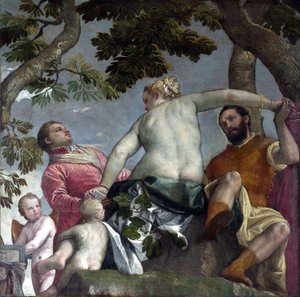
In the grand tapestry of the Venetian High Renaissance, few works capture the turbulent intersection of desire and morality as poignantly as Paolo Veronese’s “Scorn.” Painted around 1575, this monumental oil on canvas is far more than a mere depiction of figures; it is a profound allegory that breathes life into the complex trials of human emotion. As one gazes upon this masterpiece, one is immediately struck by the dramatic tension held within its frame. A naked man lies prone upon a ruined classical structure, his body a vessel for the struggle between earthly impulse and spiritual restraint. Above him, the figure of Cupid—not the playful cherub of later eras, but a stern arbiter of consequence—stands atop the man's chest, wielding a bow with a snapped string, as if chastising the subject for his surrender to hedonistic whims.
The painting serves as a breathtaking window into the Venetian soul, where opulence and intellect danced in equal measure. Veronese, a master of the colorito technique, utilizes a palette that is nothing short of symphonic. Deep, resonant reds, shimmering golds, and the ethereal blues of the sky create an atmosphere of theatrical grandeur. Even as time has subtly altered the pigments—softening the once-vibrant smalt blues into a more melancholic grey—the work retains an undeniable luminosity that commands the room. For the discerning collector or interior designer, this piece offers a profound sense of depth, acting as a focal point that invites long periods of contemplation and conversation.
Symbolism and the Language of Allegory
To understand “Scorn” is to decode a visual language of symbols designed to guide the viewer toward moral reflection. Veronese masterfully employs juxtaposition to illustrate the duality of love. Flanking the central figure are two women who represent the opposing forces of the human heart. One woman, draped in luxurious silks, gazates down with an expression of palpable disdain, embodying the sting of rejection and the weight of earthly temptation. In stark contrast, another figure leads a companion away, clutching an ermine—a creature long revered as a symbol of purity, moderation, and even chastity. This interplay between the sensual and the sacred transforms the canvas from a mere scene into a philosophical treatise on the necessity of virtue in the face of overwhelming passion.
The composition itself was likely conceived for a grand architectural setting, perhaps a decorated ceiling, as evidenced by Veronese’s use of oblique perspective. This technique allows the figures to appear as though they are unfolding directly above the viewer, creating an immersive, almost three-dimensional experience. The inclusion of classical ruins and lush, textured foliage adds layers of historical weight, suggesting that the struggle between passion and restraint is a timeless, eternal cycle. It is this very complexity—the way the eye wanders from the tension in Cupid's stance to the delicate texture of the ermine's fur—that makes a high-quality reproduction of this work such a transformative addition to any curated space.
An Eternal Inspiration for Modern Interiors
Bringing a reproduction of “Scorn” into a contemporary environment is an act of bringing history to life. For those seeking to infuse a room with character, the painting offers a unique blend of classical prestige and emotional intensity. Its large-scale presence (measuring approximately 186 x 188 cm) makes it an ideal centerpiece for grand dining halls, sophisticated studies, or luxurious living areas where art is intended to provoke thought and evoke awe. The rich textures and dramatic lighting characteristic of Veronese’s style provide a sense of warmth and historical continuity that modern minimalism often lacks.
Whether you are an art historian captivated by the nuances of Venetian patronage or an interior designer looking for a statement piece that embodies elegance and drama, “Scorn” remains an inexhaustible source of inspiration. A meticulously hand-painted reproduction captures not just the image, but the very spirit of Veronese’s brushwork—the heavy impasto, the luminous glazes, and the dramatic chiaroscuro. To possess such a work is to hold a piece of the Renaissance within one's walls, ensuring that the dialogue between beauty, virtue, and desire continues for generations to come.
Биография на художника
A Venetian Visionary: The Life and Art of Paolo Veronese
Paolo Caliari, universally known as Paolo Veronese, emerged from the vibrant artistic currents of 16th-century Venice as a master of color, composition, and breathtaking spectacle. Born in Verona in 1528, his early life was deeply intertwined with the visual richness of his surroundings – the classical architecture, sculpted forms, and burgeoning humanist ideals that defined the region. His initial training under Antonio Badile and Giovanni Francesco Caroto provided him with a solid foundation in traditional techniques, but it was his relocation to Venice in the 1550s that truly ignited his artistic genius. The city itself became his constant muse, its bustling marketplaces, magnificent palazzi, and shimmering waterways profoundly shaping the scale and dramatic intensity of his work. Veronese swiftly absorbed the influences of established Venetian masters like Titian, whose mastery of color exerted a powerful impact on his palette; however, he forged a distinctive style characterized by an unparalleled sense of theatricality and grandeur – a truly unique vision.The Painter of Feasts and Grand Narratives
Veronese’s enduring legacy rests primarily upon his monumental paintings, particularly those depicting lavish feasts and biblical scenes reimagined as dazzling displays of Venetian life. The *Wedding at Cana*, completed in 1563 for the Benedictine monastery of San Giorgio Maggiore, stands as a prime example of his exceptional skill. This colossal canvas transcends mere illustration; it’s a vibrant panorama of 16th-century society, teeming with elegantly dressed figures, musicians, and architectural details rendered with astonishing precision. The painting isn't simply about *what* happened at Cana but rather *how* it would have appeared if it had unfolded in Venice during Veronese’s time – a remarkable feat of historical reconstruction. Similarly, *The Feast in the House of Levi*, originally titled *The Last Supper*, provoked considerable controversy with the Inquisition due to its inclusion of contemporary figures and an atmosphere that seemed almost irreverent. Veronese defended his artistic choices, asserting that painters possessed the same creative liberty as poets and jesters – a bold declaration reflecting his belief in art’s capacity to interpret and reimagine sacred narratives. These works weren't merely religious depictions; they were celebrations of life, wealth, and the splendor of Venice itself. He prioritized capturing the joy and abundance of existence over strict adherence to theological dogma.Influences and Artistic Development
While Titian’s influence on Veronese’s coloristic approach is undeniable, his artistic development was shaped by a complex interplay of diverse influences. The architectural precision evident in his compositions draws heavily from the classical traditions prevalent in Verona during his formative years, particularly the work of architects like Michele Sanmicheli. He also absorbed elements from Central Italian masters such as Raphael and Parmigianino, reflected in the graceful lines and harmonious arrangements within his paintings. However, Veronese didn’t merely imitate these influences; he synthesized them into a uniquely Venetian style characterized by its dramatic use of light, vibrant color palettes, and meticulous attention to detail. He excelled at creating illusions of space and depth, employing perspective techniques to draw viewers directly into the heart of his elaborate scenes. His mastery of oil painting allowed him to achieve an unparalleled luminosity and richness of texture – a hallmark of his distinctive style. Furthermore, Veronese maintained a large workshop, with contributions from his brother Benedetto and sons Gabriele and Carlo (or ‘Carletto’), ensuring that his artistic vision continued to flourish even after his death in 1588.Major Achievements and Notable Works
Veronese’s career was marked by numerous significant commissions and masterpieces. The full-scale decoration of the Venetian church of S. Sebastiano (1555–around 1570) stands as a testament to his ambition and technical skill. His ceiling and wall paintings for the library of S. Marco (1556–57) and the Ducal Palace (early 1550s and 1575–82) are equally impressive, showcasing his ability to transform vast spaces into breathtaking works of art. Perhaps most famously, he created a series of mythological paintings for an international clientele, including *Venus and Adonis* and *Bacchus and Ariadne*. His depiction of the *Last Supper*, though initially controversial, remains one of his most celebrated works, demonstrating his innovative approach to historical narrative. The sheer scale and opulent detail of these paintings cemented Veronese’s reputation as a leading figure in Venetian art.Legacy and Historical Significance
Paolo Veronese's impact extends far beyond the realm of Renaissance art. His work has resonated through centuries, inspiring artists across various disciplines. His dramatic compositions and vibrant color schemes have been cited as influences on everything from Baroque painting to modern cinema – even finding echoes in the visual aesthetics of Spaghetti Westerns. He was a key member of the “great trio” of Venetian painters—alongside Titian and Tintoretto—each contributing uniquely to the city’s artistic legacy, yet Veronese often stands apart for his sheer exuberance and celebration of earthly pleasures. His paintings continue to captivate audiences with their grandeur and spectacle, offering a glimpse into the opulent world of 16th-century Venice. Veronese's legacy is a testament to his artistic genius, his ability to capture the essence of an era, and his enduring contribution to the history of art – a true embodiment of Venetian splendor.
Паоло Веронезе
1528 - 1588 , Италия
Бързи факти
- Artistic Movement Or Style: Ренесанс, Маниеризм
- Artists Or Movements Influenced By This Artist:
- Рафаел
- Памиччини
- Artists Who Influenced This Artist: ['Тициан']
- Date Of Birth: 1528 г.
- Date Of Death: 1588 г.
- Full Name: Паоло Веронезе
- Nationality: Италианец
- Notable Artworks:
- Сватбата в Кана
- Тържество в дома на Леви
- Place Of Birth: Верона, Италия
Всички статии
Paolo Veronese: A Renaissance Master of Color, Composition, and Venetian Splendor
Explore the vibrant world of Paolo Veronese, a Renaissance master renowned for his opulent compositions, masterful use of color, and dramatic Venetian scenes. Discover key artworks & legacy.

Топ 25 шедьовъра на Якопо Тинторето: Драма, светлина и величие в изкуството
Разгледайте топ 25 шедьовъра на Якопо Тинторето – венециански ренесанс, драматизъм и чиароскуро. Открийте историите зад картините му и преобразете дома си с луксозни репродукции от OriginalUniqueArt.com!

Venetian Renaissance: The Mastery of Color, Light, and the Art of Colorito
Explore the luminous mastery of the Venetian Renaissance. Discover how masters like Titian and Giorgione revolutionized art through colorito, light, and atmosphere. An expert guide to the golden age of Italian painting for collectors and enthusiasts.
Топ 10 произведения на изкуството за дълбоки романтични чувства | OriginalUniqueArt.com
Открийте топ 10 произведения на изкуството, които възбуждат дълбоки романтични чувства! Разгледайте историите зад класически картини от Ренесанса до Импресионизма. Вдъхновете се за интериорен дизайн с OriginalUniqueArt.com – музейно качество репродукции и изкуство за вашия дом.
The Enduring Motif of Love in Art History: A Cross-Cultural Exploration of Representation and Emotion
Explore the rich history of love in art! Discover iconic masterpieces, artistic techniques & cultural symbolism from antiquity to modern times. Expert analysis for collectors.