

 Представи си го
 Изпрати
 Сподели
 Детайли

 Изтегляне
 Подобни
 Рентгенова снимка
 Слайдшоу
 Статистика
Wolfgang Amadé Mozart


 Прочетете повече
Жикле / Художествен принт
Giclée печат или принт върху платно с музейно качество, бързо производство и гъвкави опции за завършен вид. ( Купете ръчно рисувана картина Превключване към дигитално изображение)




P118B $10

P118H $10

P118W $10

P438Z $10

P508JH $12

P508YH $12

P805H $10

P805Z $10

P919BZ $10

P919G $10

P919XJ $10

P959ZH $10

P968JZ $12

W106C $8

W218G $10

W218JH $8

W218Y $10

W307PJ $10

W316G $10

W316PJ $8

W316Y $10

W398PJ $8

W4111J $10

W500HY $15

W500JH $15

W692G $12

W849H $8

W940BG $15

W953PJ $8




Изберете от предварително зададените размери, които съответстват на оригиналните пропорции на произведението.

Можете да въведете собствени размери, за да паснат на конкретна рамка или пространство. Ако избраният от Вас размер не съвпада с пропорциите на оригиналното изображение, ние ще изрежем произведението или ще разширим изображението с огледален или едноцветен ръб. Дигитален макет ще бъде изпратен за Ваше одобрение преди започването на производството.
Моля, имайте предвид, че предпрегледът на екрана не отразява реалното изрязване или разширяване. Само макетът ще покаже точно финалната композиция.
Въпреки че са налични персонализирани размери, препоръчваме да изберете размер от предварително дефинирания списък, за да запазите оригиналните пропорции.
Доставка по целия свят () в рамките на 2 седмици вместо стандартните 4/5 седмици. (17 Септември)

Безплатна експресна доставка по целия свят

Висококачествено ленено платно

Пълно застраховане при доставка

Гаранция за възстановяване на митнически такси

Гаранция за цветова точност

Политика за връщане в рамките на 100 дни (само при дефекти)

100% Гаранция за връщане на парите

Предложение за отстъпка при поръчка на едро
 Стъклото е налично само в размери под 110 см

Wolfgang Amadé Mozart
Жикле / Художествен принт
Размер на репродукцията
-


Обща цена
$ 80
A Vision of Musical Genius
In the quiet intimacy of Martin Knoller’s 1773 portrait, we encounter more than just the likeness of a man; we witness the captured essence of a legend. The subject, the incomparable Wolfgang Amadeus Mozart, is presented not as the mythic figure of later centuries, but as a vibrant, living presence. Through Knoller's masterful brushwork, the viewer is drawn into an 18th-century moment where the air seems to hum with the potential of unwritten symphonies. The composer’s gaze, directed slightly away from the observer, suggests a mind preoccupied with the celestial harmonies that only he could hear, inviting us to contemplate the profound depth of his creative spirit.
The portrait serves as a breathtaking intersection of two great artistic eras. Knoller, an artist deeply rooted in the dramatic traditions of the Baroque, utilizes light and shadow to bestow a sense of sculptural weight upon Mozart’s features. Yet, there is an unmistakable whisper of Neoclassicism within the composition—a refined clarity and a balanced elegance that mirrors the structural perfection found in Mozart’s own musical compositions. This stylistic duality creates a visual rhythm that is both emotive and orderly, making the piece a captivating study in tension and grace.
Technique and the Art of Detail
To behold this work is to appreciate the meticulous technical prowess of Martin Knoller. The artist employs a sophisticated palette where the deep, regal blues of Mozart’s jacket contrast beautifully with the soft, luminous tones of his skin. Every curl of hair is rendered with a delicate touch, suggesting texture and movement, while the crispness of the bow tie provides a focal point of sartorial precision. This attention to detail does not merely serve a descriptive purpose; it elevates the portrait from a mere historical record to a sensory experience.
For the discerning collector or interior designer, the painting offers an unparalleled opportunity to introduce a sense of intellectual prestige and classical beauty into a space. The interplay of light across the fabric and the subtle modeling of the face create a three-dimensional quality that commands attention from any vantage point. Whether placed in a grand library, a sophisticated study, or a contemporary gallery setting, this reproduction brings with it an aura of timelessness and cultural significance.
A Legacy Captured in Color
Beyond its aesthetic merits, the portrait carries a profound emotional resonance. It captures Mozart during a period of immense transition and burgeoning fame, embodying the restless energy of a prodigy navigating the complexities of the European courts. There is a certain vulnerability in his expression, tempered by an undeniable brilliance, which speaks to the human struggle behind the divine talent. This emotional complexity ensures that the artwork remains deeply relatable, bridging the gap between the 18th century and the modern day.
Owning a piece of this caliber is an invitation to surround oneself with the echoes of greatness. It is more than a decoration; it is a conversation piece that celebrates the enduring power of human creativity. As a high-quality reproduction, it allows the splendor of Knoller’s vision and the legacy of Mozart to inhabit contemporary homes, offering daily inspiration through its masterful blend of historical narrative and exquisite artistry.
Биография на художника
Martin Knoller: Life and Legacy
Early Life and Education
Martin Knoller (1725 – 1804) was an Austrian-Italian painter, primarily active in Italy, renowned for his fresco work. Born in Steineck im Brenner, near Innsbruck, Austria, he received his initial artistic training under the tutelage of Paul Troger and Michelangelo Unterberger in Salzburg and Vienna. These masters instilled in him a foundation in Baroque techniques that would later inform his distinctive style.
Artistic Development and Influences
In 1755, Knoller journeyed to Rome, a pivotal moment in his artistic development. Exposure to the burgeoning Neoclassical movement profoundly influenced his work. He studied under Anton Raphael Mengs and engaged with the writings of Johann Joachim Winckelmann, absorbing their emphasis on classical ideals of form and composition. While retaining elements of Baroque drama, Knoller’s style increasingly incorporated clarity, balance, and a refined aesthetic sensibility.
Key Characteristics and Style
Knoller's art occupies an interesting space between the Baroque and Rococo periods, with the latter often prevailing in his paintings rather than his frescoes. He specialized in both frescoes and altarpiece paintings. His compositions frequently feature groups of figures, always ensuring the principal subject is prominently located in the foreground. A hallmark of his work is the use of bright, vibrant colors, particularly in clothing, adding a sense of life and dynamism to his scenes.
- Emphasis on Figure Groups: Knoller excelled at depicting dynamic interactions between figures.
- Vibrant Color Palette: His use of color adds energy and visual interest.
- Clear Composition: He favored well-ordered arrangements, avoiding the excessive drama of High Baroque.
- Masterful Perspective: Knoller demonstrated a strong understanding of perspective, creating realistic spatial depth.
Major Achievements and Commissions
Knoller’s breakthrough came with his completion of “The Glory of St Stephen” in 1754 at the parish church of Anras in East Tyrol. However, it was through the patronage of Karl Joseph von Firmian, the Imperial Governor of Lombardy under Maria Theresa, that Knoller achieved widespread recognition. Von Firmian commissioned him to paint frescoes for the Palazzo Firmian-Vigoni, a significant undertaking that showcased Knoller’s talent and cemented his reputation.
Later Life and Legacy
From 1793 until his death in 1804, Knoller served as a professor at the Brera Academy of Fine Arts in Milan. Among his pupils was Giuseppe Mazzola, who continued to propagate Knoller’s artistic principles. While not as widely celebrated as some of his contemporaries, Martin Knoller left behind a substantial body of work that reflects the transition between Baroque exuberance and Neoclassical restraint. His frescoes and altarpieces remain important examples of 18th-century Italian art.
Historical Significance
Knoller’s significance lies in his ability to synthesize diverse artistic influences – Baroque, Rococo, and Neoclassicism – into a unique and compelling style. He represents a transitional figure whose work embodies the changing aesthetic sensibilities of his time. His emphasis on clarity, balance, and vibrant color continues to resonate with art enthusiasts today.

Martin Knoller
1725 - 1804 , Austria
Бързи факти
- Birth Date: 1725
- Birth Place: Steineck im Brenner, Austria
- Death Date: 1804
- Influenced: ['Giuseppe Mazzola']
- Influenced By:
- Paul Troger
- Michelangelo Unterberger
- Anton Raphael Mengs
- Johann Joachim Winckelmann
- Movement:
- Baroque
- Rococo
- Neoclassicism
- Name: Martin Knoller
- Nationality: Austrian-Italian
- Notable Works:
- The Glory of St Stephen
- Palazzo Firmian-Vigoni frescoes
Всички статии

The Grandeur of Baroque Classicism: A Sophisticated Study of Drama, Order, and Artistic Mastery
Explore the breathtaking tension of Baroque Classicism. Discover how 17th-century masters reconciled dramatic emotion with classical order through light, shadow, and divine grandeur in this expert art history guide for true connoisseurs.
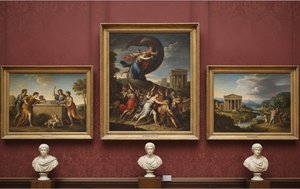
Mastering the Classics: The 25 Greatest Paintings by Nicolas Poussin
Journey through the grandeur of French Baroque with our curated list of the top 25 Nicolas Poussin masterpieces. Explore the stories behind these timeless classical paintings and find museum-quality art reproductions for your decor. Discover all masterpieces on OriginalUniqueArt.com.

Baroque Classicism: The Grandeur of Order and Drama in 17th-Century Art History
Explore the profound elegance of Baroque Classicism. Discover how 17th-century masters synthesized dramatic emotion with classical order through the lens of the Counter-Reformation and the works of legends like Carlo Maratta and Andrea Sacchi.

Mastering the Classics: The Top 25 Essential Works by Nicolas Poussin
Immerse yourself in the grandeur of French Baroque with our curated guide to the top 25 Nicolas Poussin masterpieces. Explore the stories behind these timeless classical paintings and find museum-quality art reproductions for your decor. Discover all masterpieces on OriginalUniqueArt.com.
Baroque Classicism: Reconciling Drama & Order in 17th-Century Art
Explore the captivating world of Baroque Classicism! Discover its history, key artists like Caravaggio & Rubens, and defining characteristics. Expert insights & high-quality reproductions at OriginalUniqueArt.