

 Преглед в реален мащаб
 Сподели
 Сподели
 Подробности
 Ръководство

 Изтегляне
 Подобни артикули
 Рентгенова снимка
 Слайдшоу
 Статистика
Chocolate Grinder


 Разгърни целия текст
Закупете дигитално изображение с висока резолюция и подобрени характеристики, значително по-качествено от онлайн прегледа.
Всеки файл е щателно подготвен от нашите специалисти с помощта на съвременни инструменти и експертен ръчен ретуш. Гарантираме, че всяко изображение притежава изключителна яснота, прецизна цветова точност и фини детайли.
Окончателният файл се доставя по имейл в рамките на 72 часа, оптимизиран за незабавна употреба в професионални, редакционни и печатни среди. Това е същото качество, на което се доверяват водещи дизайнерски студия, издатели и галерии.
Дигитално изображение
Изтеглете файл с висока резолюция за лично съхранение, принтиране и творчески проекти. ( Избор на принт Поръчайте ръчно рисувано репродукция на този колекционерски предмет)
Включено във всяка поръчка за дигитални изображения
Експертна дигитална доставка, гарантирана
Избирайки OriginalUniqueArt.com, вие не получавате просто изображение – вие придобивате професионално обработена дигитална творба, създадена с прецизност и подкрепена от гаранция за удовлетворение. Ето какво автоматично е включено във вашата поръчка:

Бърза доставка по имейл
Вашето дигитално изображение с висока резолюция ще бъде изпратено по имейл в рамките на 72 часа от поръчката – готово за незабавно използване.

Дигитален файл с подобрено качество чрез ИИ
Вашата картина е професионално оптимизирана с помощта на усъвършенствани инструменти за изкуствен интелект и ръчна редакция, осигурявайки максимална детайлност, яснота и точност на цветовете.

Безплатна доживотна повторна доставка
Изгубили сте или сте изтрили файла си по погрешка? Не се притеснявайте – ще го изпратим отново на Вас по всяко време, безплатно.

Без митнически такси – завинаги
Насладете се на вашето произведение незабавно, без мита, данъци или такси за доставка – дигиталните изтегляния винаги са освободени от данъци.

Гаранция за точност на цветовете
Гарантираме, че вашето дигитално изображение отразява оригиналните цветове възможно най-точно, чрез използването на професионални инструменти и системи за управление на цветовете.

100-дневна гаранция за удовлетвореност
Ако не сте доволни от вашето дигитално изображение, ще го преработим или ще възстановим 100% от сумата в рамките на 100 дни – без излишни въпроси.

100% Гаранция за връщане на сумата
Не сте доволни? Получете пълен възврат на сумата в рамките на 100 дни от получаването на вашия цифров файл – без излишни въпроси.

Отстъпки за големи поръчки
Купете 3 изображения, спестете 10% - Купете 5, спестете 15% - Купете 10+, спестете 20%. Идеално за творчески проекти, галерии и агенства.
A Mechanical Dream: Marcel Duchamp’s *Chocolate Grinder* (1914)
Marcel Duchamp's *Chocolate Grinder*, created in 1914, is a fascinating and enigmatic work that exemplifies the artist’s burgeoning departure from traditional painting towards conceptual art. This isn’t a realistic depiction of an industrial machine; it’s a stylized, almost abstracted vision – a premonition of the mechanical age filtered through a surreal lens.Deconstructing the Industrial Form
The artwork presents a flattened perspective of a chocolate mill, reduced to its essential geometric components: cylinders and basket-like structures. Duchamp deliberately avoids realistic representation, instead opting for simplified forms and angular lines. The composition feels rigidly structured, emphasizing the mechanical nature of the subject matter. While seemingly depicting an object of production, it’s presented with a deliberate lack of detail – we aren't seeing *how* chocolate is made, but rather an *idea* of the process.Style and Technique: A Bridge Between Worlds
The style leans heavily towards both Surrealism and Constructivism. The geometric abstraction echoes the principles of Constructivism, with its emphasis on industrial forms and simplified shapes. However, the dreamlike quality and distortion of reality firmly place it within the emerging Surrealist movement. Duchamp employs a primarily linear technique, using straight lines to define the machine’s components, complemented by subtle shading to suggest volume without fully realizing it. The likely medium – oil or acrylic on canvas – contributes to the work's smooth, almost clinical surface.Historical Context: On the Cusp of Change
Created on the eve of World War I, *Chocolate Grinder* reflects a period of rapid industrialization and societal upheaval. Duchamp, along with other avant-garde artists, was questioning traditional artistic values and exploring new ways to represent the modern world. This work foreshadows his later rejection of “retinal art” – art meant solely for aesthetic pleasure – in favor of works that engaged the intellect. It’s a pivotal piece marking his transition away from purely visual concerns towards conceptual exploration.Symbolism and Interpretation
The chocolate grinder itself is symbolic, representing industrial production and the mechanization of everyday life. However, Duchamp doesn't present it as a celebration of progress. Instead, its abstracted form and dreamlike quality suggest a sense of alienation or detachment from the manufacturing process. The work invites contemplation on the relationship between humans and machines, and the impact of technology on society. It’s not simply *about* a chocolate grinder; it’s about what that machine represents in the modern world.Emotional Impact & Aesthetic Appeal
Despite its mechanical subject matter, *Chocolate Grinder* evokes a surprisingly whimsical feeling. The simplified forms and muted color palette create a sense of calm contemplation. It's an artwork that rewards close viewing, inviting viewers to decipher its hidden meanings and appreciate Duchamp’s innovative approach to representation. Its unique aesthetic – a blend of precision and abstraction – makes it a compelling addition to any collection or interior space.- For Art Lovers: A key example of Duchamp's early experimentation, showcasing his move towards conceptual art.
- For Collectors: A rare opportunity to own a piece that represents a turning point in 20th-century art history.
- For Interior Designers: Its geometric forms and muted palette make it versatile, complementing modern or minimalist interiors. The artwork’s intellectual depth adds a layer of sophistication to any space.
Въпроси и отговори
От какво е направена "Chocolate Grinder" и в какъв стил е?
„Chocolate Grinder“ на Марсел Дюшан съчетава техниката Oil On Canvas със стила Surrealism. Техниката и направлението описват начина на изработка и художествения стил на произведението.
Колко наситен е палитрата на "Chocolate Grinder"?
„Chocolate Grinder“ на Марсел Дюшан е заснето с Clear Color Presence наситеност.
Какво разположение е подходящо за формата на „Chocolate Grinder“ на Марсел Дюшан?
Формат (Portrait) и препоръчителното пространство (Living Room) са двете записани подробности за разположението на „Chocolate Grinder“ на Марсел Дюшан.
Биография на художника
Marcel Duchamp (1887–1968): A Revolutionary Spirit
Marcel Duchamp, Henri-Robert-Marcel Duchamp, was born in Blainville-sur-Mer, Normandy, France, on July 28, 1887. His artistic lineage traced back to his father, a notary, and his brother Jacques Villon, who established himself as a successful painter – a familial encouragement that nevertheless wouldn’t fully encapsulate the rebellious spirit that would define Duchamp's life and career. Initially drawn to formal training in Paris, he mastered traditional techniques and experimented with Post-Impressionist styles, absorbing influences from artists like Cézanne and Gauguin. However, this grounding in academic art served as a crucial catalyst for his profound questioning of artistic conventions. He recognized that mere visual representation wasn’t sufficient to grapple with the existential anxieties of the era—specifically, the devastating impact of World War I on European society. This disillusionment fueled his embrace of Dadaism, a movement born from utter rejection of logic and reason, marking a decisive break from established artistic paradigms.Early Artistic Explorations: Cubism and Impressionism
Duchamp’s initial foray into art began with an exploration of Cubism alongside Jacques Villon. Their collaborative efforts yielded works like *Portrait of Chess Players* (1911), demonstrating a fascination for fragmented forms and multiple perspectives—a radical departure from the single viewpoint championed by earlier artistic traditions. While acknowledging the aesthetic merits of Cubist principles, Duchamp swiftly transcended purely visual concerns, perceiving that artistic expression demanded more than just rearranging elements on canvas. He sought to engage with deeper philosophical questions about perception and reality. This intellectual curiosity would propel him toward Dadaism and beyond.The Dadaist Rebellion: Challenging Artistic Boundaries
Duchamp’s involvement in Dadaism solidified his commitment to dismantling conventional notions of art. Rejecting the values of beauty, craftsmanship, and emotional expression—characteristics deemed paramount by mainstream artistic circles—he championed a stance of deliberate provocation. Dada artists aimed not to create aesthetically pleasing objects but rather to disrupt established hierarchies and expose the absurdity inherent in societal norms. Duchamp’s Dadaist output included provocative collages and assemblages that questioned accepted standards of taste and challenged viewers to confront uncomfortable truths. The movement's manifesto proclaimed “Anti-art,” asserting that art should be conceived as a negation of everything it represented.The Birth of Conceptual Art: ‘Ready-Made’ Sculpture
Duchamp’s most enduring contribution to the history of art arrived in 1917 with his groundbreaking concept of the ‘ready-made.’ Recognizing that artistic creativity extended beyond mere manual skill, he questioned whether an object could be considered art if it was simply presented as such—without any transformative intervention. His seminal work, *Fountain* (1917), consisted of a porcelain urinal signed “R. Mutt,” submitted anonymously to Marcel Duchamp’s own exhibition in New York City. This audacious act deliberately undermined the distinction between artwork and everyday object, sparking intense debate about authorship, originality, and the very definition of artistic value. It established Conceptual Art as a dominant force in postwar art, prioritizing ideas over visual form.Later Works: The Large Glass and Beyond
Duchamp continued to push boundaries throughout his career, culminating in *The Large Glass* (1915–1923), an ambitious multi-faceted project incorporating glass panels, enamel paint, and intricate sculptural elements. This monumental artwork explored themes of illusion, perception, and the subconscious—reflecting Duchamp’s lifelong fascination with psychoanalysis and his desire to delve into the complexities of human consciousness. His later explorations encompassed film, poetry, and graphic design, demonstrating a multifaceted artistic sensibility that defied categorization. Marcel Duchamp died October 2, 1968, leaving behind an unparalleled legacy as one of the most influential figures in modern art—a testament to his unwavering conviction that art should provoke thought and challenge accepted conventions. His influence persists today, inspiring artists to question assumptions about creativity and artistic expression.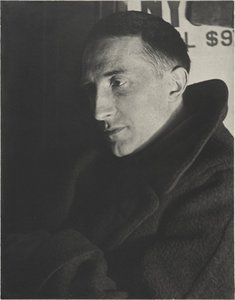
Марсел Дюшан
1887 - 1968 , Франция
Кратка информация
- Artistic Movement Or Style:
- Кубизъм
- Дадаизъм
- Концептуален изкуство
- Artists Or Movements Influenced By This Artist:
- Концептуално изкуство
- Поп арт
- Минимализъм
- Date Of Birth: Юли 28, 1887
- Date Of Death: Октомври 2, 1968
- Full Name: Marcel Duchamp
- Nationality: Френски-Американски
- Notable Artworks:
- Фонтан
- Л.Х.О.О.К.
- Голям стъкло
- Place Of Birth: Блейнвил, Франция