Cubist Sculpture · 1914
Bottlerack (Марсел Дюшан, 1914)
Марсел Дюшан (1887–1968) създаде Bottlerack. Датира от 1914. Това произведение принадлежи към движението Cubist Sculpture. Изdelano е от Found Object Art. Размерите са 59 × 37 cm.
- 1914
- Found Object Art
- 59 × 37 cm

 Ръчно изработена маслена картина
 Изпрати
 Сподели
 Информационен лист


 Изтегляне
 Подобни артикули
 Слайдшоу
 Въпроси и отговори

 Статистика
Bottlerack накратко
- Заглавие
- Bottlerack
- Художник
- Марсел Дюшан (1887–1968)
- Роден в
- Блейнвил-сюр-Мер, Франция
- Дата
- 1914
- Техника
- Found Object Art
- Размери
- 59 × 37 cm
- Движение
- Cubist Sculpture
- Епоха
- Modern
- Предмет
- metal sculpture, industrial art, geometric form, conceptual art, shelf structure, hook arrangement
Какво е изобразено в Bottlerack?
The Radical Simplicity of the Everyday
In the early twentieth century, a profound shift occurred in the landscape of modern art, one that moved away from the pursuit of traditional beauty toward a deeper, more intellectual engagement with reality. At the heart of this revolution stands Marcel Duchamp’s Bottlerack, a work created in 1914 that continues to challenge our very definition of what an artwork can be. On its surface, the piece presents a deceptively simple subject: a stack of metal shelves or racks, reminiscent of industrial utility rather than high art. Yet, within this mundane structure lies the seed of a conceptual explosion. By selecting a mass-produced object and elevating it to the status of sculpture, Duchamp bypassed the need for traditional virtuosity, instead inviting us to find profound meaning in the most commonplace of items.
The sculpture embodies the rebellious spirit of Dadaism, an avant-garde movement that emerged as a visceral reaction against the chaos and perceived irrationality of the era. Through the lens of this piece, we see the rejection of established aesthetic conventions in favor of a new, provocative logic. The technique employed—primarily the use of steel tubing and hooks—emphasizes a stark, industrial materiality. There is no attempt to hide the object's utilitarian origins; rather, Duchamp celebrates its geometric precision and structural honesty. This deliberate choice underscores his rejection of "retinal art"—art intended only to please the eye—and instead directs our attention toward the intellectual act of selection and the transformative power of the artist's gaze.
Symbolism and the Birth of the Readymade
Beyond its physical presence, Bottlerack carries a heavy symbolic weight that resonates through the decades. It serves as a primary example of the "readymade," a term Duchamp used to describe ordinary manufactured goods that become art through the mere act of choice and repositioning. The stack of hooks acts as a metaphor for the artist’s intervention into the realm of the everyday, asserting that creativity can be found in appropriation and conceptual thought rather than just skillful execution. This piece is not merely a rack; it is a declaration of independence from the constraints of representation, a monument to the idea that art can exist entirely outside the boundaries of beauty or narrative.
For the modern collector or interior designer, a high-quality reproduction of Bottlerack offers more than just a visual accent; it provides a conversation piece that evokes feelings of detachment, curiosity, and intellectual rigor. The sculpture’s stark lines and industrial aesthetic lend themselves beautifully to contemporary spaces, where they can act as a focal point of minimalist sophistication. To display this work is to invite the spirit of Duchamp into one's environment—to celebrate the beauty of structure and to honor the revolutionary moment when the boundaries between life and art were forever dissolved.
Изображения с висока резолюция на Bottlerack
Protected by copyright: these files are for personal reference, not a licence to republish.
Марсел Дюшан, Bottlerack (1914).
Отговори на въпроси относно Bottlerack
Коя е датата на създаване на „Bottlerack“ на Марсел Дюшан?
"Bottlerack" датира от 1914. Тази дата поставя произведението в контекста на кариерата на Марсел Дюшан и неговата епоха.
С каква техника е изпълнено „Bottlerack“ на Марсел Дюшан?
"Bottlerack" е изпълнено в Found Object Art.
Какви са размерите на оригиналната творба "Bottlerack"?
Размерите на оригиналното произведение "Bottlerack" са 59 x 37 cm. Оригиналните размери са полезен ориентир при избора на размер на репродукцията.
Какви сюжети се появяват в „Bottlerack“ на Марсел Дюшан?
„Bottlerack“ на Марсел Дюшан изобразява: metal sculpture, industrial art, geometric form, conceptual art, shelf structure, hook arrangement, dada aesthetic.
Намира ли се „Bottlerack“ на Марсел Дюшан в обществено достояние?
Що се отнася до авторското право, „Bottlerack“ е в все още е защитено с авторско право.
Кой е създал "Bottlerack"?
„Bottlerack“ е създадена от Марсел Дюшан. Информацията на тази страница описва оригиналната творба на Марсел Дюшан.
Към кое художествено течение принадлежи „Bottlerack“ на Марсел Дюшан?
„Bottlerack“ на Марсел Дюшан принадлежи към художественото направление Cubist Sculpture. Това движение определя стилистичния контекст на произведението.
Коя е фазата от творческия път на Марсел Дюшан, която представлява „Bottlerack“?
"Bottlerack" представлява Dada Era на Марсел Дюшан.
На колко години е бил Марсел Дюшан, когато е създал „Bottlerack“ през 1914?
Когато „Bottlerack“ е създадена през 1914, Марсел Дюшан – роден/а през 1887 – е бил/а на 27 години.
За художника Марсел Дюшан
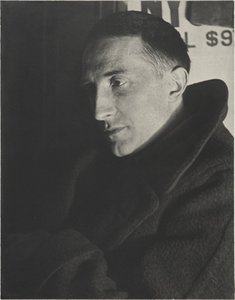
1887–1968, Франция
Марсел Дюшан
The Life and Art of Marcel Duchamp Born on July 28, 1887, in Blainville, Normandy, France, Marcel Duchamp entered a world where the impulse to create was deeply embedded in his very blood. He was the fourth of seven children born to Eugene and Lucie Duchamp. This was a household of makers and thinkers; his siblings shared this creative restlessness, as his brothers Jacques Villon and Raymond Duchamp-Villon, along with his sister Suzanne Duchamp-Crotti, all pursued lives as artists. While he would eventually become a French American figure of immense complexity, his origins remained rooted in the quietude of Normandy.
Други творби на Марсел Дюшан
 Ню Дъсцентър Стейдж Но.21912
 Мъжът със тъжната младост в влака1911
 Дадено: 1. Водопадът, 2. Газът за осветление1966
 Фонтан1917
Есеи по темата Bottlerack
 Индустриална Естетика в Изкуството: 10 Шедьовъра за Вашия Дом | OriginalUniqueArt.comОткрийте 10 шедьовъра, улавящи индустриалната атмосфера! Разгледайте историите на Ван Гог, Моне и други велики художници. Вдъхновете се за …
 Marcel Duchamp: Challenging Conventions & Redefining Art in the 20th CenturyExplore the revolutionary art of Marcel Duchamp! Discover how his Dadaist readymades challenged artistic conventions & redefined modern art…
 The Radical Evolution of the Bottle in Still Life: From Cubist Deconstruction to Pop Art BoldnessTrace the evolution of bottle still life from Cubism to Pop Art with expert insight. Explore how masters redefined everyday objects now.