

 Преглед в реален мащаб
 Сподели
 Сподели
 Подробности
 Ръководство

 Изтегляне
 Подобни артикули
 Рентгенова снимка
 Слайдшоу
 Статистика
The Glass
 Oil On Canvas
- WallArt
- Cubism
 1914
1914 27.0 x 22.0 cm
 Разгърни целия текст
Ръчно изработена маслена репродукция
Ръчно рисувана маслена картина върху платно във вашия размер и рамка, изработена по поръчка от нашите художници. ( Избор на принт Превключване към дигитално изображение)




P118B €10

P118H €10

P118W €10

P438Z €10

P508JH €12

P508YH €12

P805H €10

P805Z €10

P919BZ €10

P919G €10

P919XJ €10

P959ZH €10

P968JZ €12

W106C €8

W218G €10

W218JH €8

W218Y €10

W307PJ €10

W316G €10

W316PJ €8

W316Y €10

W398PJ €8

W4111J €10

W500HY €15

W500JH €15

W692G €12

W849H €8

W940BG €15

W953PJ €8




Изберете от нашите предварително зададени размери, които съответстват на оригиналните пропорции на произведението.

Въведете необходимата ширина и височина, за да паснат на вашата рамка или стена. Тъй като това е ръчна работа, при избор на размер с различен формат, художникът може да нарисува малко повече около картината или да отреже малко от периферията — вие избирате. Преди да започне рисуването, ще ви изпратим дигитален мок업 за одобрение. Картината, показана на тази страница, не е реалният резултат — само мок업ът го показва.
След получаване на поръчка, екипът на OriginalUniqueArt.com ще изпрати имейл до клиента с инструкции и ще предостави примерен макет за преглед.
Доставка по целия свят () в рамките на 3-4 седмици вместо стандартните 5 седмици. (25 Октомври). Без компромис с качеството.

Безплатна експресна доставка по целия свят

Висококачествено ленено платно

Пълно застраховане на доставката

Гаранция за възстановяване на митнически такси

Гаранция за пълно съответствие на цветовете

Политика за връщане в рамките на 100 дни (само при дефекти)

100% Гаранция за връщане на сумата

Отстъпка при поръчка на повече произведения
 Опцията със стъкло е налична само за размери под 110 см

The Glass
Техника на репродукция
Размер на репродукцията
-


Крайна цена
€ 263
The Geometry of Perception: Exploring Juan Gris's "The Glass"
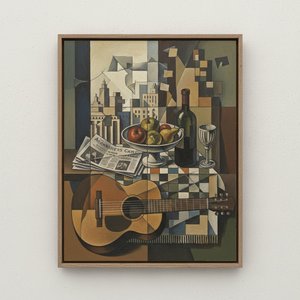
To stand before Juan Gris’s The Glass is not merely to observe an arrangement of painted objects; it is to step into a meticulously constructed intellectual puzzle, a vibrant dialogue between form and perception. Created in the pivotal year of 1914, this oil on canvas captures the essence of everyday materiality through the revolutionary lens of Cubism. The painting immediately draws the eye to its central subject—a face rendered with an almost haunting abstraction—juxtaposed against the elegant curve of a guitar receding into the background. Gris does not present reality as it is seen in a single glance, but rather as it is known through intellect and memory, inviting the viewer into a multi-faceted contemplation.
A Masterclass in Cubist Innovation
The technical brilliance at play here is undeniable. As a seminal work of Cubism, The Glass exemplifies how the movement shattered traditional single-point perspective. Gris masterfully employs geometric fragmentation, breaking down recognizable forms—the contours of the face, the structure of the instrument—into interlocking planes and facets. This technique forces the viewer’s eye to actively participate in the act of seeing, piecing together the whole from its constituent parts. It is a sophisticated visual vocabulary that speaks volumes about the early 20th-century desire to redefine representation itself. The interplay between the solid geometry and the implied depth creates an exhilarating sense of spatial ambiguity.
Symbolism and the Everyday Object
What appears at first glance as a still life—a glass, a face, a musical instrument—is imbued with deeper symbolic resonance. Gris often elevated humble, quotidian objects to monumental status, suggesting that profound meaning can be unearthed from the most ordinary corner of life. The guitar, an object associated with culture and narrative, anchors the composition alongside the enigmatic portraiture. These elements combine to suggest themes of identity, memory, and the way art itself functions as a structure for understanding our complex existence. It is a meditation on how we assemble meaning from disparate sensory inputs.
Bringing Cubism Home: Decorating with Intellectual Depth
For the collector or designer seeking an artwork that transcends mere decoration, The Glass offers intellectual depth alongside unparalleled aesthetic beauty. Its controlled vibrancy and complex structure make it a breathtaking focal point for any sophisticated interior space. Whether placed in a gallery setting or integrated into a modern living area, its cool, analytical palette and dynamic composition provide a stimulating counterpoint to softer furnishings. Owning a reproduction of this piece is acquiring not just paint on canvas, but a tangible connection to one of the most revolutionary periods in art history—a conversation starter that whispers of Picasso, Braque, and the enduring spirit of artistic inquiry.
Въпроси и отговори
Типична ли е „The Glass“ за това, което Хуан Грис обикновено създава?
Сред закрепените теми на Хуан Грис – cubist geometric analysis of objects, influence of picasso and braque, exploration of form and space – „The Glass“ привнося собствен фокус върху cubism, juan gris, still life, guitar, face, abstraction, geometric.
Каква техника и стил характеризират „The Glass“ на Хуан Грис?
В „The Glass“ техниката Oil On Canvas се среща с движението Cubism.
На кой етап от кариерата на Хуан Грис принадлежи „The Glass“ (1914)?
"The Glass", създадена през 1914, принадлежи на Cubist Period от кариерата на Хуан Грис.
Биография на художника
A Spanish Visionary of Cubism: The Life and Art of Juan Gris
Born José Victoriano González-Pérez in Madrid in 1887, the artist who would become known as Juan Gris embarked on a journey that profoundly shaped the course of early 20th-century art. His initial path wasn’t immediately aligned with canvas and brush; he pursued engineering at the Madrid School of Arts and Sciences, revealing an analytical mind – one that would later deeply inform his artistic approach. Even during these formative years, a creative spark flickered, evidenced by his contributions to local periodicals through drawings, hinting at a burgeoning visual talent waiting to be unleashed. It was in 1905 that he adopted the pseudonym Juan Gris, a name resonating with newfound identity and purpose as he began formal painting studies under José Moreno Carbonero – a pivotal shift that set him firmly on a trajectory toward artistic innovation.Parisian Awakening and the Embrace of Cubism
The year 1906 marked a transformative relocation to Paris, a city then brimming with unparalleled artistic energy. Gris immersed himself completely in this vibrant milieu, forging enduring friendships with luminaries such as Henri Matisse, Georges Braque, and Fernand Léger. Initially, he honed his observational skills and developed a keen sense of visual wit through satirical illustration for publications like *L'Assiette au Beurre*, skillfully capturing the nuances of Parisian life. However, the magnetic pull of Pablo Picasso proved particularly influential, sparking a period of intense study and emulation. Around 1910, Gris began to dedicate himself wholeheartedly to painting, deliberately moving away from caricature and embracing the burgeoning language of Cubism – not merely imitating its style, but actively seeking a new visual order based on deconstruction and reconstruction. His early explorations were characterized by a deliberate departure from traditional representation, prioritizing abstraction as a means of capturing reality’s underlying structure and essence.The Geometry of Perception: Style and Key Works
Juan Gris's artistic output is distinguished by an exceptional clarity and intellectual rigor. He didn’t simply break down objects; he meticulously rebuilt them, emphasizing geometric forms and employing a carefully considered palette. This approach led to what became known as his “crystal period,” exemplified in masterpieces such as *Still Life Before an Open Window* (1912) and *Place Ravignan* (1915). These works showcase a remarkable interplay of planes and angles, creating a sense of depth and solidity while simultaneously challenging conventional notions of perspective. The use of overlapping forms and fragmented viewpoints allowed him to represent multiple perspectives within a single image, reflecting the complexities of modern perception. After 1913, Gris wholeheartedly embraced Synthetic Cubism, pioneering the innovative use of *papier collé* – collage – incorporating real-world materials like newspaper clippings, fabric scraps, and wood grain into his compositions. This technique added another layer of complexity and tactile richness to his work, blurring the boundaries between painting and sculpture and inviting viewers to engage with the artwork on a more visceral level. Notable examples include *Guitar in front of the sea* (1925), a testament to his simplified forms and adherence to cubist principles, and *Homage à Pablo Picasso* (1912), which signaled his growing recognition within the avant-garde art world as he paid tribute to his influential mentor.The Influence of Color and Form
Gris’s artistic development was profoundly shaped by both visual and intellectual influences. He studied the works of Cézanne, whose emphasis on geometric forms and spatial relationships served as a foundational influence. The principles of mathematics, particularly those explored by Jean Metzinger, also played a significant role in his approach to composition, guiding him toward a more structured and rational representation of reality. Furthermore, he was deeply inspired by the vibrant colors and expressive brushwork of Henri Matisse, incorporating bold hues and dynamic contrasts into his paintings. This synthesis of influences – Cézanne’s geometry, Metzinger's mathematics, and Matisse’s color palette – resulted in a uniquely innovative style characterized by clarity, precision, and emotional resonance.Legacy and Lasting Influence
Juan Gris’s contribution to Cubism extends far beyond mere stylistic innovation; he brought an unparalleled intellectual depth and structural clarity to the movement. He moved past the analytical phase, transitioning towards a more organized and synthetic approach, emphasizing order and precision. His work profoundly influenced the Purist style championed by Amédée Ozenfant and Charles Edouard Jeanneret (Le Corbusier), advocating for a return to classical principles of form and composition. Gris’s emphasis on geometric forms, harmonious color palettes, and the integration of everyday objects into his art established him as a pivotal figure in 20th-century art. His legacy continues to inspire artists today, demonstrating the enduring power of Cubism and the visionary genius of Juan Gris – a Spanish master who reshaped our understanding of perception and representation.
Хуан Грис
1887 - 1927 , Испания
Бързи факти
- Artistic Movement Or Style: Кубизъм, Синтетичен кубизъм
- Artists Or Movements Influenced By This Artist:
- Пуризъм
- Озенфан
- Ле Корбюзье
- Artists Who Influenced This Artist:
- Пикасо
- Матис
- Брак
- Date Of Birth: 23 март 1887
- Date Of Death: 11 май 1927
- Full Name: José Victoriano González-Pérez
- Nationality: Испанец
- Notable Artworks:
- Guitar in front of the sea
- Homage à Pablo Picasso
- The Miller
- Place Of Birth: Мадрид, Испания
Свързани статии

Neo-Abstract Art: The High-Impact Evolution of Modern Visual Energy and Geometric Sophistication
Discover the power of Neo-Abstract art. Explore how bold geometric forms and high-impact visual energy are redefining modern design. Learn to curate sophisticated, high-energy spaces with the latest trends in contemporary abstraction and structural color.

Топ 10 шедьовъра на геометричната абстракция за Вашия дом | OriginalUniqueArt.com
Разгледайте топ 10 шедьовъра на геометричната абстракция – Кандински, Мондриан и други! Открийте историите зад тези емблематични картини и добавете елегантност към дома си с репродукции от OriginalUniqueArt.com. Разгледайте пълната колекция онлайн!

Beyond Form & Color: Geometric Abstraction's Evolution in 20th/21st Century Art
Explore the evolution of geometric abstraction from Cubism to contemporary art. Discover key artists like Malevich & Mondrian, investment insights, and expert collecting advice at OriginalUniqueArt.
Juan Gris: Cubist Deconstruction & Synthesis – A Comprehensive Exploration
Explore the revolutionary art of Juan Gris – a master of Cubism. Discover his unique approach to deconstruction, vibrant Synthetic Cubist works, and lasting influence on modern art. Expert analysis for collectors.
Топ 25 шедьовъра на Фернанд Леже: Изкуство, модернизъм и декоративни идеи от OriginalUniqueArt.com
Разгледайте топ 25 шедьовъра на Фернанд Леже – пионер на кубизма и тубизма. Открийте историите зад картините, техниките и вдъхновението му. Купете висококачествени репродукции и декоративни идеи за дома от OriginalUniqueArt.com.


