Преглед в реален мащаб
 Сподели
 Сподели
 Подробности
 Ръководство

 Изтегляне
 Подобни артикули
 Рентгенова снимка
 Слайдшоу
 Статистика
Saint Eulalia
 Oil On Canvas
- WallArt
- Romantic Pre-Raphaelite
 1885
1885 188.0 x 117.0 cm
 Tate Gallery
 Разгърни целия текст
Жикле / Художествен принт
Giclée печат или принт върху платно с музейно качество, бързо производство и гъвкави опции за завършен вид. ( Поръчайте ръчно рисувано репродукция на този колекционерски предмет Превключване към дигитално изображение)




P118B €10

P118H €10

P118W €10

P438Z €10

P508JH €12

P508YH €12

P805H €10

P805Z €10

P919BZ €10

P919G €10

P919XJ €10

P959ZH €10

P968JZ €12

W106C €8

W218G €10

W218JH €8

W218Y €10

W307PJ €10

W316G €10

W316PJ €8

W316Y €10

W398PJ €8

W4111J €10

W500HY €15

W500JH €15

W692G €12

W849H €8

W940BG €15

W953PJ €8




Изберете от нашите предварително зададени размери, които съответстват на оригиналните пропорции на произведението.

Въведете необходимата ширина и височина, за да паснат на вашата рамка или стена. Принтовете могат само да се изрязват, но никога не могат да бъдат по-големи от оригиналната картина, така че при размер с различен формат част от изображението ще бъде загубена. Преди да започнем печат, ще ви изпратим дигитален мок업 за одобрение. Изображението, показано на тази страница, не показва реалното изрязване — само мок업ът го показва.
Доставка по целия свят () в рамките на 2 седмици вместо стандартните 4/5 седмици. (22 Октомври)

Безплатна експресна доставка по целия свят

Висококачествено ленено платно

Пълно застраховане на доставката

Гаранция за възстановяване на митнически такси

Гаранция за пълно съответствие на цветовете

Политика за връщане в рамките на 100 дни (само при дефекти)

100% Гаранция за връщане на сумата

Отстъпка при поръчка на повече произведения
 Опцията със стъкло е налична само за размери под 110 см

Saint Eulalia
Жикле / Художествен принт
Размер на репродукцията
-


Крайна цена
€ 70
A Vision of Suffering and Grace: Exploring John William Waterhouse’s Saint Eulalia
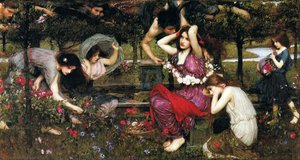
John William Waterhouse's 1885 painting, *Saint Eulalia*, stands as a cornerstone of Pre-Raphaelite Romanticism—a movement obsessed with idealized beauty intertwined with profound emotional depth. More than just a depiction of biblical martyrdom, it’s an exquisitely crafted tableau that invites contemplation on themes of faith, sacrifice, and the ephemeral nature of earthly existence.
- Subject Matter: The artwork portrays Saint Eulalia, a young Christian martyr who endured agonizing torture before her death for refusing to renounce Christianity. This narrative resonates with broader anxieties surrounding religious devotion and moral fortitude prevalent in Victorian England.
- Style & Influences: Waterhouse’s work firmly anchors itself within the Pre-Raphaelite aesthetic—a deliberate rejection of academic conventions favoring instead meticulous detail, luminous color palettes, and a harkening back to artistic ideals considered purer than those championed by Raphael and his contemporaries. The influence of Dante Gabriel Rossetti is palpable in the ethereal atmosphere and languid poses characteristic of Waterhouse’s female figures.
- Technique: Employing oil paint on canvas with masterful brushwork, Waterhouse achieves remarkable textural realism—particularly evident in the depiction of snow-covered ground and the delicate folds of fabric. Layers of pigment create subtle gradations of light and shadow, enhancing the painting's dramatic impact and conveying a palpable sense of sorrow.
Color Palette & Composition: Reflecting Emotional Resonance
The color scheme is deliberately muted—dominated by cool shades of grey, icy blue, and pristine white—effectively mirroring the bleakness of Saint Eulalia’s final moments. However, subtle warmth emanates from the woman's skin tone and clothing, providing a poignant counterpoint that underscores her vulnerability amidst the surrounding coldness. The composition is carefully balanced, guiding the viewer’s gaze across multiple figures—soldiers and civilians alike—each contributing to the overarching narrative of tragedy.
Symbolism & Artistic Intent
Beyond its immediate visual appeal, *Saint Eulalia* is laden with symbolic significance. Scattered pigeons represent souls ascending towards heaven—a motif frequently employed by Pre-Raphaelites to convey spiritual aspiration and transcendence. Waterhouse’s deliberate choice of lighting—diffused and overcast—further amplifies the painting's melancholic mood, fostering a feeling of solemn contemplation.
Legacy & Reproduction
Displayed prominently in the Tate Gallery in London, *Saint Eulalia* continues to captivate audiences with its haunting beauty and psychological complexity. To experience this masterpiece firsthand is to immerse oneself in the artistic spirit of Victorian Romanticism. Fortunately, OriginalUniqueArt offers exceptional reproductions crafted by skilled artisans—allowing collectors and enthusiasts alike to appreciate Waterhouse’s vision without compromising on quality or authenticity.
Въпроси и отговори
Има ли информационен лист за „Saint Eulalia“ на Йоан Уилям Уудхаус, предназначен за ученици?
Наръчникът за „Saint Eulalia“ е страницата Ръководство на произведението – предназначен за принтиране информационен лист, който представя творбата заедно с нейното описание, авторство и таблица с данни (художник, дати, техника, оригинален размер, колекция).
Къде трябва да бъде окачана репродукция на „Saint Eulalia“ на Йоан Уилям Уудхаус?
Формат (Tall) и препоръчителното пространство (Living Room) са двете записани подробности за разположението на „Saint Eulalia“ на Йоан Уилям Уудхаус.
Каква атмосфера би внесло в помещението репродукция на „Saint Eulalia“ на Йоан Уилям Уудхаус?
Romantic атмосферата на „Saint Eulalia“ на Йоан Уилям Уудхаус съответства на препоръчаното пространство: Living Room.
Биография на художника
A Roman Beginning: The Early Life and Influences of John William Waterhouse
John William Waterhouse, a name synonymous with the romantic allure of Pre-Raphaelite painting, began his artistic journey far from the fog-laden landscapes often associated with the movement. Born in Rome in 1849 to English parents, his earliest years were steeped in the classical beauty of Italy – an environment that would profoundly shape his aesthetic sensibilities. This formative period instilled within him a deep appreciation for ancient Roman art and mythology, themes that would recur throughout his prolific career. The Waterhouse family returned to England in 1854, settling in South Kensington, London, a location strategically chosen for its proximity to the burgeoning Victoria and Albert Museum. Here, young John was exposed to an unparalleled collection of classical sculpture and decorative arts, further nurturing his fascination with antiquity. His initial training was conventional, encompassing studies at the Royal Academy Schools, where he honed his technical skills in drawing and painting, but it was the atmosphere of intellectual curiosity and artistic innovation that truly ignited his passion. Even early works reveal a meticulous attention to detail and a commitment to historical accuracy, qualities that would become hallmarks of his style.Embracing the Pre-Raphaelite Brotherhood
While Waterhouse’s initial work displayed classical leanings reminiscent of artists like Alma-Tadema and Frederic Leighton, he gradually gravitated towards the ideals of the Pre-Raphaelite Brotherhood. This artistic collective, founded in 1848, championed a return to the detailed observation of nature and the vibrant colors found in early Italian Renaissance art – before what they perceived as the stylistic decline initiated by Raphael. Waterhouse didn’t join the brotherhood itself, but he wholeheartedly embraced its principles, infusing his paintings with a lyrical beauty and emotional depth that resonated deeply with audiences. His 1874 painting, *Sleep and his Half-Brother Death*, exhibited at the Royal Academy, marked a turning point, demonstrating his growing mastery of symbolic narrative and atmospheric effects. This success paved the way for consistent inclusion in the annual exhibitions, establishing him as a rising star within the London art scene. He wasn’t merely replicating Pre-Raphaelite techniques; he was interpreting them through his own unique lens, blending classical precision with romantic sensibility.Mythological Visions and Arthurian Echoes
Waterhouse's most celebrated works are those that draw inspiration from mythology and Arthurian legend. He possessed a remarkable ability to breathe life into ancient stories, portraying goddesses, nymphs, and tragic heroines with an exquisite blend of beauty and pathos. *The Lady of Shalott*, perhaps his most iconic painting, exists in three versions (1888, 1894, and 1916), each a testament to his enduring fascination with Tennyson’s poem. The image of the doomed lady, adrift on her river barge, became emblematic of Victorian romanticism and the plight of artistic isolation. Similarly, his depictions of Ophelia, capturing the moment before her tragic demise, are imbued with a haunting melancholy. He didn't simply illustrate these tales; he explored their psychological depths, focusing on the emotional states of his subjects. *Hylas and the Nymphs*, *Ariadne*, and *Penelope and the Suitors* are further examples of his ability to transform classical narratives into visually stunning and emotionally resonant works of art. His paintings weren’t just beautiful; they were imbued with a sense of narrative power, inviting viewers to contemplate the complexities of human experience.Technique and Style
Waterhouse's distinctive style was characterized by several key elements. He meticulously researched historical costumes and settings, striving for an unparalleled level of accuracy in his depictions. His use of color was particularly noteworthy – he favored rich, luminous hues, often employing glazing techniques to create a sense of depth and atmosphere. Unlike some of the more overtly detailed Pre-Raphaelites, Waterhouse’s brushwork tended to be smoother and less immediately visible, contributing to the paintings' overall elegance and refinement. He frequently worked on a large scale, creating monumental compositions that commanded attention. His ability to seamlessly blend classical influences with Romantic sensibilities resulted in works that were both intellectually stimulating and emotionally captivating.Legacy and Lasting Influence
John William Waterhouse continued to paint prolifically until his death in 1917, achieving widespread recognition and acclaim during his lifetime. He was elected a full Academician in 1895 and dedicated time to teaching at the St. John’s Wood Art School, nurturing the next generation of artists. While his popularity waned somewhat after World War I, there has been a significant resurgence of interest in his work in recent decades. Today, Waterhouse is celebrated as one of the most important figures of the Pre-Raphaelite movement and a master of Victorian painting. His paintings continue to captivate audiences with their exquisite beauty, emotional depth, and timeless appeal. He left behind a legacy of romantic visions, mythological interpretations, and tragic heroines that continue to inspire artists and art lovers alike. The enduring power of his work lies in its ability to transport viewers to another world – a realm of myth, legend, and profound human emotion.
Йоан Уилям Уудхаус
1849 - 1917 , Италия
Бързи факти
- Artistic Movement Or Style: Прерафаелити, Викториански
- Artists Or Movements Influenced By This Artist: ['Импресионизъм']
- Artists Who Influenced This Artist:
- Алма-Тадема
- Фредерик Лийтон
- Date Of Birth: 1849
- Date Of Death: 1917
- Full Name: John William Waterhouse
- Nationality: Английски
- Notable Artworks:
- Леди Шаллот
- Офелия
- Хилас и нимфата
- Place Of Birth: Рим, Италия
Свързани статии

Топ 25 шедьовъра на Джон Констабъл: Английски пейзажи за вашия дом | OriginalUniqueArt.com
Открийте топ 25 шедьовъра на Джон Констабъл – английски пейзажи, романтизъм и красотата на природата. Репродукции с музейно качество за вашия дом! Разгледайте пълната колекция онлайн на OriginalUniqueArt.com.

Топ 25 шедьовъра на Данте Габриел Росети: Изкуство, символизъм и красота за вашия дом
Открийте 25 шедьовъра на Данте Габриел Росети! Потопете се в света на прерафаелитизма, символизма и викторианската красота. Висококачествени репродукции за вашия дом – купете картини онлайн на OriginalUniqueArt.com.

Sir John Everett Millais: Pre-Raphaelite Rebellion & Victorian Narrative Detail
Explore the revolutionary art of Sir John Everett Millais & the Pre-Raphaelite Brotherhood. Discover their radical realism, symbolic narratives, and lasting impact on Victorian aesthetics. A deep dive into 19th-century masterpieces.

Pre-Raphaelite Romanticism: A Guide to Vivid Detail and Medieval Beauty in Victorian Art
Explore the vivid detail and medieval beauty of Pre-Raphaelite Romanticism. Discover the history of masters like Rossetti and Millais through our expert guide to Victorian art, perfect for collectors and professionals seeking authentic, museum-quality reproductions.

John William Waterhouse: Pre-Raphaelite Mythmaker & Poetic Depictions of Female Identity
Explore the captivating world of John William Waterhouse, a master of Pre-Raphaelite painting. Discover his iconic depictions of mythology and female identity in this expert guide.