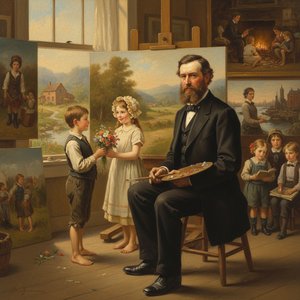
Tuckered OUt
Ръчно изработена маслена репродукция
Ръчно рисувана маслена картина върху платно във вашия размер и рамка, изработена по поръчка от нашите художници. ( Купете принт
Купете изображение)
P118B $10
P118H $10
P118W $10
P438Z $10
P508JH $12
P508YH $12
P805H $10
P805Z $10
P919BZ $10
P919G $10
P919XJ $10
P959ZH $10
P968JZ $12
W106C $8
W218G $10
W218JH $8
W218Y $10
W307PJ $10
W316G $10
W316PJ $8
W316Y $10
W398PJ $8
W4111J $10
W500HY $15
W500JH $15
W692G $12
W849H $8
W940BG $15
W953PJ $8
Изберете от предварително зададените размери, които съответстват на оригиналните пропорции на произведението.
Можете да въведете свои собствени размери, за да пасне на конкретна рамка или пространство. Ако избраният от вас размер не съответства на пропорциите на оригиналното изображение, ние ще изрежем произведението или ще удължим картината с допълнителни ръчно рисувани елементи. Дигитален макет ще бъде изпратен за ваше одобрение преди започване на производството.
Моля, обърнете внимание, че прегледът на екрана не отразява действителното изрязване или разширяване. Само макетът ще покаже точно финалния състав.
Въпреки че са налични персонализирани размери, препоръчваме да изберете размер от предварително дефинирания списък, за да запазите оригиналните пропорции.
След поръчка, екипът на OriginalUniqueArt.com ще изпрати имейл на клиента за инструкции и ще предостави преглед на макет.
Доставка по целия свят () в рамките на 3/4 седмици вместо стандартните 5 седмици. (15 Август). Без компромис с качеството.
Безплатна експресна доставка по целия свят
Висококачествено ленено платно
Пълно застраховане при доставка
Гаранция за възстановяване на митнически такси
Гаранция за цветова точност
60-Дневен период за връщане (Само при дефекти)
100% Гаранция за връщане на парите
Предложение за отстъпка при поръчка на едро
Tuckered OUt
Репродукционен метод
Размер на репродукцията
-
Обща цена
$ 300
Описание на произведението
The Poignant Portrait of a Weary Boy
John George Brown’s “Tuckered Out” (circa 1888) isn't merely a painting; it’s a distilled moment of quiet observation, a tenderly rendered study in Victorian childhood. The scene unfolds within a modestly furnished room – a blend of bedroom and living space – dominated by the figure of a young boy seated on a chair, his head resting heavily upon his hand. This posture, instantly recognizable and deeply affecting, speaks volumes about fatigue, perhaps even melancholy, yet it’s imbued with an undeniable charm.
Brown masterfully captures the essence of this youthful weariness through his meticulous technique. The brushstrokes are deliberate and controlled, creating a sense of solidity in the boy's form while simultaneously suggesting the softness of his skin and the weight of his exhaustion. Notice how he utilizes subtle gradations of light and shadow to define the boy’s face – the slight furrow of his brow, the closed eyelids hinting at slumber, and the delicate curve of his hand supporting his head. The muted palette—primarily browns, grays, and creams—further enhances the painting's somber yet comforting mood, evoking a sense of domestic tranquility tinged with quiet sadness.
A Window into Victorian Life
To fully appreciate “Tuckered Out,” it’s crucial to understand the social context in which it was created. The late 19th century witnessed significant shifts within British society, particularly regarding childhood and family life. While industrialization brought prosperity to some, many families struggled with poverty and hardship. Children often worked long hours in factories or as street urchins, facing challenging conditions that profoundly impacted their well-being. Brown’s painting offers a rare glimpse into this reality, portraying not the idealized image of childhood often presented in art, but rather its more vulnerable and less romanticized aspects.
The scattered suitcases in the background are particularly telling. They suggest a journey – perhaps a temporary move or a return home after a period of travel. This detail adds another layer of complexity to the scene, hinting at the transient nature of Victorian life and the frequent dislocations experienced by families due to economic pressures. The boy’s attire—simple suspenders—underscores his youth and vulnerability, reinforcing the painting's poignant message.
Symbolism and Emotional Resonance
Beyond its realistic depiction of a tired child, “Tuckered Out” is rich in symbolic meaning. The pose itself – head resting on hand – is a universal gesture of exhaustion and surrender, evoking empathy and compassion within the viewer. It’s a posture that speaks to the burdens carried by young shoulders, reminding us of the challenges faced by those less fortunate. The painting's quiet stillness invites contemplation, prompting viewers to reflect on themes of childhood innocence, poverty, and the complexities of human experience.
Furthermore, Brown’s choice of subject matter—a seemingly ordinary boy—elevates him to a position of universal significance. He represents all children who have known hardship or faced adversity, embodying the resilience and quiet dignity of those who persevere despite challenging circumstances. “Tuckered Out” is not simply a portrait; it's a meditation on the human condition, a testament to the enduring power of empathy, and a beautiful reminder of the fleeting nature of childhood.
A Timeless Masterpiece
Reproductions of "Tuckered Out" continue to resonate with audiences today, offering a poignant connection to the past. Its quiet beauty and emotional depth make it an ideal addition to any collection, serving as both a decorative piece and a thought-provoking work of art. Consider framing this evocative image in a warm wood or neutral tone to best complement its subdued palette, allowing its subtle nuances to shine through.
Биография на художника
A Life Etched in Childhood: The World of John George Brown
John George Brown, a name perhaps less immediately recognizable than some of his contemporaries, nevertheless occupies a significant and deeply affecting niche within the landscape of 19th-century American art. Born in Durham, England, in 1831, his journey was one of determined self-improvement and astute observation, culminating in a career that captured the poignant realities – and often idealized sentiments – surrounding childhood during a period of rapid social change. Brown’s story isn't simply about artistic talent; it’s about an immigrant’s ambition, a keen eye for detail, and a shrewd understanding of the burgeoning American art market. His early life was marked by necessity rather than privilege. Apprenticed to a glass factory at just fourteen years old, he labored to support his family, yet even amidst the demanding work, a passion for drawing persisted. This dedication led him to evening classes at the School of Design in Newcastle, and later, further study at the Trustees Academy in Edinburgh – formative experiences that laid the groundwork for his future artistic endeavors. In 1853, Brown bravely crossed the Atlantic, settling in Brooklyn, New York, a city poised to become both his home and his muse. He continued his education at the Graham Art School and the National Academy of Design, honing his skills under the guidance of instructors like Thomas Seir Cummings, preparing himself for a life dedicated to capturing the essence of American experience.From Portraiture to the Streets: Finding His Voice
Initially establishing himself as a portrait painter, Brown quickly discovered that his true calling lay elsewhere – in the vibrant, often overlooked world of everyday life. He began to focus on genre scenes, and it was through his depictions of street children that he truly found his voice. The 1860s witnessed the rise of Brown’s “street urchin” paintings, images that resonated deeply with a public fascinated by – and perhaps simultaneously troubled by – the realities of urban poverty. These weren't merely sentimental portrayals; they were carefully observed studies of character, capturing the resilience, resourcefulness, and quiet dignity of children navigating difficult circumstances. Bootblacks diligently polishing shoes, newsboys hawking papers on bustling street corners, flower sellers offering their wares – these scenes became Brown’s signature, imbued with a remarkable level of detail and empathy. His work wasn't born in isolation; it was influenced by the Barbizon school, particularly its emphasis on realism and depictions of everyday life, as well as the dramatic use of light and color championed by artists like J.M.W. Turner. However, Brown synthesized these influences into a uniquely American style, one that spoke to the specific social conditions and cultural anxieties of his adopted homeland.A Master of Sentiment and Commerce
Brown was not only an artist but also a remarkably astute businessman. Recognizing the appeal of his work, he strategically copyrighted many of his most popular paintings, allowing for widespread reproduction as chromolithographs and photographic prints. This savvy move dramatically increased his fame and financial success, making him one of the wealthiest genre painters in the United States during his lifetime. He was dubbed “The Boot Black Raphael” by some circles due to the glowing faces of his child figures and his skill of execution. However, this commercial success didn’t diminish the artistic merit of his work. Paintings like “The Net Mender” and “The First Point” exemplify his ability to capture moments of quiet beauty and emotional depth. "Claiming the Shot - A Group of Portraits after the Hunt in the Adirondacks" demonstrates a broader range, showcasing his skill in depicting group scenes with remarkable realism. His paintings offered more than just aesthetic pleasure; they provided valuable insights into 19th-century American society, particularly the lives of working children and the changing urban landscape. Often imbued with subtle moral undertones, Brown’s work reflected his belief in the importance of hard work, honesty, and resilience – values that resonated deeply with Victorian audiences.Shifting Focus: From Youth to Age
As Brown matured as an artist, so too did his subject matter evolve. In his later years, he shifted his focus from depicting the energy and vitality of childhood to portraying the quiet dignity and solitude of old age. These paintings often featured elderly individuals in rural settings, evoking a sense of nostalgia for a simpler past. While this shift might seem dramatic, it was a natural progression for an artist deeply concerned with capturing the human condition in all its complexity. He continued to be an active member of various art institutions, serving as vice-president of the National Academy of Design from 1899 to 1904, demonstrating his ongoing commitment to the artistic community. His later works, though different in subject matter, retained the meticulous attention to detail and emotional sensitivity that characterized his earlier paintings.A Lasting Legacy: Echoes of Childhood
John George Brown passed away in New York City in 1913, leaving behind a substantial body of work that continues to captivate and move audiences today. His paintings are held in prestigious collections around the world, including the National Gallery in London and the Detroit Institute of Arts, testament to his enduring artistic significance. He is remembered not only for his technical skill but also for his ability to capture the essence of a particular time and place – Victorian America – with honesty, empathy, and a touch of romanticism. *His work serves as a poignant reminder of the challenges faced by children in the 19th century, while simultaneously celebrating their resilience and spirit.* Brown’s legacy extends beyond his paintings; he represents a fascinating intersection of artistic talent, entrepreneurial acumen, and social commentary – a true chronicler of American life. **His ability to transform everyday scenes into enduring works of art ensures that his vision will continue to resonate with generations to come.**Джон Джордж Браун
1831 - 1913 , Великобритания
Бързи факти
- Artistic Movement Or Style: Жанров реализъм
- Artists Or Movements Influenced By This Artist: ['Барбизон']
- Artists Who Influenced This Artist:
- Барбизон
- Уилям Търнър
- Date Of Birth: 11 ноември 1831
- Date Of Death: 8 февруари 1913
- Full Name: John George Brown
- Nationality: Британско-американец
- Notable Artworks:
- The Net Mender
- The First Point
- Place Of Birth: Дърам, Великобритания


Стъклото е налично само в размери под 110 см