
 Преглед в реален мащаб
 Изпрати
 Сподели
 Детайли
 Ръководство

 Изтегляне
 Подобни артикули
 Рентгенова снимка
 Слайдшоу
 Въпроси и отговори
 Статистика
A Mountain Scene


 Прочети повече
Жикле / Художествен принт
Giclée печат или принт върху платно с музейно качество, бързо производство и гъвкави опции за завършен вид. ( Купете ръчно рисувана картина Превключване към дигитално изображение)




P118B €10

P118H €10

P118W €10

P438Z €10

P508JH €12

P508YH €12

P805H €10

P805Z €10

P919BZ €10

P919G €10

P919XJ €10

P959ZH €10

P968JZ €12

W106C €8

W218G €10

W218JH €8

W218Y €10

W307PJ €10

W316G €10

W316PJ €8

W316Y €10

W398PJ €8

W4111J €10

W500HY €15

W500JH €15

W692G €12

W849H €8

W940BG €15

W953PJ €8




Изберете от нашите предварително зададени размери, които съответстват на оригиналните пропорции на произведението.

Въведете необходимата ширина и височина, за да паснат на вашата рамка или стена. Принтовете могат само да се изрязват, но никога не могат да бъдат по-големи от оригиналната картина, така че при размер с различен формат част от изображението ще бъде загубена. Преди да започнем печат, ще ви изпратим дигитален мок업 за одобрение. Изображението, показано на тази страница, не показва реалното изрязване — само мок업ът го показва.
Доставка по целия свят () в рамките на 2 седмици вместо стандартните 4/5 седмици. (11 Ноември)

Безплатна експресна доставка по целия свят

Висококачествено ленено платно

Пълно застраховане на доставката

Гаранция за възстановяване на митнически такси

Гаранция за пълно съответствие на цветовете

Политика за връщане в рамките на 100 дни (само при дефекти)

100% Гаранция за връщане на сумата

Оферта за отстъпка при поръчка на повече бройки
 Опцията със стъкло е налична само за размери под 110 см

A Mountain Scene
Жикле / Художествен принт
Размер на репродукцията
-


Обща цена
€ 73
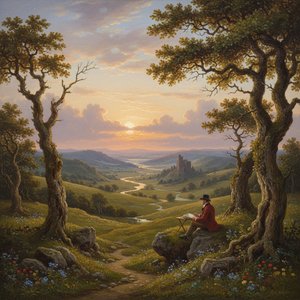
A Mountain Scene by John Crome
The Norfolk landscape holds a special place in British artistic memory, largely thanks to the unwavering dedication of artists like John Crome who tirelessly sought to capture its sublime beauty. Painted in 1806, “A Mountain Scene” exemplifies the Norwich School’s distinctive approach to landscape painting—a style characterized by understated tonal harmonies and an acute sensitivity to atmospheric conditions. This piece isn't merely a depiction of mountains; it’s an embodiment of Romantic ideals, reflecting a profound connection between humanity and the natural world.Subject Matter & Composition
The artwork presents a panoramic vista of East Anglian hills dominated by a substantial rock outcrop. The artist skillfully employs perspective to convey depth, drawing the viewer's eye upwards towards the cloudy sky—a crucial element in establishing mood and conveying the grandeur of the landscape. Two figures stand prominently positioned near the left side of the canvas, gazing out upon this breathtaking panorama. Their presence serves not only as compositional anchor but also subtly suggests contemplation and admiration for the majesty of nature.Style & Technique: Norwich School Characteristics
Crome’s technique is rooted in the Norwich School's core principles—a deliberate rejection of flamboyant brushwork favored by earlier Romantic painters. Instead, he achieves remarkable tonal gradation through meticulous layering of thin washes of oil paint, creating a velvety surface that captures the subtle nuances of light and shadow. This understated approach prioritizes observation and accuracy, mirroring the Norfolk landscape’s muted palette. The artist's masterful use of color—primarily browns, greys, and blues—creates an atmosphere of quiet contemplation and reinforces the painting’s emotional resonance.Historical Context & Romantic Ideals
“A Mountain Scene” emerged during a period marked by significant intellectual ferment – the burgeoning Romantic movement. Artists like Crome were deeply influenced by thinkers such as Edmund Burke and William Wordsworth, who championed emotion and imagination as pathways to understanding the sublime—that feeling of awe and wonder experienced when confronted with overwhelming natural beauty. The painting reflects this philosophical preoccupation, conveying not just visual information but also a spiritual appreciation for the power and majesty of the mountains.Symbolism & Emotional Impact
The rock formation itself symbolizes resilience and permanence against the forces of time and weather—a recurring motif in Romantic art reflecting anxieties about mortality alongside an affirmation of enduring natural order. The figures observing the landscape represent humanity's yearning for connection with something larger than oneself, inviting viewers to contemplate their place within the vastness of creation. Ultimately, “A Mountain Scene” succeeds in evoking a feeling of tranquility and reverence—a testament to Crome’s ability to translate visual observation into profound emotional experience. It remains an enduring symbol of Norfolk's artistic heritage and a captivating example of Romantic landscape painting at its finest.Въпроси и отговори
На кой художник се приписва "A Mountain Scene"?
Художникът зад "A Mountain Scene" е Джон Кром. Произведението е каталогизирано под името на Джон Кром.
Към кое художествено течение принадлежи „A Mountain Scene“ на Джон Кром?
Творческото направление, свързано с „A Mountain Scene“ на Джон Кром, е Norwich School Landscape. Тази класификация поставя произведението сред съответните автори и художествени творби.
Каква атмосфера предава "A Mountain Scene"?
Общото настроение на „A Mountain Scene“ на Джон Кром е Calm. То описва общата атмосфера на произведението.
Биография на художника
John Crome (1768–1821) - Art UK
Открийте „Мелницата Флатфорд от шлюза“ на Джон Констабъл – шедьовър на английския романтизъм, улавящ спокойствието и красотата на провинциалната Англия. Разгледайте детайлите и символиката на тази емблематична картина!
John Crome, affectionately known as “Old Crome” to distinguish him from his artist son, stands as a pivotal figure in British art history—a founder and leading light of the celebrated Norwich School. Born in 1768 in the bustling market town of Norwich, Norfolk, Crome’s journey was one of remarkable self-education and dedication, rising from humble beginnings to become a respected landscape painter who captured the very essence of his beloved East Anglian countryside. His father, a weaver, instilled a strong work ethic, but it was an apprenticeship with house, coach, and sign painter Francis Whisler that first nurtured Crome’s artistic inclinations, providing him with foundational skills in design and color. This practical training proved invaluable as he began to explore his passion for depicting the natural world around him.
A formative friendship with Robert Ladbrooke, a fellow aspiring artist, further fueled his development; together they sketched en plein air, honing their observational abilities and sharing a burgeoning enthusiasm for art. He was born on 22 December 1768 in Norwich, UK, baptised on 25 December at St George’s Church, Tombland, Norwich.
Early Life and Apprenticeship
John Crome was the son of John Crome, a weaver (who is also described as either an innkeeper or a lodger at a Norwich inn), and his wife Elizabeth. After a period working as an errand boy for a doctor (from the age of 12), he was apprenticed to Francis Whisler, a house, coach and sign painter. This early experience instilled in him a disciplined approach to craftmanship and exposed him to techniques vital for mastering landscape painting.
The Norwich School and Influences
Crome’s artistic trajectory was significantly shaped by the generosity of Thomas Harvey of Old Catton, who granted him access to his impressive art collection. This exposure to masterpieces by artists like Gainsborough and Hobbema proved transformative, providing Crome with crucial models for composition, light, and atmosphere. Further guidance came from established figures such as Sir William Beechey and John Opie, cementing his connection to the wider artistic community. However, it was in 1803 that Crome truly left his mark on the art world, co-founding the Norwich Society of Artists with Robert Ladbrooke. This bold initiative marked the formal beginning of the Norwich School—a groundbreaking movement that championed direct observation of nature and sought to capture the unique character of the Norfolk landscape, distinct from the prevailing artistic trends emanating from London.
He drew heavily from Dutch 17th-century masters like Hobbema – a lifelong admiration culminating in his famous last words, “Oh Hobbema, my dear Hobbema, how I have loved you!” – he also acknowledged the influence of Richard Wilson’s lyrical landscapes. Crome distinguished himself by being among the first English artists to accurately represent identifiable tree species, moving beyond generalized forms and demonstrating a keen botanical eye.
Notable Works and Legacy
Crome produced over 300 paintings throughout his career, each imbued with a sense of intimacy and authenticity. His works weren’t merely representations of places; they were evocations of mood and feeling, capturing the spirit of Norfolk with remarkable sensitivity. Views of Norwich regularly feature in his oeuvre, as does the Norfolk coast.
His paintings include “The Lime Kiln,” “Grove Scene” and “Mousehold Heath.” They are held in public art galleries, including the Tate Gallery and the Royal Academy in London, and the Castle Museum in Norwich. He taught art and produced etchings.
John Crome passed away on April 22, 1821, in his beloved Norwich, leaving behind a legacy as one of England’s most important landscape painters. His life serves as an inspiring example of how artistic vision, combined with a deep connection to one's surroundings, can create a body of work that resonates across generations.
His work continues to captivate viewers with its quiet beauty, evocative atmosphere, and enduring connection to the heart of Norfolk.

Джон Кром
1768 - 1821 , Великобритания
Бърза информация
- Artistic Movement Or Style: Norwich School
- Artists Or Movements Influenced By This Artist: ['Dutch Masters']
- Artists Who Influenced This Artist:
- Hobbema
- Wilson
- Date Of Birth: 1768
- Date Of Death: 1821
- Full Name: John Crome
- Nationality: English
- Notable Artworks:
- The Lime Kiln
- Grove Scene
- Mousehold Heath
- Place Of Birth: Norwich, UK
Свързани статии

Топ 10 шедьовъра на Романтичния пейзаж: Изкуство за вашия дом от OriginalUniqueArt.com
Открийте 10 шедьовъра на Романтичния пейзаж – Фридрих, Търнър и други! Разгледайте историите зад картините, техниките и емоциите. Репродукции с музейно качество от OriginalUniqueArt.com. Вдъхновете се за вашия дом!

Джон Сингър Сарджент: 25 шедьовъра за вашия дом | OriginalUniqueArt.com
Разгледайте 25 шедьовъра на Джон Сингър Сарджент – импресионистични портрети, елегантни дами и исторически сцени. Вдъхновете се за вашия дом! Луксозни репродукции на картини в OriginalUniqueArt.com.

Топ 25 шедьовъра на Джон Констабъл: Английски пейзажи за вашия дом | OriginalUniqueArt.com
Открийте топ 25 шедьовъра на Джон Констабъл – английски пейзажи, романтизъм и красотата на природата. Репродукции с музейно качество за вашия дом! Разгледайте пълната колекция онлайн на OriginalUniqueArt.com.
John Varley I: Intimate Observation & the British Romantic Landscape
Explore the serene landscapes of John Varley I, a key figure in British Romanticism. Discover his unique watercolour style, collaboration with William Blake & lasting artistic legacy. Learn about collecting Varley's work.

The Sublime and the Picturesque: Exploring Emotion & Nature in Romantic Landscape Painting
Explore the emotional power of Romantic landscape painting! Discover the sublime & picturesque traditions, key artists like Friedrich & Cole, and find your perfect artwork at OriginalUniqueArt.
