
 Представи си го
 Изпрати
 Сподели
 Детайли

 Изтегляне
 Подобни
 Рентгенова снимка
 Слайдшоу
Natural Bridge


 Прочетете повече
Жикле / Художествен принт
Giclée печат или принт върху платно с музейно качество, бързо производство и гъвкави опции за завършен вид. ( Купете ръчно рисувана картина Купете изображение)




P118B $10

P118H $10

P118W $10

P438Z $10

P508JH $12

P508YH $12

P805H $10

P805Z $10

P919BZ $10

P919G $10

P919XJ $10

P959ZH $10

P968JZ $12

W106C $8

W218G $10

W218JH $8

W218Y $10

W307PJ $10

W316G $10

W316PJ $8

W316Y $10

W398PJ $8

W4111J $10

W500HY $15

W500JH $15

W692G $12

W849H $8

W940BG $15

W953PJ $8




Изберете от предварително зададените размери, които съответстват на оригиналните пропорции на произведението.

Можете да въведете собствени размери, за да паснат на конкретна рамка или пространство. Ако избраният от Вас размер не съвпада с пропорциите на оригиналното изображение, ние ще изрежем произведението или ще разширим изображението с огледален или едноцветен ръб. Дигитален макет ще бъде изпратен за Ваше одобрение преди започването на производството.
Моля, имайте предвид, че предпрегледът на екрана не отразява реалното изрязване или разширяване. Само макетът ще покаже точно финалната композиция.
Въпреки че са налични персонализирани размери, препоръчваме да изберете размер от предварително дефинирания списък, за да запазите оригиналните пропорции.
Доставка по целия свят () в рамките на 2 седмици вместо стандартните 4/5 седмици. (16 Август)

Безплатна експресна доставка по целия свят

Висококачествено ленено платно

Пълно застраховане при доставка

Гаранция за възстановяване на митнически такси

Гаранция за цветова точност

60-Дневен период за връщане (Само при дефекти)

100% Гаранция за връщане на парите

Предложение за отстъпка при поръчка на едро
 Стъклото е налично само в размери под 110 см

Natural Bridge
Жикле / Художествен принт
Размер на репродукцията
-


Обща цена
$ 80
Описание на колекционерския предмет
A Melancholic Majesty: Reimagining Virginia's Natural Bridge
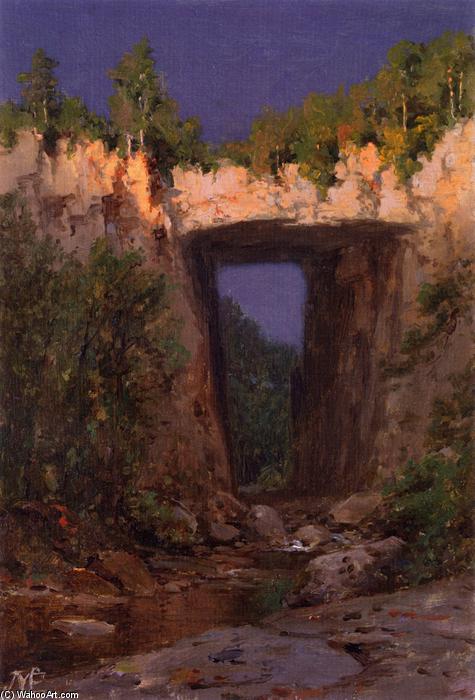
In the quiet, contemplative realm of the Hudson River School, few artists captured the soul of the American landscape with as much poetic intimacy as Jervis McEntee. His 1877 masterpiece, Natural Bridge, serves as a profound window into the geological wonders of Virginia, yet it transcends mere topographical documentation. The painting presents a breathtaking view of the iconic rock formation, where massive stone arches loom over a gentle stream, creating a sense of ancient permanence. Through McEniente's lens, we do not merely see a landmark; we witness a silent dialogue between the enduring strength of the earth and the fleeting passage of time. For the discerning collector or interior designer, this piece offers more than decoration—it provides a focal point of profound geological dignity and serene introspection.
The technique employed in this work reflects McEntee’s signature ability to weave light and shadow into a tapestry of subtle emotion. Rather than the explosive, panoramic grandeur seen in the works of his contemporary Albert Bierstadt, McEntee utilizes a more nuanced palette to evoke the atmosphere of the Shenandoah Valley. The artist meticulously renders the textures of the weathered stone and the lush, surrounding foliage, using delicate brushwork to capture the way light filters through the canopy. The water flowing beneath the bridge is depicted with a rhythmic grace, its movement providing a soft, auditory quality to the visual experience. This mastery of atmosphere ensures that the painting possesses a lifelike depth, making it an exquisite addition to any space seeking to evoke a sense of natural tranquility and classical elegance.
Beyond its physical beauty, Natural Bridge is steeped in the symbolic language of the late 19th-century American landscape movement. The bridge itself acts as a powerful metaphor for connection—a link between the terrestrial and the sublime, between the past and the present. McEntee, often noted for his "melancholic" vision, imbues this scene with a sense of quietude that invites the viewer to pause and reflect. There is a certain stillness in the arrangement of the smaller rocks and the surrounding trees that suggests a world untouched by the frantic pace of industrialization. For those looking to curate an environment of peace and sophistication, this reproduction brings the timeless, restorative power of the American wilderness into the modern home, offering a sanctuary of thought and a celebration of nature's enduring grace.
Биография на художника
Jervis McEntee (1828–1891): Painter of Melancholy Landscapes and Insightful Journals
Jervis McEntee, born in Rondout, New York, on July 14, 1828, stands as a quietly influential voice within the celebrated panorama of Hudson River School painters. Unlike Frederic Church or Albert Bierstadt whose names resonate with broader public acclaim, McEntee carved out an artistic identity defined by profound introspection and a poetic sensibility toward the natural world—a subtle yet powerful divergence from his peers’ exuberant depictions of wilderness grandeur. Little is known about his formative years beyond the details of his parentage – James Smith McEntee (1800–1887), a civil engineer, and Sarah Jane McEntee (1805–1883)—yet an academic inclination was evident from his attendance at Clinton Liberal Institute between 1844 and 1846, establishing a foundation that would prove invaluable as he embarked on a career blending artistic skill with intellectual depth. His early commitment to art is underscored by his debut exhibition at the National Academy of Design in New York City as early as 1850—a decisive step toward realizing his artistic ambitions.Early Artistic Training and Apprenticeship
McEntee’s formative years were marked by a dedication to honing his craft, culminating in an apprenticeship under Frederic Edwin Church in 1851. This mentorship proved profoundly transformative, shaping not only McEntee’s technical approach but also his fundamental understanding of landscape painting as a vehicle for conveying emotion and spiritual contemplation. Church's influence instilled in McEntee a belief that art could transcend mere representation—that it possessed the capacity to communicate profound truths about human experience and the relationship between humanity and nature. However, McEntee swiftly distinguished himself from Church’s often dramatic and luminous style, developing a palette characterized by subdued hues and prioritizing scenes imbued with a melancholic atmosphere—a deliberate departure that cemented his artistic individuality. This stylistic divergence foreshadowed his enduring preoccupation with capturing not just visual beauty but also the emotional resonance of nature's passage.A Distinctive Aesthetic: The Poetics of Decline
McEntee’s artistic vision is fundamentally rooted in his fascination with the concept of decline—a theme that permeates his oeuvre and distinguishes him from many of his contemporaries who celebrated the exuberance of springtime or summer landscapes. He recognized that beauty wasn't solely found in youthful vigor but also resided in the quiet dignity of aging, decay, and transformation. This perspective was deeply informed by his appreciation for poetry, particularly the verses of William Cullen Bryant—whose evocative imagery served as inspiration for McEntee’s paintings. As he himself eloquently expressed, “The soberer phases of Nature” held a particular allure, prompting him to depict autumn scenes not merely as aesthetically pleasing but also as expressions of profound emotional depth. Consider *November Day*, 1863—a canvas dominated by muted browns and grays, conveying a palpable sense of peaceful resignation rather than triumphant joy. This deliberate avoidance of flamboyant color underscored McEntee’s conviction that art could communicate truths beyond the superficial—that it possessed the power to illuminate the complexities of human experience and the enduring beauty of impermanence.The Hudson River School Community and Artistic Collaborations
McEntee's artistic journey unfolded within the vibrant context of the Hudson River School, a movement characterized by its reverence for American wilderness and its commitment to elevating landscape painting to the status of high art. He joined forces with fellow artists—including Calvert Vaux, Sanford Robinson Gifford, Worthington Whittredge, and John Ferguson Weir—forming a collaborative network that fostered intellectual exchange and artistic critique. These relationships weren’t merely social; they were instrumental in shaping McEntee's stylistic development and reinforcing his belief in the importance of shared vision within the creative process. Notably, he resided alongside Eastman Johnson at Tenth Street Studio Building from 1857—a crucible for artistic innovation where ideas circulated freely among kindred spirits. This environment nurtured McEntee’s ability to synthesize observation with emotion—to translate poetic sensibilities into visual form and to capture the elusive beauty of fleeting moments in time.Legacy Beyond Paintbrushes: Journals as Historical Record
Beyond his paintings, Jervis McEntee bequeathed a legacy that extends far beyond the canvas—namely, his meticulously documented journals spanning from 1872 to 1891. These diaries offer an unparalleled glimpse into the life of a New York painter during and after the Gilded Age—a period marked by unprecedented economic prosperity and social transformation. They chronicle not only McEntee’s artistic endeavors but also his daily routines, social interactions, and reflections on the broader cultural landscape. More than simply autobiographical accounts, these journals constitute invaluable primary sources for historians studying the Hudson River School movement and its influence on American art and culture—providing firsthand testimony to the intellectual currents of the era and illuminating the personal experiences of a pivotal figure in artistic history. Today, five volumes of McEntee’s journals are digitally scanned and accessible online through the Archives of American Art at the Smithsonian Institution—ensuring that his voice continues to resonate with scholars and art enthusiasts alike—a testament to his enduring contribution to both art and literary scholarship.
Джейвс МакЭнтъи
1828 - 1891 , Съединени американски щати
Бързи факти
- Artistic Movement Or Style: Хъдсън Ривър Скуул
- Artists Or Movements Influenced By This Artist: ['Санфорд Рибсън Гифорд']
- Artists Who Influenced This Artist: ['Фредерик Едвин Чърч']
- Date Of Birth: 14 юли 1828 г.
- Date Of Death: 27 януари 1891 г.
- Full Name: Jervis McEntee
- Nationality: Американски
- Notable Artworks:
- Лейк Комо
- Роман Аквадекът
- Ноември Ден
- Place Of Birth: Рондоут, САЩ
Всички статии
The Hudson River School: A Definitive Guide to America's Romantic Landscape Tradition
Explore the profound legacy of the Hudson River School. Discover how masters like Thomas Cole captured the American sublime through Romanticism and Luminism. A definitive guide for art historians and collectors seeking to understand America's wild beauty.

Топ 10 шедьовъра на Художественото движение "Речна школа на Хъдсън" – Вдъхновение за Вашия Дом
Открийте 10 шедьовъра на "Речната школа на Хъдсън" – Томас Коул, Чърч и Биърщадт. Разгледайте американския романтизъм, пейзажи и историческа живопис. Луксозни репродукции за Вашия дом! Explore the full collection on OriginalUniqueArt.com
The Sublime Landscape: Exploring the Hudson River School Movement
Explore the captivating world of the Hudson River School! Discover the history, artists, and defining characteristics of this iconic American art movement. Learn about Romanticism's influence & find inspiration for your collection.
Capturing the American Spirit: A Journey Through Iconic Landscapes and the Legacy of the Hudson River School
Explore the profound beauty of American art history. From the Hudson River School to iconic landscapes, discover a curated journey through the masterpieces that defined a nation's spirit and the enduring legacy of American Romanticism.
Топ 10 шедьовъра, изобразяващи пейзажа: Изкуство за вашия дом от OriginalUniqueArt
Открийте топ 10 шедьовъра в пейзажната живопис! Ван Гог, Моне и други велики художници. История на изкуството, техники и емоции. Репродукции с музейно качество за вашия дом от OriginalUniqueArt.com.

