

 Преглед в реален мащаб
 Сподели
 Сподели
 Подробности
 Ръководство

 Изтегляне
 Подобни артикули
 Рентгенова снимка
 Слайдшоу
 Статистика
Helios
 Woodcut
- WallArt
- Northern Mannerism
 1589
1589 35.0 x 27.0 cm
 Лувърски музей
 Разгърни целия текст
Жикле / Художествен принт
Giclée печат или принт върху платно с музейно качество, бързо производство и гъвкави опции за завършен вид. ( Поръчайте ръчно рисувано репродукция на този колекционерски предмет Превключване към дигитално изображение)




P118B €10

P118H €10

P118W €10

P438Z €10

P508JH €12

P508YH €12

P805H €10

P805Z €10

P919BZ €10

P919G €10

P919XJ €10

P959ZH €10

P968JZ €12

W106C €8

W218G €10

W218JH €8

W218Y €10

W307PJ €10

W316G €10

W316PJ €8

W316Y €10

W398PJ €8

W4111J €10

W500HY €15

W500JH €15

W692G €12

W849H €8

W940BG €15

W953PJ €8




Изберете от нашите предварително зададени размери, които съответстват на оригиналните пропорции на произведението.

Въведете необходимата ширина и височина, за да паснат на вашата рамка или стена. Принтовете могат само да се изрязват, но никога не могат да бъдат по-големи от оригиналната картина, така че при размер с различен формат част от изображението ще бъде загубена. Преди да започнем печат, ще ви изпратим дигитален мок업 за одобрение. Изображението, показано на тази страница, не показва реалното изрязване — само мок업ът го показва.
Доставка по целия свят () в рамките на 2 седмици вместо стандартните 4/5 седмици. (23 Октомври)

Безплатна експресна доставка по целия свят

Висококачествено ленено платно

Пълно застраховане на доставката

Гаранция за възстановяване на митнически такси

Гаранция за пълно съответствие на цветовете

Политика за връщане в рамките на 100 дни (само при дефекти)

100% Гаранция за връщане на сумата

Отстъпка при поръчка на повече произведения
 Опцията със стъкло е налична само за размери под 110 см

Helios
Жикле / Художествен принт
Размер на репродукцията
-


Крайна цена
€ 70
The Radiant Vision of Helios
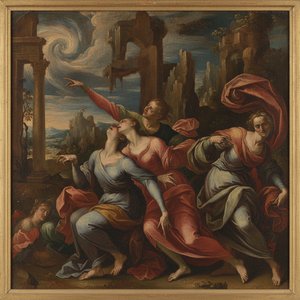
Hendrik Goltzius’s “Helios,” painted in 1589, isn't merely a depiction of the sun god; it’s an embodiment of his power and majesty. This woodcut, rendered with meticulous detail and a masterful understanding of chiaroscuro, transports us to a moment of profound celestial drama. The image captures Helios not as a distant star, but as a dynamic force, actively commanding the heavens – a truly arresting vision for its time.

A Master of Mannerism
Goltzius, a pivotal figure in the transition from Renaissance to Baroque art, was deeply rooted in the Northern Mannerist style. This period emphasized dramatic contrasts, elongated figures, and an intense emotionality – qualities vividly realized in “Helios.” His technical skill is breathtaking; each line of the woodcut speaks volumes about his dedication to precision and control. The intricate layering of textures, achieved through careful carving and printing techniques, creates a remarkable sense of depth and realism, defying the limitations of the medium.
Born in Braunschweig (Brunswick) in 1558, Goltzius’s early life was shaped by his family's move to Duisburg. His training under Dirck Volkertszoon Coornhert, a renowned engraver and printmaker, provided him with the foundational skills that would define his career. He later worked for Philip Galle, further honing his craft before establishing himself in Haarlem, where he remained until his death in 1617. The slight imperfection of his right hand, sustained during childhood, is a subtle reminder of the human element behind this extraordinary artistic achievement.
Symbolism and Mythological Resonance
“Helios” is steeped in symbolism, drawing upon ancient Greek mythology and religious beliefs. Helios, as the personification of the sun, represents light, warmth, life-giving energy, and divine authority. The figure’s outstretched arms and raised hands evoke a sense of command and control over the cosmos. The inclusion of the cloth or flag – often interpreted as a banner – reinforces his role as a sovereign ruler of the heavens. The composition itself is carefully constructed to convey this power: the solitary figure dominates the landscape, dwarfing the clouds beneath him, emphasizing his supreme position.
Furthermore, the image resonates with themes of fate and destiny. Helios’s journey across the sky mirrors humanity's own passage through life, highlighting the cyclical nature of time and the inevitability of change. The dramatic lighting – a hallmark of chiaroscuro – adds to this sense of drama and underscores the god’s radiant presence.
A Legacy in Print
“Helios” stands as a testament to Goltzius's artistic genius and his mastery of woodcut technique. It is not simply a beautiful image; it’s a window into a world of ancient mythology, religious belief, and artistic innovation. Reproductions of this work offer an opportunity to bring this powerful vision into any space, adding a touch of timeless elegance and spiritual depth. The enduring appeal of “Helios” lies in its ability to capture the essence of divine power – a radiant reminder of the sun’s eternal journey across the sky.
Въпроси и отговори
Каква е техниката и датата на създаване на „Helios“ на Хендрик Голтциус?
„Helios“ е създадена през 1589 г. с Woodcut.
Налична ли е творбата "Helios" като художествено отпечатък?
За да поръчате принт на „Helios“ на Хендрик Голтциус, просто го направете на неговата страница за поръчка: Художествен принт: художествен принт върху памучно платно или архивен канвас хартия.
Колко наситени са цветовете в „Helios“ на Хендрик Голтциус?
Интензивността на цветовете в „Helios“ е Balanced. Интензивността описва колко наситени изглеждат цветовете.
Биография на художника
Early Life and Artistic Foundations
Hendrik Goltzius, a name synonymous with the vibrant dynamism of Northern Mannerism in Dutch art, was born in 1558 in Mulebrecht, a small village nestled within the Duchy of Jülich (now part of Germany). His lineage traced back through generations of artists – his great-grandfather and grandfather both served as painters in Venlo, while his father, Jan Goltz II, dedicated his life to the intricate craft of stained-glass artistry in Duisburg. This rich artistic heritage provided a fertile ground for young Hendrik’s burgeoning talent. Initially apprenticed to his father, he quickly demonstrated an aptitude for painting on glass, mastering its delicate techniques and developing a keen eye for detail. However, it was his encounter with Dirck Volckertszoon Coornhert, a renowned printmaker and polymath residing in Cleves, that truly shaped his artistic trajectory. Coornhert recognized Goltzius’s potential and took him under his wing, introducing him to the world of copperplate engraving – a medium that would become the cornerstone of Goltzius's illustrious career. This pivotal mentorship instilled in him not only technical proficiency but also an appreciation for the expressive possibilities inherent within the art form.The Rise of a Master Engraver
Moving to Haarlem, a thriving center of artistic and commercial activity in the Dutch Republic, in 1577, Goltzius established his own independent printmaking business. This strategic relocation proved instrumental in propelling him to international recognition. He quickly gained renown for his sophisticated technique, characterized by an exuberant dynamism and a masterful command of line. His early works were largely reproductions of prints created by esteemed masters such as Albrecht Dürer and Lucas van Leyden, demonstrating his meticulous study of their techniques and styles. However, Goltzius soon began to develop his own distinctive voice, experimenting with innovative approaches to composition and shading. His marriage in 1579 to Margaretha Jansdr., a woman of considerable wealth, provided him with the financial stability necessary to pursue his artistic ambitions without constraint. This afforded him the freedom to experiment, refine his skills, and ultimately establish himself as one of the leading printmakers of his era.Technique and Innovation: The "Swelling Line"
Hendrik Goltzius’s engraving style was revolutionary for its time, distinguished by a unique technique he dubbed the “swelling line.” This involved manipulating the burin – the tool used to cut lines into metal plates – to create varying thicknesses of line. By subtly altering the pressure and angle of the burin, he could produce lines that appeared thicker or thinner depending on their distance from the viewer, effectively simulating tonal shading without resorting to hatching or cross-hatching. This technique, combined with his pioneering use of the “dot and lozenge” method – strategically placing dots within lozenge-shaped spaces created by cross-hatching – allowed him to achieve an unprecedented level of realism and depth in his engravings. Legend has it that Goltzius’s unique physical characteristic—a malformed right hand resulting from a childhood accident—contributed significantly to the development of this technique, forcing him to develop exceptional control and precision with his dominant left hand. His command of the burin was often compared to that of Dürer, solidifying his reputation as a master craftsman.Influence and Legacy
Goltzius’s influence extended far beyond the borders of the Netherlands, impacting artists across Europe. He played a crucial role in introducing the style of Mannerist masters like Bartholomeus Spranger and Annibale Carracci to the northern Netherlands, broadening artistic horizons and fostering cross-cultural exchange. His meticulous reproductions of Roman sculptures, particularly the *Farnese Hercules*, were highly sought after by royalty and collectors alike. Furthermore, Goltzius’s own compositions—including series depicting the Story of Ruth, the History of Lucretia, and scenes from the life of Christ—demonstrated his exceptional artistic vision and technical skill. His legacy is reflected in the works of numerous subsequent engravers, who continued to build upon his innovations and refine his techniques. Today, Goltzius’s engravings are treasured possessions within major print rooms worldwide, including the Rijksmuseum in Amsterdam, the Metropolitan Museum of Art in New York, and the British Museum in London, ensuring that his contributions to art history endure for generations to come. His work stands as a testament to the power of artistic innovation, technical mastery, and enduring beauty.
Хендрик Голтциус
1558 - 1617 , Италия
Бързи факти
- Artistic Movement Or Style: Северен маниеризъм & Барок
- Artists Or Movements Influenced By This Artist: ['Жак Беланже']
- Artists Who Influenced This Artist: ['Дирк Волкертсзоон Коорнхерт']
- Date Of Birth: Януари/Февруари 1558
- Date Of Death: 1 януари 1617
- Full Name: Hendrik Goltzius
- Nationality: Нюландски
- Notable Artworks:
- Почитането на пастирите
- Аркадиански пейзаж
- Place Of Birth: Брауншвейг, Италия
Свързани статии

Барокова Драма: Изкуството, Което Внася Величие в Дома
Открийте великолепието на бароковия стил! Разгледайте историята, изкуството и интериорните решения, вдъхновени от епохата. Съвети за създаване на разкошен дом.
Drama & Distortion: A Journey Through the Captivating World of Baroque Mannerism
Explore the dramatic tension of Mannerism and the opulent grandeur of Baroque art. Discover how masters used light, shadow, and distortion to redefine European history through a captivating journey of emotional intensity and spiritual fervor.

Drama and Distortion: A Definitive Guide to the Mastery of Mannerism and Baroque Art
Explore the dramatic evolution from Mannerist distortion to Baroque grandeur. Discover how light, shadow, and emotion redefined art history through a masterclass in technical mastery and religious fervor.

Drama & Distortion: The High-Voltage Energy of Baroque Mannerism
Dive into the high-voltage world of Baroque Mannerism. Explore how artists traded Renaissance harmony for dramatic distortion, intense light, and pure visual energy. Discover the masters of tension and learn to bring this bold, cinematic aesthetic into your modern space.

Hendrick Goltzius: Master Engraver & the Flourishing of Dutch Mannerism
Explore the life & art of Hendrick Goltzius, a master engraver of Dutch Mannerism. Discover his innovative techniques, iconic engravings like 'Jahel', and lasting influence on Baroque art. Learn about collecting Goltzius today.

