
 Превключване към принт
 Прочети повече







































 За произведения на изкуството или репродукции, чийто размер е над 105 см (приблизително 41 инча) във всяка страна, рамката ще бъде изпратена в разглобен вид като комплект за сглобяване. Този метод гарантира безопасна доставка и предотвратява повреди по време на транспортиране.


A Vision of Faith: Giotto’s Saint Stephen
Saint Stephen, painted around 1320 by the revolutionary artist Giotto di Bondone, is more than just a religious depiction; it's a profound exploration of devotion, intellect, and the nascent humanism that would define the Renaissance. Currently residing in the Museo Horne in Florence, Italy, this tempera on wood panel (84 x 54 cm) offers a captivating glimpse into a pivotal moment in art history.The Subject & Symbolism
The painting portrays Saint Stephen, recognized as the first Christian martyr, a figure of immense significance within early Church history. He is depicted holding a book – symbolizing his wisdom and theological knowledge – and adorned with a crown, representing his ultimate triumph through faith. His downward gaze isn’t one of sorrow, but rather deep contemplation, suggesting an internal dialogue with the scriptures or perhaps a premonition of his impending sacrifice. The very act of depicting Stephen *with* these attributes—book and crown—elevates him beyond mere historical figure to a symbol of intellectual and spiritual fortitude.Artistic Style & Technique
Giotto’s style marks a decisive break from the Byzantine traditions that dominated Italian art for centuries. Instead of flat, stylized figures, he imbues Saint Stephen with a sense of volume and weight. The use of *chiaroscuro* – the interplay of light and shadow – subtly models the face and drapery, creating a more realistic and emotionally resonant image.- The rich gold background isn’t merely decorative; it evokes a divine realm, emphasizing Stephen's sanctity.
- Dominant colors of red and yellow contribute to the painting’s warmth and vibrancy, drawing the viewer into the scene.
- Giotto’s innovative use of perspective, though still rudimentary by later standards, creates a sense of depth and spatial awareness.
Historical Context & Giotto's Innovation
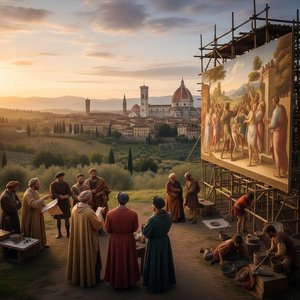
Giotto lived during the Proto-Renaissance, a period of transition between the medieval and Renaissance eras. He is credited with pioneering techniques that would become hallmarks of Renaissance art:- Naturalism: A move away from stylized representations towards more lifelike depictions.
- Emotional Realism: Capturing genuine human emotions in his figures, making them relatable and engaging.
- Spatial Awareness: Creating a sense of depth and three-dimensionality in his compositions.
Emotional Impact & Interior Design Considerations
Saint Stephen evokes a sense of quiet reverence and intellectual curiosity. The painting’s subdued palette and contemplative mood make it suitable for spaces dedicated to reflection – libraries, studies, or meditation rooms. Its relatively small size (84 x 54 cm) allows for versatile placement within various interior design schemes. A high-quality reproduction would serve as a focal point in a classically styled room, adding a touch of historical elegance and spiritual depth. The gold leaf detailing will beautifully catch the light, creating a warm and inviting atmosphere. This artwork isn’t just a visual experience; it's an invitation to contemplate faith, knowledge, and the enduring power of the human spirit.Въпроси и отговори
Как е описана цветовата палитра на „Saint Stephen“ на Джото ди Бондоне?
Цветовете на "Saint Stephen" образуват Тъмни нюанси палитра. Тази класификация описва доминиращите цветни групи.
Остана ли "Saint Stephen" в родината на своя автор?
Не – произведението се намира в чужбина. „Saint Stephen“ се намира в Italy, докато Джото ди Бондоне е роден в Италия.
Какви цветове доминират в „Saint Stephen“ на Джото ди Бондоне?
„Saint Stephen“ на Джото ди Бондоне използва палитра от Тъмни нюанси, като Бронзов (#c38044) е доминиращият цвят.
 Преглед в реален мащаб
 Изпрати
 Сподели
 Детайли
 Ръководство

 Изтегляне
 Подобни артикули
 Рентгенова снимка
 Слайдшоу
 Q&A
Q&A Статистика






![Скroveгни - Последният съд (детайл) [03]](/media/artworks/images-thumb/7d/a9/7da93e3737abc9f37453cee26f9f9796.jpg)
