Преглед в реален мащаб
 Сподели
 Сподели
 Подробности
 Ръководство

 Изтегляне
 Подобни артикули
 Рентгенова снимка
 Слайдшоу
 Статистика
A Soldier
 Acrylic On Canvas
- WallArt
- High Renaissance
 1510
1510 72.0 x 57.0 cm
 Kunsthistorisches Museum
 Разгърни целия текст
Жикле / Художествен принт
Giclée печат или принт върху платно с музейно качество, бързо производство и гъвкави опции за завършен вид. ( Поръчайте ръчно рисувано репродукция на този колекционерски предмет Превключване към дигитално изображение)




P118B €10

P118H €10

P118W €10

P438Z €10

P508JH €12

P508YH €12

P805H €10

P805Z €10

P919BZ €10

P919G €10

P919XJ €10

P959ZH €10

P968JZ €12

W106C €8

W218G €10

W218JH €8

W218Y €10

W307PJ €10

W316G €10

W316PJ €8

W316Y €10

W398PJ €8

W4111J €10

W500HY €15

W500JH €15

W692G €12

W849H €8

W940BG €15

W953PJ €8




Изберете от нашите предварително зададени размери, които съответстват на оригиналните пропорции на произведението.

Въведете необходимата ширина и височина, за да паснат на вашата рамка или стена. Принтовете могат само да се изрязват, но никога не могат да бъдат по-големи от оригиналната картина, така че при размер с различен формат част от изображението ще бъде загубена. Преди да започнем печат, ще ви изпратим дигитален мок업 за одобрение. Изображението, показано на тази страница, не показва реалното изрязване — само мок업ът го показва.
Доставка по целия свят () в рамките на 2 седмици вместо стандартните 4/5 седмици. (25 Октомври)

Безплатна експресна доставка по целия свят

Висококачествено ленено платно

Пълно застраховане на доставката

Гаранция за възстановяване на митнически такси

Гаранция за пълно съответствие на цветовете

Политика за връщане в рамките на 100 дни (само при дефекти)

100% Гаранция за връщане на сумата

Отстъпка при поръчка на повече произведения
 Опцията със стъкло е налична само за размери под 110 см

A Soldier
Жикле / Художествен принт
Размер на репродукцията
-


Крайна цена
€ 70
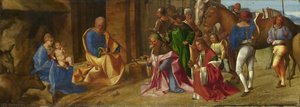
A Soldier: An Enigma of Venetian High Renaissance
Giorgione’s “A Soldier,” painted circa 1505–1510, stands as one of the most perplexing and celebrated canvases emerging from Venice during its golden age. More than just a portrait—though undeniably so—it embodies the spirit of the High Renaissance's fascination with ambiguity and layered meaning, captivating viewers centuries later.
The painting depicts a man in armor, positioned in a three-quarter pose, gazing intently off to his right. While seemingly simple in composition, every element contributes to an atmosphere of profound contemplation. The artist’s masterful use of color—primarily muted reds and browns—creates a subdued palette that contrasts sharply with the luminous flesh tones of the figure’s face and torso. This technique aligns perfectly with Giorgione's signature style: prioritizing atmospheric perspective and capturing fleeting moments of emotion rather than striving for photographic realism.
- Subject Matter & Symbolism: The soldier, dressed in Venetian armor—a symbol of authority and protection—appears to be observing something beyond the frame. Scholars debate whether he represents a noble warrior or simply an ordinary man caught in contemplation. Some interpret his gaze as directed towards divine grace, reflecting the humanist ideals prevalent at the time.
- Technique: Giorgione employed oil paint on canvas, utilizing glazing techniques to achieve remarkable depth and luminosity. The subtle blending of colors—particularly evident in the armor’s surface—demonstrates an unparalleled level of artistic skill.
- Historical Context: Venice during the early 16th century was a crucible of artistic innovation, fueled by patronage from wealthy merchants and nobles who championed humanist ideals. Giorgione's work reflects this cultural dynamism, aligning with the broader trend toward exploring psychological complexity and capturing the beauty of the natural world.
- Emotional Impact: The painting’s stillness—coupled with the soldier’s enigmatic expression—invites viewers to ponder questions of identity, purpose, and faith. Giorgione's ability to convey emotion through subtle gestures and tonal variations elevates “A Soldier” beyond mere visual representation, transforming it into a powerful meditation on human experience.
Further research suggests that the presence of a sword in the foreground adds an element of tension—a reminder of conflict and mortality—while another figure partially visible on the right side remains elusive, prompting speculation about his role within the narrative.
“A Soldier” continues to fascinate art historians and collectors alike. Its enduring appeal lies not only in its technical brilliance but also in its capacity to provoke contemplation and inspire awe. Reproductions of this masterpiece offer a glimpse into the artistic genius of Giorgione and the profound beauty of Venetian High Renaissance painting.
Въпроси и отговори
Каква цветова хармония демонстрира „A Soldier“ на Джорджоне?
Цветовете на „A Soldier“ на Джорджоне показват Unified Palette хармония. Хармонията описва начина, по който цветовете се съотнасят един спрямо друг.
Как се съчетават медиумът и движението в "A Soldier"?
„A Soldier“ на Джорджоне съчетава техниката Acrylic On Canvas със стила High Renaissance. Техниката и направлението описват начина на изработка и художествения стил на произведението.
Каква емоция предава произведението от High Renaissance „A Soldier“?
Mysterious емоцията на „A Soldier“ допълва нейния High Renaissance стил.
Биография на художника
Giorgione (1477/8-1510): A Venetian Enigma
Giorgio Barbarelli da Castelfranco, known to the world as Giorgione, remains one of the most elusive and captivating figures in Renaissance art. Born in the small town of Castel Franco Veneto near Venice around 1477 or 1478 – the exact year is debated – his tragically short life, ending around 1510 at the age of thirty-two or thirty-three, belies an artistic impact that continues to resonate centuries later. Unlike many of his contemporaries whose lives are well documented, Giorgione’s story is shrouded in mystery, pieced together from scant historical records and the often romanticized accounts of Giorgio Vasari. What we do know suggests a man deeply immersed in the vibrant culture of Venice, a city that fostered both artistic innovation and a sensual appreciation for beauty. He likely apprenticed under Giovanni Bellini, a leading Venetian painter, absorbing the established traditions before forging his own unique path. Early commissions included portraits of prominent figures like Doge Agostino Barbarigo, demonstrating an immediate talent for capturing likeness and status. However, it was in his departure from conventional subject matter and his revolutionary approach to painting that Giorgione truly distinguished himself.Early Life and Artistic Training
Giorgio Barbarelli’s origins are relatively obscure. He was born into a family of modest means in Castel Franco Veneto, a region known for its textile industry and burgeoning artistic patronage. While precise details about his childhood remain elusive, biographical sketches indicate he possessed an innate fascination with art from a young age. His formal training began under Giovanni Bellini, arguably the most influential Venetian painter of his time. Bellini’s workshop served as a crucible for artistic experimentation, fostering a tradition of blending Byzantine influences with emerging humanist ideals. Giorgione diligently studied Bellini's techniques – particularly his masterful use of color and glazing – absorbing the stylistic conventions that would shape his own distinctive style. This apprenticeship instilled in him not only technical proficiency but also a profound understanding of Venetian artistic culture.A Revolutionary Style: Color, Atmosphere, and *Sfumatò*
Giorgione’s artistic style represented a radical departure from the prevailing Florentine aesthetic, which prioritized linear perspective and meticulous draughtsmanship. He championed color, atmosphere, and an evocative moodiness that became hallmarks of the Venetian school – a movement characterized by its sensual beauty and emotional depth. Unlike his Florentine counterparts who sought to represent the world as it appeared objectively, Giorgione aimed to capture its essence—its fleeting emotions and spiritual resonance. His technique involved softening outlines, employing subtle gradations of tone – *sfumato* – to create atmospheric effects that blurred boundaries between objects and imbued scenes with a hazy luminescence. This approach wasn’t merely a stylistic preference; it reflected a fundamentally different artistic sensibility rooted in Byzantine art traditions. Giorgione skillfully utilized color symbolism—particularly muted hues—to convey complex psychological states and heighten the emotional impact of his paintings. The result was an unparalleled sense of depth and luminosity, transforming landscapes into immersive experiences for the viewer.Notable Works: Visions of Beauty and Mystery
Giorgione’s oeuvre is remarkably small compared to other Renaissance masters, consisting primarily of a handful of paintings that nevertheless command immense artistic significance. The Tempest (c. 1506-1508), arguably his masterpiece, depicts a soldier and a nursing mother amidst a stormy landscape—a scene fraught with ambiguity and symbolic richness. The painting’s hazy atmosphere and muted colors evoke a profound sense of melancholy and contemplation, prompting viewers to ponder the mysteries of human existence. Similarly, Pastoral Concert (Fête champêtre) presents an idyllic gathering of musicians in a pastoral setting—a celebration not of narrative detail but of harmonious composition and lyrical beauty. Giorgione’s masterful use of color and light creates an ethereal illusion, transporting the viewer to another realm of sensory experience. Other notable works include Sleeping Venus (c. 1509-1510), a sensual depiction of Aphrodite resting on a scallop shell—a testament to Giorgione's ability to convey beauty and emotion with understated elegance; *Judith* (c. 1504), an early example of his evolving style, demonstrating his growing mastery of chiaroscuro—the dramatic interplay of light and shadow—and *Portrait of Lucrezia Borgia* – a psychologically astute portrayal capturing the enigmatic gaze and aristocratic demeanor of one of Venice’s most influential figures.Influence and Legacy
Giorgione's artistic innovations profoundly impacted Venetian painting and exerted considerable influence on subsequent generations of artists. His pioneering use of *sfumato*, combined with his masterful color palette and atmospheric perspective, established a new aesthetic standard that resonated throughout Europe. He served as a mentor to Titian, who would become one of the most celebrated painters of the High Renaissance—carrying forward Giorgione’s stylistic legacy and solidifying Venice's position as a center for artistic excellence. Giorgione’s enduring fascination stems not only from his technical brilliance but also from the profound emotional depth of his paintings—works that continue to inspire awe and contemplation centuries after their creation. He remains an emblem of artistic freedom, innovation, and the pursuit of beauty—a painter who dared to transcend convention and forge a path toward new expressive possibilities.
Джорджоне
1477 - 1510 , Италия
Бързи факти
- Artistic Movement Or Style: Виенцианска школа
- Artists Or Movements Influenced By This Artist: ['Тициан']
- Artists Who Influenced This Artist:
- Джовани Белини
- Мантегна
- Date Of Birth: 1477/78 или 1473/74
- Date Of Death: 1510
- Full Name: Giorgio Barbarelli da Castelfranco
- Nationality: Италиански
- Notable Artworks:
- Ла Темпест
- Мадона от Кастелфранко
- Сънна Венера
- Place Of Birth: Кастелфранко Венеция, Италия
Свързани статии

Timeless Pastoral Landscapes: Curating Serenity and Natural Grandeur within the Luxury Interior
Discover the profound serenity of timeless pastoral landscapes. From Impressionist masterpieces to bespoke oil commissions, explore how curated fine art brings the enduring beauty and tranquility of nature into your luxury home interior.

Топ 25 шедьовъра на Джон Констабъл: Английски пейзажи за вашия дом | OriginalUniqueArt.com
Открийте топ 25 шедьовъра на Джон Констабъл – английски пейзажи, романтизъм и красотата на природата. Репродукции с музейно качество за вашия дом! Разгледайте пълната колекция онлайн на OriginalUniqueArt.com.

Venetian Renaissance: The Mastery of Color, Light, and the Art of Colorito
Explore the luminous mastery of the Venetian Renaissance. Discover how masters like Titian and Giorgione revolutionized art through colorito, light, and atmosphere. An expert guide to the golden age of Italian painting for collectors and enthusiasts.

Idyllic Visions: Exploring the Pastoral Scene in Art History – From Arcadia to Modern Interpretations
Explore the captivating history of pastoral art from classical Arcadia to modern masterpieces. Discover key artists like Millet & Cole at OriginalUniqueArt. Find serene landscape paintings for your home.
Idyllic Visions: Exploring the Pastoral Tradition in Western Art – Themes, Techniques & Enduring Appeal
Explore the rich history of pastoral art from classical Arcadia to contemporary interpretations. Discover key artists, themes & collecting tips at OriginalUniqueArt.