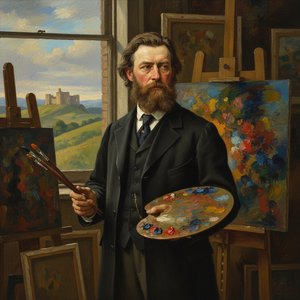
John MacRobin, MD
Ръчно изработена маслена репродукция
Ръчно рисувана маслена картина върху платно във вашия размер и рамка, изработена по поръчка от нашите художници. ( Превключване към печат
Превключване към изображение)
P118B $10
P118H $10
P118W $10
P438Z $10
P508JH $12
P508YH $12
P805H $10
P805Z $10
P919BZ $10
P919G $10
P919XJ $10
P959ZH $10
P968JZ $12
W106C $8
W218G $10
W218JH $8
W218Y $10
W307PJ $10
W316G $10
W316PJ $8
W316Y $10
W398PJ $8
W4111J $10
W500HY $15
W500JH $15
W692G $12
W849H $8
W940BG $15
W953PJ $8
Изберете от предварително зададените размери, които съответстват на оригиналните пропорции на произведението.
Можете да въведете свои собствени размери, за да пасне на конкретна рамка или пространство. Ако избраният от вас размер не съответства на пропорциите на оригиналното изображение, ние ще изрежем произведението или ще удължим картината с допълнителни ръчно рисувани елементи. Дигитален макет ще бъде изпратен за ваше одобрение преди започване на производството.
Моля, обърнете внимание, че прегледът на екрана не отразява действителното изрязване или разширяване. Само макетът ще покаже точно финалния състав.
Въпреки че са налични персонализирани размери, препоръчваме да изберете размер от предварително дефинирания списък, за да запазите оригиналните пропорции.
След поръчка, екипът на OriginalUniqueArt.com ще изпрати имейл на клиента за инструкции и ще предостави преглед на макет.
Доставка по целия свят () в рамките на 3/4 седмици вместо стандартните 5 седмици. (11 Август). Без компромис с качеството.
Безплатна експресна доставка по целия свят
Висококачествено ленено платно
Пълно застраховане при доставка
Гаранция за възстановяване на митнически такси
Гаранция за цветова точност
60-Дневен период за връщане (Само при дефекти)
100% Гаранция за връщане на парите
Предложение за отстъпка при поръчка на едро
John MacRobin, MD
Репродукционен метод
Размер на репродукцията
-
Обща цена
$ 300
Описание на произведението
John MacRobin, MD: A Portrait of Dignified Reflection
George Reid’s “John MacRobin, MD” stands as a testament to the Victorian era's fascination with formal portraiture and its ability to convey profound emotion. Painted in 1877, this artwork captures John MacRobin, a Scottish physician practicing in Aberdeen, Scotland, with remarkable sensitivity and detail.
Reid’s artistic style leans heavily into Dutch Impressionism—a movement that prioritized capturing fleeting moments of light and color rather than striving for photographic realism. This influence is evident in the subdued palette of reds and browns dominating the canvas, creating a rich textural surface reminiscent of Rembrandt’s masterful use of chiaroscuro.
- Subject Matter: The portrait depicts MacRobin seated in a chair against a crimson wall, gazing intently outwards. His posture exudes composure and thoughtfulness, suggesting introspection and contemplation.
- Technique: Reid employed oil paint on canvas using layering techniques—a hallmark of Impressionism—to build up tonal variations and achieve luminous effects. Careful brushstrokes contribute to the painting’s palpable atmosphere.
- Historical Context: Aberdeen in 1877 was a thriving university town, fostering intellectual curiosity and artistic experimentation. Reid's work reflects this cultural milieu, aligning with broader trends toward psychological portraiture during the Victorian period.
The symbolism embedded within “John MacRobin, MD” extends beyond mere representation. The crimson wall serves as a visual anchor, grounding the figure in his surroundings while simultaneously symbolizing passion and vitality—contrasting subtly with MacRobin’s serene gaze.
More than just an image of a man, Reid's painting evokes a feeling of quiet dignity and contemplative awareness. It invites viewers to consider themes of intellectuality, responsibility, and the inner life – qualities valued during Victorian society. The artwork remains a captivating example of Impressionist artistry and a poignant glimpse into the character of a prominent Aberdeen physician.
George Reid: Influenced by Dutch Masters
Reid’s artistic vision was profoundly shaped by his exposure to the art world of Philadelphia, where he studied under Thomas Eakins—a celebrated realist painter who championed anatomical accuracy and meticulous observation. This formative experience instilled in Reid a respect for established techniques while simultaneously nurturing his desire to explore innovative approaches.
Eakins’s influence is palpable in Reid's commitment to capturing the human form with precision, mirroring Eakins’s dedication to portraying subjects with unflinching realism. However, Reid skillfully blended these influences with Impressionistic principles—particularly the pursuit of atmospheric effects—resulting in a distinctive artistic style.
- Philadelphia Academy: Reid's time at Philadelphia solidified his understanding of academic art traditions and provided invaluable experience in mastering observational skills.
- Eakins’s Impact: Eakins encouraged Reid to prioritize anatomical correctness alongside expressive brushwork—a balance that characterizes many of Reid’s landscapes and genre scenes.
Reid's artistic journey exemplifies the dynamic interplay between tradition and innovation, demonstrating how artists can draw inspiration from established masters while forging their own unique creative voice.
Aberdeen Landscapes: A Reflection of Victorian Sentiment
Beyond portraits, Reid’s oeuvre encompasses a series of evocative landscapes that capture the beauty of Scotland—particularly Aberdeen—during the Victorian era. These paintings are characterized by a lyrical quality and an emotional resonance that speaks to the period's preoccupation with nature and spirituality.
Reid skillfully employed color palettes reminiscent of Dutch Impressionists, prioritizing tonal harmonies and subtle gradations to convey mood and atmosphere. His brushstrokes are loose and expressive, capturing the fleeting effects of light on rolling hills and tranquil waterways—a hallmark of Victorian landscape painting.
- Scottish Inspiration: Reid’s landscapes celebrate Aberdeen's scenic grandeur—drawing inspiration from the region’s dramatic coastline and verdant countryside.
- Atmospheric Rendering: The artist meticulously rendered light and shadow, creating a sense of depth and realism that aligns with Impressionistic ideals.
These paintings are not merely depictions of places; they embody Victorian sensibilities—a yearning for beauty, contemplation, and connection to the natural world.
Symbolism in Reid’s Artistic Vision
Reid's artistic approach extended beyond mere visual representation. He deliberately incorporated symbolic elements into his compositions—reflecting Victorian intellectual currents and conveying deeper meanings beneath the surface of imagery.
Consider, for example, the recurring use of crimson hues throughout Reid’s paintings. Crimson symbolizes passion, vitality, and nobility—qualities that Reid wished to imbue his subjects with—particularly in portraits like “John MacRobin, MD.”
- Color Symbolism: Reid skillfully utilized color palettes to communicate emotional states and convey thematic ideas—a technique rooted in Victorian artistic conventions.
- Emotional Resonance: The artist’s deliberate choices of imagery and tonal harmonies contribute to the paintings' profound impact on viewers—eliciting feelings of serenity, contemplation, and appreciation for natural beauty.
Through his masterful artistry, George Reid succeeded in capturing not only the visual splendor of Victorian Scotland but also its underlying spiritual ethos.
Биография на художника
Early Life and Artistic Foundations
George Agnew Reid emerged from the fertile landscapes of rural Canada West, born in 1860 in Wingham, Ontario – a place that would indelibly shape his artistic vision. His beginnings were far removed from formal art training; instead, he was steeped in the rhythms of farm life – a setting he’d later revisit with poignant detail and emotional depth in his paintings. Though initially hesitant about his son's aspirations, Reid’s father eventually recognized and supported his burgeoning talent, allowing him to pursue studies at the Central Ontario School of Art in Toronto in 1879 under the tutelage of Robert Harris. This foundational period instilled a respect for established techniques and representational art, yet it also ignited within Reid a desire to explore beyond mere imitation – a yearning to capture not just what he saw, but *how* he felt about what he saw. He sought further refinement at Philadelphia’s Pennsylvania Academy of the Fine Arts from 1882 to 1885, where he was profoundly influenced by Thomas Eakins – a master of realism and anatomical accuracy whose dedication to truthful representation became a guiding principle throughout Reid's career. Equally significant during this time was his meeting and subsequent marriage to Mary Hiester Reid, herself a gifted artist; their union forged a lifelong artistic partnership built on mutual respect and creative exchange – a dynamic collaboration that fueled both individual growth and the creation of remarkable works. Reid’s early exposure to art was nurtured by his family's collection of illustrated books and magazines, as well as by his grandfather John Reid and an itinerant bookseller named Jamie Young who provided him with volumes about artistic techniques.A Blossoming Style: Genre Painting and Narrative Depth
Upon returning to Canada, Reid’s artistic focus shifted from portraiture towards genre painting – a style that allowed him to explore the narratives embedded within everyday life. This wasn't merely a change in subject matter; it represented a deepening of his artistic intent. He sought to capture not just scenes, but the *stories* behind them—the struggles, joys, and quiet dignity of ordinary Canadians. The Foreclosure of the Mortgage (1893), a powerful depiction of rural hardship, stands as a landmark achievement in Canadian art – a testament to his ability to translate observation into profound emotional resonance. The painting, depicting a family facing eviction from their farm, is imbued with a palpable sense of loss and vulnerability. Reid masterfully blended the precision he had absorbed during his Parisian academic training with subtle Impressionistic touches—a delicate interplay of light and atmosphere that imbued his canvases with realism and emotional depth. He wasn’t simply recording scenes; he was interpreting them, imbuing them with a psychological complexity that resonated deeply with viewers. His paintings became windows into the lives of ordinary Canadians – particularly those in rural Ontario – offering glimpses into their joys, struggles, and enduring spirit. Reid possessed an exceptional ability to observe and capture the nuances of human emotion, translating these observations onto canvas with remarkable skill. This period saw him create works that weren’t just aesthetically pleasing but also socially conscious, reflecting a growing awareness of the challenges faced by rural communities.Career Highlights and Educational Leadership
Reid's artistic achievements were paralleled by a distinguished career in art education and administration. His election to the Royal Canadian Academy of Arts in 1889 solidified his position within the burgeoning Canadian art community, recognizing his contributions and influence. However, perhaps his most significant contribution lay in his role as Principal of the Central Ontario School of Art and Design (later OCAD University) from 1912 to 1918. During this period, he spearheaded crucial reforms, shaping the institution into a leading center for artistic training in Canada – fostering a new generation of Canadian artists. He passionately believed in the power of art education to nurture creativity and foster a vibrant cultural landscape. Beyond his administrative duties, Reid continued to produce significant works, including murals and commissioned pieces for public buildings—most notably contributing to the decoration of Toronto’s third City Hall. His architectural interests were also evident, reflecting an appreciation for the Arts and Crafts movement – a desire to integrate beauty and functionality in design.Notable Works
- Spynie Castle and Loch, Moray (1866): A captivating Scottish landscape painting showcasing dramatic light and detail.
- Mrs Alexander Hay Moncur (1887): A stunning Victorian portrait exhibiting rich detail and luxurious elegance.
- John Ritchie Findlay of Aberlour (1899): An academic realist portrait capturing wisdom and experience.
- The Foreclosure of the Mortgage (1893): A poignant depiction of rural hardship, considered a landmark achievement in Canadian art.
Legacy and Lasting Influence
George Agnew Reid’s legacy extends far beyond his individual paintings; he was a catalyst for change within the Canadian art world – fostering a distinctly national artistic identity while simultaneously embracing international influences. His mentor, Thomas Eakins, instilled in him a commitment to realism and anatomical accuracy, while his time in Paris exposed him to the innovative techniques of Impressionism—elements that he skillfully integrated into his own unique style. He played a crucial role in establishing a visual language that reflected the Canadian experience, depicting Ontario landscapes and rural life with both sensitivity and authenticity. As an educator and administrator, Reid nurtured generations of Canadian artists, shaping the future of art education within the country. His artworks continue to be held in esteemed public and private collections across Canada – including the Art Gallery of Ontario and the National Gallery of Canada – a testament to their enduring artistic merit and historical significance. He died in 1947, leaving behind a body of work that continues to captivate and inspire, solidifying his place as one of Canada’s most important and influential artists. His ability to combine academic rigor with emotional depth created works that resonate with viewers on a profound level – reflecting the social realities of his time and offering enduring insights into the human condition.george reid
1860 - 1947 , Канада
Бързи факти
- Artistic Movement Or Style: Жанров реализъм
- Artists Or Movements Influenced By This Artist: ['Канадски художници']
- Artists Who Influenced This Artist: ['Томас Ейкинс']
- Date Of Birth: 25 юли 1860
- Date Of Death: 23 август 1947
- Full Name: George Agnew Reid
- Nationality: Канадец
- Notable Artworks:
- Предоставяне на ипотека
- Спайнс Каസിൽ и Лох
- Г-жа А.Х. Монкур
- Place Of Birth: Уиндъм, Канада


Стъклото е налично само в размери под 110 см