

 Преглед в реален мащаб
 Сподели
 Сподели
 Подробности
 Ръководство

 Изтегляне
 Подобни артикули
 Рентгенова снимка
 Слайдшоу
 Статистика
John C. Calhoun
 Oil On Canvas
- WallArt
- Historical Portraiture
 1845
1845 74.0 x 91.0 cm
 Национална портретна галерия
 Разгърни целия текст
Ръчно изработена маслена репродукция
Ръчно рисувана маслена картина върху платно във вашия размер и рамка, изработена по поръчка от нашите художници. ( Избор на принт Превключване към дигитално изображение)




P118B €10

P118H €10

P118W €10

P438Z €10

P508JH €12

P508YH €12

P805H €10

P805Z €10

P919BZ €10

P919G €10

P919XJ €10

P959ZH €10

P968JZ €12

W106C €8

W218G €10

W218JH €8

W218Y €10

W307PJ €10

W316G €10

W316PJ €8

W316Y €10

W398PJ €8

W4111J €10

W500HY €15

W500JH €15

W692G €12

W849H €8

W940BG €15

W953PJ €8




Изберете от нашите предварително зададени размери, които съответстват на оригиналните пропорции на произведението.

Въведете необходимата ширина и височина, за да паснат на вашата рамка или стена. Тъй като това е ръчна работа, при избор на размер с различен формат, художникът може да нарисува малко повече около картината или да отреже малко от периферията — вие избирате. Преди да започне рисуването, ще ви изпратим дигитален мок업 за одобрение. Картината, показана на тази страница, не е реалният резултат — само мок업ът го показва.
След получаване на поръчка, екипът на OriginalUniqueArt.com ще изпрати имейл до клиента с инструкции и ще предостави примерен макет за преглед.
Доставка по целия свят () в рамките на 3-4 седмици вместо стандартните 5 седмици. (27 Октомври). Без компромис с качеството.

Безплатна експресна доставка по целия свят

Висококачествено ленено платно

Пълно застраховане на доставката

Гаранция за възстановяване на митнически такси

Гаранция за пълно съответствие на цветовете

Политика за връщане в рамките на 100 дни (само при дефекти)

100% Гаранция за връщане на сумата

Отстъпка при поръчка на повече произведения
 Опцията със стъкло е налична само за размери под 110 см

John C. Calhoun
Техника на репродукция
Размер на репродукцията
-


Крайна цена
€ 264
A Portrait of Power and Shadow: George Peter Alexander Healy’s John C. Calhoun
George Peter Alexander Healy's 1845 portrait of John C. Calhoun is more than simply a likeness; it’s a carefully constructed visual argument, a window into the complex and often troubling currents of antebellum American politics. Painted during a period of intense debate over slavery and states’ rights, the image captures Calhoun not as a man, but as an embodiment of a particular ideology – one that simultaneously commanded respect and fueled division.
Healy, a prolific portraitist known for his meticulous attention to detail and ability to imbue his subjects with personality, employed a classic, formal style reminiscent of the mid-19th century. The composition is deliberately restrained, focusing entirely on Calhoun himself. He sits in a simple chair, draped in dark, somber attire – a deep brown suit accented by a black tie – colors that immediately evoke seriousness and authority. His hands are clasped gently before him, projecting an image of quiet contemplation, yet also conveying a sense of contained power. The backdrop is equally understated: a muted wall and a book suggest intellectualism and the weight of accumulated knowledge, subtly reinforcing Calhoun’s position as a learned statesman.
The Weight of States' Rights
Calhoun’s posture and expression are key to understanding Healy’s intent. He isn’t smiling; there’s no overt warmth in his gaze. Instead, the portrait suggests a man deeply engaged in thought, wrestling with weighty issues. The slight furrow of his brow hints at the intellectual rigor required to defend his fiercely held beliefs. This is a man accustomed to debate and deliberation, yet also capable of unwavering conviction. The painting’s historical context is crucial: Calhoun was a leading voice for states' rights and nullification – doctrines that argued against federal overreach and asserted the sovereignty of individual states. Healy masterfully captures this intellectual stance, presenting Calhoun as a formidable advocate for a system increasingly threatened by the rising tide of abolitionism.
Symbolism and the Shadow of Slavery
While the portrait primarily focuses on Calhoun’s physical presence, subtle details offer glimpses into the ideological landscape he represented. The book in the background, though not explicitly identified, likely references legal texts – a testament to his extensive knowledge of constitutional law. However, it's important to acknowledge the uncomfortable truth that Calhoun’s defense of states’ rights was inextricably linked to the institution of slavery. His staunch advocacy for white supremacy and the economic necessity of slavery in the South is a dark undercurrent within this portrait. Healy doesn’t directly address this aspect, but by presenting Calhoun as a figure of authority and intellect, he implicitly legitimizes his views – a troubling consequence of the era's political climate.
A Legacy in Oil on Canvas
Measuring 74 x 91 cm, the painting is currently housed at the National Portrait Gallery in London. Healy’s masterful use of oil paints creates a rich and textured surface, capturing the nuances of Calhoun’s face – the lines etched by age and thought, the subtle shifts in expression. The lighting is carefully controlled, emphasizing Calhoun's features and casting shadows that contribute to the portrait’s somber mood. Healy’s work reflects the artistic trends of his time while simultaneously offering a poignant reflection on a pivotal period in American history – a period defined by both ambition and moral compromise.
Collecting a Piece of History
Reproductions of Healy's John C. Calhoun offer an opportunity to own a tangible connection to this complex and consequential figure. Whether displayed in a study, a library, or a room dedicated to American history, this portrait serves as a powerful reminder of the debates that shaped our nation – debates that continue to resonate today. It’s not merely a painting; it's a historical document, a visual testament to the enduring power of ideas and the lasting legacy of John C. Calhoun.
Въпроси и отговори
На кой етап от кариерата на Джордж Питер Александър Хили съответства датата от 1845 на „John C. Calhoun"]?
"John C. Calhoun", създадена през 1845, принадлежи на Mature Period от кариерата на Джордж Питер Александър Хили.
Намира се ли „John C. Calhoun“ на Джордж Питер Александър Хили в родината на своя автор?
Не – произведението се намира в чужбина. Родината на Джордж Питер Александър Хили е Съединени американски щати, а музейът, в който се съхранява оригиналът на „John C. Calhoun“, се намира в Великобритания.
Как мога да си купя принт на „John C. Calhoun“ на Джордж Питер Александър Хили?
Принт на „John C. Calhoun“ на Джордж Питер Александър Хили може да бъде поръчан директно от неговата страница Художествен принт: художествен принт върху памучно платно или архивен канвас хартия.
Биография на художника
A Life Etched in Likeness: The World of George Peter Alexander Healy
George Peter Alexander Healy, a name that resonates deeply within the annals of 19th-century American portraiture, was far more than simply a painter of faces. He was a meticulous recorder of an era, a skilled observer of human nature, and a master storyteller who imbued his canvases with both realism and profound historical significance. Born in Boston on July 15, 1813, Healy’s early life, marked by the sudden loss of his father – a merchant marine captain – instilled within him a resilience and a drive that would shape his entire career. This formative experience, coupled with the encouragement of Jane Stuart, daughter of the renowned Gilbert Stuart, ignited an artistic spark that quickly blossomed into a remarkable legacy.European Refinement and Artistic Foundations
In 1834, Healy embarked on a transformative journey to Europe, a period spanning sixteen years that fundamentally altered his artistic perspective and technique. He immersed himself in the vibrant art scenes of Paris and Rome, seeking guidance from masters such as Antoine-Jean Gros and Thomas Couture. These encounters weren’t merely superficial; they represented a deliberate effort to absorb the academic traditions and stylistic nuances of European painting. The influence of French Realism is strikingly evident throughout his work – a testament to the profound impact of his time abroad. He diligently studied composition, color theory, and the art of capturing fleeting expressions, honing his skills with an unwavering dedication. Crucially, he also visited Italy, absorbing the classical influences that would subtly inform his approach to portraiture. His commitment was recognized in 1840 when he received a third-class medal at the Paris Salon – a significant validation of his burgeoning talent and a recognition within the established artistic community. Further solidifying his position, he was elected an honorary academician into the National Academy of Design in 1843, marking him as a respected artist on both sides of the Atlantic.Capturing an Era: Portraits of Power and Influence
Upon his return to the United States in 1855, Healy swiftly established himself as a leading portraitist, renowned for his ability to capture not just physical likeness but also the very essence of his subjects – their character, personality, and authority. He was relentlessly sought after by those who held positions of power and influence, painting portraits of figures such as John C. Calhoun and James Buchanan. However, it is his series of presidential portraits that truly cemented his place in American art history. Commissioned for the Corcoran Gallery in Washington, D.C., Healy meticulously immortalized every U.S. president from John Quincy Adams to Ulysses S. Grant, creating a visual record of American leadership during a period of profound transformation and national growth. These weren’t simply flattering depictions; they were insightful studies of personality and authority – offering glimpses into the minds and lives of those who shaped the nation's destiny. His portrait of Abraham Lincoln stands as perhaps his most iconic work, capturing not only the president’s physical appearance but also his solemnity, unwavering resolve, and inherent dignity during a time of immense national crisis.Beyond Likeness: Historical Narratives on Canvas
Healy’s artistic ambition extended far beyond mere representation; he sought to capture moments of historical significance, imbuing his canvases with narrative power. This is most powerfully demonstrated in *The Peacemakers* (1868), a monumental painting depicting a strategy session between Abraham Lincoln and his advisors following the end of the Civil War. This work transcends a simple depiction of a meeting; it’s a poignant meditation on peace, reconciliation, and the immense weight of leadership. Healy masterfully orchestrates a complex composition, utilizing gesture, expression, and lighting to convey the tension, deliberation, and ultimately, the hope for a new era. *The Peacemakers* remains a testament to his skill as a historical painter – offering a visual window into one of the most pivotal moments in American history.A Lasting Legacy: Remembrance and Reflection
George Peter Alexander Healy returned to Chicago in 1892, spending his final years surrounded by family and continuing to paint prolifically. He passed away on June 24, 1894, leaving behind an extensive body of work that continues to captivate and inspire art enthusiasts worldwide. His autobiography, *Reminiscences of a Portrait Painter*, published posthumously, provides invaluable insights into his life, artistic philosophy, and the world he inhabited – offering a rare glimpse into the mind of a master artist. Healy’s legacy rests not only on the sheer volume of his output but also on the quality, historical significance, and enduring beauty of his paintings. He was a true innovator, a keen observer of human nature, and a skilled storyteller who used his art to document the lives and times of those who shaped America – solidifying his place as one of the most important portrait painters in American history.
Джордж Питер Александър Хили
1813 - 1894 , Съединени американски щати
Бързи факти
- Artistic Movement Or Style: Реализъм
- Artists Or Movements Influenced By This Artist: ['Франклин Ру징']
- Artists Who Influenced This Artist:
- Антоин Жан Грос
- Томас Кутур
- Томас Сол
- Date Of Birth: 15 юли 1813
- Date Of Death: 24 юни 1894
- Full Name: George Peter Alexander Healy
- Nationality: Американски
- Notable Artworks:
- The Peacemakers
- Джон К. Калхун
- Джеймс Бюканан
- Place Of Birth: Бостън, САЩ
Свързани статии

Grant Wood & American Regionalism: Identity, Myth & the Rural Landscape
Explore the world of Grant Wood & American Regionalism with OriginalUniqueArt. Discover the symbolism behind 'American Gothic', recurring themes, and the movement's lasting impact on art history. High-quality reproductions available.
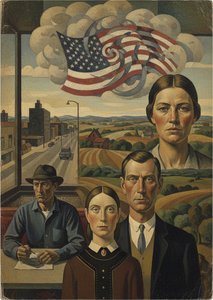
Echoes of Place: Regionalism & American Identity in Interwar Art
Explore the rise of American Regionalism in interwar art! Discover Grant Wood, Thomas Hart Benton & the movement's impact on American identity. Expert analysis & historical context.

Джон Сингър Сарджент: 25 шедьовъра за вашия дом | OriginalUniqueArt.com
Разгледайте 25 шедьовъра на Джон Сингър Сарджент – импресионистични портрети, елегантни дами и исторически сцени. Вдъхновете се за вашия дом! Луксозни репродукции на картини в OriginalUniqueArt.com.

Топ 10 шедьоври на Американския реализъм: Изкуство за вашия дом от OriginalUniqueArt
Разгледайте топ 10 шедьоври на Американския реализъм – Хопър, Едуард Хомър и други. Открийте историите зад картините, техниките и емоциите им. Купете висококачествени репродукции за вашия дом в OriginalUniqueArt.com!

Топ 25 шедьовъра на Джон Констабъл: Английски пейзажи за вашия дом | OriginalUniqueArt.com
Открийте топ 25 шедьовъра на Джон Констабъл – английски пейзажи, романтизъм и красотата на природата. Репродукции с музейно качество за вашия дом! Разгледайте пълната колекция онлайн на OriginalUniqueArt.com.