
 Преглед в реален мащаб
 Изпрати
 Сподели
 Детайли
 Ръководство

 Изтегляне
 Подобни артикули
 Рентгенова снимка
 Слайдшоу
 Въпроси и отговори
 Статистика
Glastonbury Abbey

- 124.0 x 146.0 cm

 Прочети повече
Получете файл, готов за печат, който предлага много по-високо качество от уеб прегледа. Всяко дигитално изображение, което предлагаме, е извлечено от висококачествен оригинал в нашата база данни — обикновено с ширина между 5 000 и 15 000 пиксела — така че със сигурност да можете да принтирате в голям формат, да кадрирате тесно или да възпроизведете фините детайли.
Нито един файл не напуска нашето студио без внимание. Дигитален експерт проверява цветовете спрямо оригиналната картина и ги коригира при необходимост, след което подобрява яснотата и детайлите с професионални инструменти за ретуш — винаги оставайки верен на мазките и стила на художника. Резултатът е изображение, което изглежда като самата картина, а не като сканиран образ с филтър.
Одобрявате преди финализиране: нашият експерт ще изпрати изображението по имейл в рамките на 72 часа за ваш преглед. Не сте доволни? Можете да поискате подобрения или корекции, или пълно възстановяване на сумата, ако качеството не отговаря на очакванията ви.
Това е качеството, на което разчитат издателства, дизайн студиа, галерии и печатници.
Дигитално изображение
Изтеглете файл с висока резолюция за лично съхранение, принтиране и творчески проекти. ( Превключване към принт Купете ръчно рисувана картина)
Включено във всяка поръчка за дигитални изображения
Гарантирана експертна дигитална доставка
Избирайки OriginalUniqueArt.com, вие не получавате просто изображение – вие придобивате професионално обработена дигитална творба, създадена с прецизност и подкрепена от гаранция за удовлетворение. Ето какво автоматично е включено във вашата поръчка:

Бърза доставка по имейл
Вашето дигитално изображение с висока резолюция ще бъде изпратено по имейл в рамките на 72 часа от поръчката – готово за незабавно използване.

Дигитален файл с подобрено качество чрез ИИ
Вашата картина е професионално оптимизирана чрез усъвършенствани инструменти с изкуствен интелект и ръчна редакция, което гарантира максимална детайлност, яснота и точност на цветовете.

Безплатна доживотна повторна доставка
Изгубили сте или сте изтрили файла си по погрешка? Не се притеснявайте – ще го изпратим отново на Вас по всяко време, безплатно.

Без митнически такси – завинаги
Насладете се на вашето произведение незабавно, без мита, такси или разходи за доставка – дигиталните изтегляния винаги са освободени от данъци.

Гаранция за цветово съответствие
Гарантираме, че вашето дигитално изображение отразява оригиналните цветове възможно най-точно чрез използването на професионални инструменти и системи за управление на цветовете.

100-дневна гаранция за удовлетвореност
Ако не сте доволни от вашето дигитално изображение, ще го преработим или ще възстановим 100% от сумата в рамките на 100 дни – без излишни въпроси.

100% Гаранция за връщане на сумата
Не сте доволни? Получете пълен възврат на сумата в рамките на 100 дни от получаването на вашия цифров файл – без излишни въпроси.

Отстъпки за големи поръчки
Купете 3 изображения, спестете 10% - Купете 5, спестете 15% - Купете 10+, спестете 20%. Идеално за творчески проекти, галерии и агенства.
Artistic Significance
The scene captures the beauty of the old stone buildings as they stand in the midst of decay and disrepair. The sky above the abbey appears to be cloudy, adding an ominous atmosphere to the image. In the foreground, several people are walking around the ruins, likely admiring the historical site or exploring its remains. This adds a sense of life and interest to the otherwise solemn atmosphere of the abandoned abbey. Key Features of the painting include:- The use of oil on copper, which gives the piece a unique texture and depth.
- The attention to detail in the depiction of the abbey's architecture and the surrounding landscape.
- The sense of atmosphere and mood created by the cloudy sky and the presence of people in the scene.
Artist Background
George Arnald was a prolific artist known for his landscapes and historical scenes. His work can be found in various museums, including the Museum of Somerset, which features an impressive collection of artworks that reflect the rich cultural heritage of the region. For more information on the museum's collection, visit Discovering the Artworks of Museum of Somerset, United Kingdom. To learn more about George Arnald and his work, including Glastonbury Abbey, visit Painting by 'George Arnald' | George Arnald:Glastonbury Abbey on OriginalUniqueArt.com.For those interested in purchasing a handmade oil painting reproduction of Glastonbury Abbey, OriginalUniqueArt.com offers high-quality reproductions that capture the essence and beauty of the original piece.
Въпроси и отговори
Каква цветова палитра използва "Glastonbury Abbey"?
Палитрата на „Glastonbury Abbey“ на George Arnald е описана като Earthy. Това е кратко описание на цветовете в произведението.
Има ли слайдшоу за „Glastonbury Abbey“ на George Arnald?
Налична е галерия със снимки: страницата Слайдшоу на „Glastonbury Abbey“ на George Arnald.
Каква е яркостта на „Glastonbury Abbey“ на George Arnald?
„Glastonbury Abbey“ на George Arnald има светлост от Soft Shadow. Светлостта описва колко светлина изглежда, че отразяват цветовете.
Биография на художника
The Poetic Vision of George Arnald
In the grand tapestry of British Romanticism, where the dramatic skies of Turner and the pastoral sincerity of Constable often command the spotlight, the name George Arnald (1763–1841) whispers of a more intimate, yet equally profound, connection to the landscape. A painter of remarkable sensitivity, Arnald possessed the rare ability to transform topographical accuracy into emotive storytelling. His journey from the humble beginnings of a domestic servant to an established figure within the Royal Academy is a testament to a raw, burgeoning talent that sought to capture not just the physical contours of the earth, but the very spirit of the places he depicted.
Though the precise details of his early years remain shrouded in the mists of history—with accounts placing his birth anywhere from Northamptonshire to Berkshire—his artistic evolution was shaped by the rigorous guidance of William Pether. Under Pether’s tutelage, Arnald mastered the art of the landscape and engraving, learning to balance meticulous observation with a poetic sensibility. This training allowed him to contribute significantly to the illustrated county histories of his era, providing topographical views that were as much about atmosphere as they were about geography.
A Legacy of Light and History
Arnald’s oeuvre is characterized by a remarkable versatility, ranging from the quiet, sun-drenched ruins of Scotland to the thunderous, salt-sprayed chaos of naval warfare. His work often reflects a deep engagement with the Romantic ideal—the belief that art should stir the soul through the sublime and the beautiful. One might find himself lost in the serene sunset of Ruins of Rosslyn Castle, where the decay of stone meets the eternal glow of twilight, or transported to the rugged Yorkshire countryside in his depiction of Loading a Timber Wagon in the Park of Cave Castle, where dramatic skies hint at the untamed power of nature.
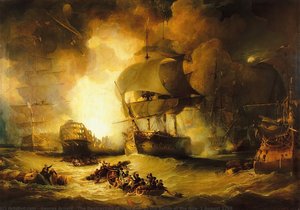
However, it was perhaps his departure from the purely pastoral that secured his place in the annals of maritime history. His most celebrated and monumental achievement, The Destruction of L'Orient at the Battle of the Nile, stands as a breathtaking masterwork of historical drama. Commissioned as part of a prestigious competition for the Greenwich Hospital, this painting captures the catastrophic moment of a naval titan’s demise. In this work, Arnald transcends mere documentation, utilizing light and shadow to evoke the terror and heroism inherent in Britain's maritime triumphs.
The Critic's Eye and Artistic Standing
Despite his prolific output—exhibiting an astounding 176 works at the Royal Academy throughout his career—Arnald’s ascent was marked by a certain bittersweet complexity. While he achieved the status of an Associate Member of the Royal Academy in 1810, he never reached the pinnacle of full fellowship. This lack of ultimate institutional acclaim famously drew the poignant commentary of the poet William Wordsworth. Wordsworth, reflecting on the Romantic necessity of intellectual depth, lamented that Arnald’s genius might have been even more profound had it been paired with a stronger literary foundation, suggesting that a true mastery of landscape requires a "tincture of the Poetic Spirit."
Yet, to judge Arnald solely through the lens of institutional rank is to miss the enduring magic of his brushwork. His significance lies in his ability to bridge the gap between the precise topographical record and the emotive power of the Romantic movement. Through his eyes, we see a Britain defined by both its historical struggles and its quiet, pastoral grace, ensuring that his contribution to the British artistic canon remains as vital and evocative as the landscapes he so lovingly rendered.
George Arnald
1763 - 1841
Бърза справка
- Artistic Movement Or Style: Romantic Landscape
- Artists Or Movements Influenced By This Artist: ['Thomas Davidson']
- Artists Who Influenced This Artist: ['William Pether']
- Date Of Birth: 1763
- Date Of Death: 1841
- Full Name: George Arnald
- Nationality: British
- Notable Artworks: ['Battle of the Nile']
- Place Of Birth: Northamptonshire (Bedfordshire)