

 Представи си го
 Изпрати
 Сподели
 Детайли

 Изтегляне
 Подобни
 Рентгенова снимка
 Слайдшоу
Figures in a Landscape
 1924
1924 66.0 x 86.0 cm
 Прочетете повече
Ръчно изработена маслена репродукция
Ръчно рисувана маслена картина върху платно във вашия размер и рамка, изработена по поръчка от нашите художници. ( Купете принт Купете изображение)




































Изберете от предварително зададените размери, които съответстват на оригиналните пропорции на произведението.

Можете да въведете свои собствени размери, за да пасне на конкретна рамка или пространство. Ако избраният от вас размер не съответства на пропорциите на оригиналното изображение, ние ще изрежем произведението или ще удължим картината с допълнителни ръчно рисувани елементи. Дигитален макет ще бъде изпратен за ваше одобрение преди започване на производството.
Моля, обърнете внимание, че прегледът на екрана не отразява действителното изрязване или разширяване. Само макетът ще покаже точно финалния състав.
Въпреки че са налични персонализирани размери, препоръчваме да изберете размер от предварително дефинирания списък, за да запазите оригиналните пропорции.
След поръчка, екипът на OriginalUniqueArt.com ще изпрати имейл на клиента за инструкции и ще предостави преглед на макет.
Доставка по целия свят () в рамките на 3/4 седмици вместо стандартните 5 седмици. (13 Август). Без компромис с качеството.

Безплатна експресна доставка по целия свят

Висококачествено ленено платно

Пълно застраховане при доставка

Гаранция за възстановяване на митнически такси

Гаранция за цветова точност

60-Дневен период за връщане (Само при дефекти)

100% Гаранция за връщане на парите

Предложение за отстъпка при поръчка на едро
 Стъклото е налично само в размери под 110 см

Figures in a Landscape
Репродукционен метод
Размер на репродукцията
-


Обща цена
$ 300
Биография на художника
Georg Schrimpf: The Stark Realism of Neue Sachlichkeit
Georg Schrimpf (aged 49) was a German painter and graphic artist who stands as one of the foremost figures in Neue Sachlichkeit – a movement that profoundly reshaped German art during the turbulent years of Weimar Republic (1919-1933). Alongside Otto Dix, George Grosz, and Christian Schad, Schrimpf championed this artistic stance as a deliberate reaction against the expressive fervor of Expressionism and the burgeoning abstraction of its time. His unflinching portrayal of societal anxieties and wartime horrors cemented his place in art history, albeit tragically curtailed by the rise of Nazism which deemed his work “degenerate.” Born in Munich in 1889, Schrimpf’s early life was marked by hardship; his father succumbed to illness before he arrived, leaving him under the care of a stepfather who ultimately forced him from home. Seeking independence and artistic fulfillment, he embarked on a nomadic journey beginning in 1902 as a baker's apprentice in Passau. This formative period instilled a disciplined craftmanship that would inform his later artistic endeavors. From 1905 to 1914, Schrimpf traversed Belgium, France, Switzerland, and Northern Italy, undertaking various jobs – waiter, baker, coal shuffler – absorbing diverse cultural influences and honing observational skills crucial for capturing the essence of reality. The First World War irrevocably altered Schrimpf’s trajectory. Driven by pacifist convictions, he skillfully evaded military service, a decision that severely impacted his health. During the war years (1915–1918), he resided in Berlin where he pursued his artistic passions with unwavering dedication. Working tirelessly as a freelance artist, he devoted every spare moment to sketching, painting, and sculpting – largely self-taught—drawing inspiration from the stylistic innovations of Old Masters. This meticulous approach to technique would become characteristic of his oeuvre. A pivotal moment arrived in 1916 when Schrimpf’s paintings were exhibited by herwarth walden's Berlin gallery, “Der Stumm,” garnering considerable public acclaim and introducing him to Maria Uhden, whom he married shortly thereafter. Sadly, Uhden succumbed to complications from childbirth in 1917, leaving Schrimpf a widower with a young son. He joined the Novembergruppe – a collective of artists committed to social realism – participating in their exhibitions of 1919, 1920, 1924 and 1929. His involvement with this influential group solidified his position within the burgeoning avant-garde scene of Weimar Berlin. Schrimpf’s artistic output extended beyond painting; he published works in Expressionist magazines like “Der Weg,” “Die Bücherkiste,” and “Die Sichel,” reflecting his engagement with intellectual currents shaping the era. Schrimpf's artistic style is defined by Neue Sachlichkeit’s uncompromising realism, prioritizing meticulous detail and tonal gradation to convey psychological depth alongside factual accuracy. He eschewed emotive exaggeration, favoring instead a stark visual language that confronted viewers with uncomfortable truths about society and human experience. His subjects often encompassed urban landscapes, portraits of ordinary people—particularly laborers—and depictions of wartime scenes imbued with palpable tension and disillusionment. Notable works include “Horses III” and “Deutsch Kinder im Hof,” which exemplify his masterful command of technique and his ability to distill complex emotions into powerfully evocative imagery. Despite Schrimpf’s artistic achievements, his career was tragically curtailed by the Nazi regime's ascendancy in 1933. The Nazis denounced his art as “degenerate,” labeling it subversive and antithetical to their ideological vision—a decision that resulted in confiscation and destruction of numerous paintings. Georg Schrimpf died prematurely in 1938, leaving behind a legacy of uncompromising artistic integrity and a poignant reminder of the devastating impact of political persecution on creative expression. His contribution to Neue Sachlichkeit remains invaluable, securing his place as one of Germany’s most significant artists of the interwar period.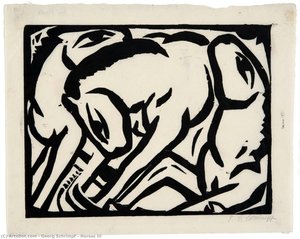
Georg Schrimpf
1889 - 1938
Бързи факти
- Artistic Movement Or Style: Neue Sachlichkeit
- Artists Who Influenced This Artist:
- Otto Dix
- Christian Schad
- Date Of Birth: February 13, 1889
- Date Of Death: April 19, 1938
- Full Name: Georg Schrimpf
- Nationality: German
- Notable Artworks:
- Horses III
- Deutsch Franz von Assisi
- Deutsch Kinder im Hof
- Place Of Birth: Munich, Germany

