- Начало

- Принт върху платно
- Франц Марк
- Jumping Horse
 Купи картина Купи изображение
 Изпрати
 Сподели
 Детайли
 Добавяне към любими

 Изтегляне
 Подобни
 Рентгенова снимка
 Слайдшоу
Jumping Horse


 Прочетете повече
Жикле / Художествен принт
Giclée печат или принт върху платно с музейно качество, бързо производство и гъвкави опции за завършен вид.




P118B $10

P118H $10

P118W $10

P438Z $10

P508JH $12

P508YH $12

P805H $10

P805Z $10

P919BZ $10

P919G $10

P919XJ $10

P959ZH $10

P968JZ $12

W106C $8

W218G $10

W218JH $8

W218Y $10

W307PJ $10

W316G $10

W316PJ $8

W316Y $10

W398PJ $8

W4111J $10

W500HY $15

W500JH $15

W692G $12

W849H $8

W940BG $15

W953PJ $8




Изберете от предварително зададените размери, които съответстват на оригиналните пропорции на произведението.

Можете да въведете собствени размери, за да паснат на конкретна рамка или пространство. Ако избраният от Вас размер не съвпада с пропорциите на оригиналното изображение, ние ще изрежем произведението или ще разширим изображението с огледален или едноцветен ръб. Дигитален макет ще бъде изпратен за Ваше одобрение преди започването на производството.
Моля, имайте предвид, че предпрегледът на екрана не отразява реалното изрязване или разширяване. Само макетът ще покаже точно финалната композиция.
Въпреки че са налични персонализирани размери, препоръчваме да изберете размер от предварително дефинирания списък, за да запазите оригиналните пропорции.
Доставка по целия свят () в рамките на 2 седмици вместо стандартните 4/5 седмици. (22 Юли)

Безплатна експресна доставка по целия свят

Висококачествено ленено платно

Пълно застраховане при доставка

Гаранция за възстановяване на митнически такси

Гаранция за цветова точност

60-Дневен период за връщане (Само при дефекти)

100% Гаранция за връщане на парите

Предложение за отстъпка при поръчка на едро
 Стъклото е налично само в размери под 110 см

Jumping Horse
Жикле / Художествен принт
Размер на репродукцията
-


Обща цена
-
Описание на колекционерския предмет
Franz Marc’s “Jumping Horse”: A Symphony of Color and Spirit
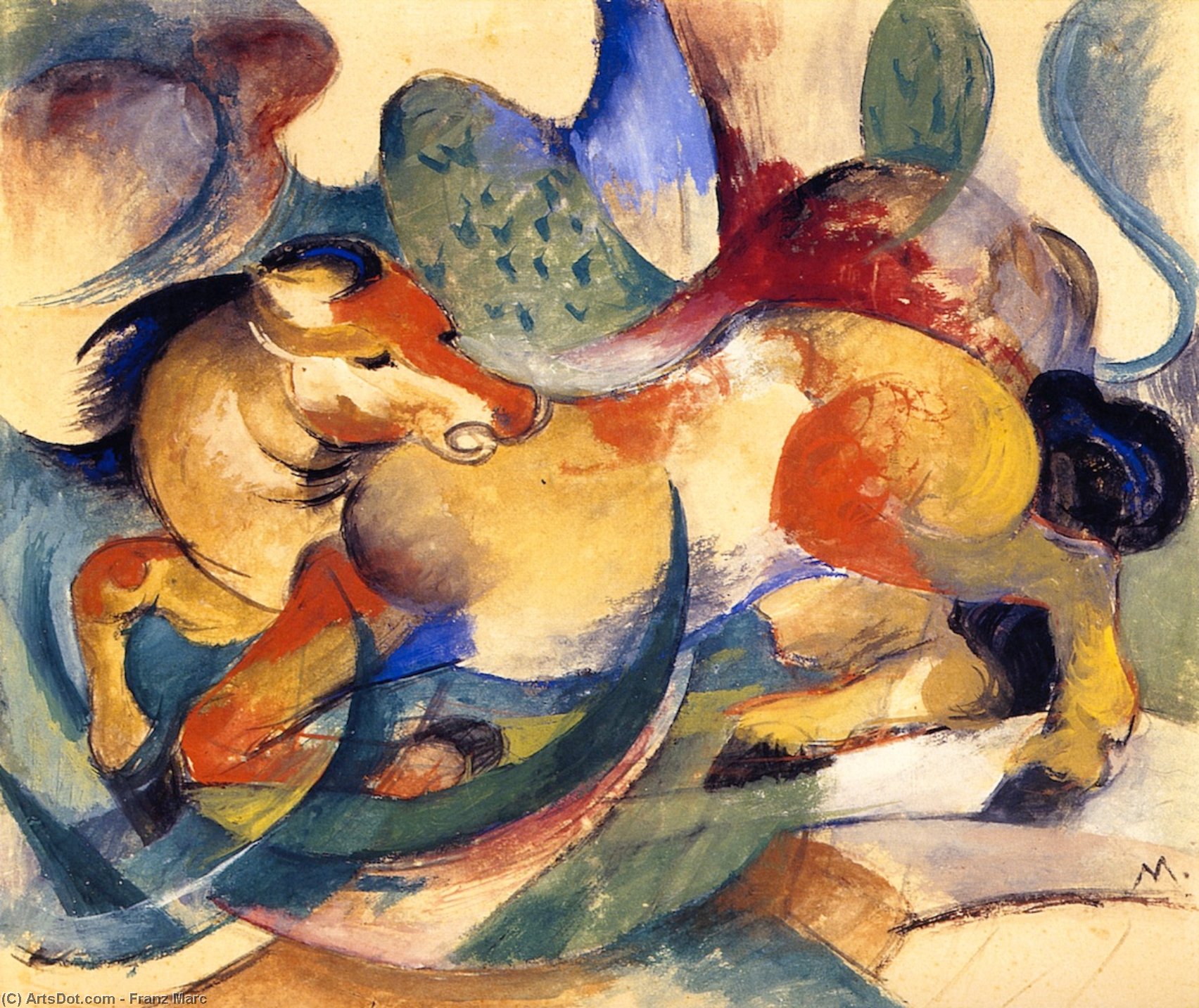
Franz Marc's "Jumping Horse," painted in 1913, isn’t merely a depiction of an equine leap; it’s a profound distillation of the Expressionist movement’s core tenets – a vibrant exploration of emotion, instinct, and the interconnectedness of nature. This artwork transcends simple representation, becoming a visual embodiment of freedom, energy, and the spiritual yearning that defined Marc's artistic vision. The painting pulsates with an almost palpable dynamism, inviting the viewer into a world where color isn’t just decorative but fundamentally expressive.
Marc, deeply influenced by his early exposure to Vincent van Gogh’s emotionally charged brushwork and his own contemplation of religious themes, sought to capture not just what he *saw*, but what he *felt*. “Jumping Horse” exemplifies this pursuit. The horse itself—a powerful, almost mythical figure—is rendered with bold, simplified forms and a palette dominated by fiery reds, oranges, and yellows. These colors aren’t applied realistically; instead, they are used to convey the horse's raw energy, its untamed spirit, and the sheer force of its movement. The distorted perspective and flattened planes contribute to an overall sense of immediacy and intensity, pulling the viewer directly into the heart of the action.
Composition and Symbolism: A Harmonious Ecosystem
The composition of “Jumping Horse” is remarkably balanced despite its energetic subject matter. The horse, positioned slightly off-center, dominates the scene but isn’t isolated. A scattering of carefully placed elements—a bird soaring towards the upper right corner, a cactus reaching upwards on the left, and a potted plant grounding the composition—create a miniature ecosystem within the frame. These seemingly disparate objects aren't merely decorative; they contribute to the painting’s overall sense of harmony and balance, suggesting a deeper connection between the horse and its environment.
The bird, often interpreted as a symbol of freedom and transcendence, adds a touch of serenity to the scene, while the cactus represents resilience and endurance. The potted plant grounds the composition, anchoring the dynamic energy of the horse within a more stable reality. Marc’s genius lies in his ability to weave these individual elements into a cohesive whole, creating an artwork that speaks to both the wildness of nature and its inherent order.
Expressionism: Capturing Inner Experience
“Jumping Horse” is a quintessential example of Expressionist art. The movement, emerging in early 20th-century Germany, rejected traditional academic painting techniques in favor of subjective expression. Artists like Marc sought to convey their inner emotional states through distorted forms, exaggerated colors, and simplified compositions. In this painting, the horse’s elongated neck, its blurred form, and the vibrant hues all contribute to a sense of heightened emotion—a feeling of exhilaration, perhaps even primal instinct.
Marc's use of color is particularly noteworthy. He employs a technique known as “color symbolism,” assigning specific meanings to different colors based on their emotional associations. Red often represents passion and energy, while yellow symbolizes joy and optimism. The careful orchestration of these colors in "Jumping Horse" creates a powerful visual narrative that resonates deeply with the viewer.
A Legacy of Spiritual Vision
“Jumping Horse” is more than just a beautiful painting; it’s a testament to Franz Marc's artistic vision and his profound belief in the power of art to communicate spiritual truths. His exploration of the animal kingdom—particularly horses, which he saw as embodiments of freedom and vitality—reflects a deep yearning for connection with nature and a desire to transcend the limitations of human experience. As a cornerstone of early 20th-century art, “Jumping Horse” continues to inspire awe and wonder, inviting us to contemplate the beauty and mystery of the natural world.
Биография на художника
A Life Immersed in Color and Spirit
Franz Moritz Wilhelm Marc, born in Munich in 1880, was a painter whose brief but intensely focused career irrevocably altered the course of German Expressionism. His story is one of profound spiritual seeking translated into a vibrant visual language, a quest to understand the essence of life through the purity he found in the natural world—particularly within the animal kingdom. Initially influenced by his father, Wilhelm Marc, a landscape painter, young Franz’s artistic path wasn't immediately certain. He briefly considered theology, grappling with questions of faith and existence before ultimately dedicating himself to art at the Academy of Fine Arts in Munich. These early explorations into religious thought would remain deeply embedded within his work, shaping his belief that art could be a conduit for spiritual experience. His academic training provided him with technical foundations, but it was encounters with the works of Vincent van Gogh during visits to Paris that truly ignited his artistic vision. Van Gogh’s emotive use of color and raw expression resonated profoundly with Marc, liberating him from conventional techniques and setting him on a path toward a more subjective and emotionally charged style.The Blue Rider and a New Artistic Vision
Marc's artistic development wasn’t solitary; it flourished within the dynamic context of early 20th-century Munich. He experimented with various artist groups, including the Neue Künstlervereinigung München, before co-founding *Der Blaue Reiter* (The Blue Rider) in 1911 alongside Wassily Kandinsky. This wasn’t merely a group or an exhibition series; it was a philosophical and artistic revolution. *Der Blaue Reiter* sought to move beyond mere representation, aiming instead to express inner spiritual truths through abstraction and symbolic color. The journal of the same name became a platform for disseminating these ideas, showcasing not only their own work but also that of other forward-thinking artists and exploring diverse cultural influences from folk art to primitive sculpture. Marc’s contributions during this period were pivotal. He moved away from depicting landscapes as static scenes, instead focusing on animals—horses, deer, foxes—as vessels of spiritual energy. These weren’t simply animal portraits; they were symbolic representations of innocence, harmony, and a connection to the natural world that he believed humanity had lost. The influence of Robert Delaunay’s exploration of abstract forms and vibrant colors further propelled Marc toward simplification and heightened emotional expression in his work. Paintings like *The Tiger* (1912) and *Red Deer* (1912) exemplify this shift, showcasing bold color choices and a growing focus on the inherent qualities of his subjects rather than realistic depiction.Symbolism, Color, and the Essence of Being
Marc’s artistic style is immediately recognizable for its distinctive use of color and form. He didn't employ color descriptively; instead, he imbued it with symbolic meaning. Blue represented spirituality and masculinity, yellow signified joy and femininity, and red embodied violence and materiality. These weren’t arbitrary choices but a carefully constructed system designed to convey specific emotional and philosophical ideas. His animals aren’t merely subjects; they are embodiments of these concepts. The simplification of forms—reducing figures to their essential shapes—further emphasized the underlying spiritual essence he sought to capture. *The Tower of Blue Horses* (1913), sadly lost during World War II, is perhaps the most iconic example of this approach, a powerful and evocative composition that encapsulates his artistic vision. He believed animals possessed an inherent purity and connection to nature that humans had forfeited through societal constraints and intellectualization. By portraying them with such reverence and symbolic weight, Marc sought to remind viewers of this lost harmony and inspire a deeper appreciation for the natural world. His work wasn’t about depicting *what* he saw but rather *how* he felt—a deeply personal and spiritual response to his surroundings.Influences and Development
Marc's artistic journey was shaped by a confluence of influences. Initially, his father’s landscape paintings instilled in him an appreciation for the beauty of nature. However, it was his exposure to Vincent van Gogh’s expressive brushwork and emotional intensity that truly transformed his approach. Van Gogh’s willingness to prioritize feeling over objective representation resonated deeply with Marc's own spiritual inclinations. Furthermore, his time in Paris exposed him to the innovations of Impressionism and Post-Impressionism, particularly the work of Paul Gauguin, who similarly sought to infuse symbolism into his art. The encounter with Wassily Kandinsky within *Der Blaue Reiter* proved crucial, fostering a shared belief in the power of abstraction to convey spiritual truths. Marc’s artistic style evolved over time, moving from a more academic style to one characterized by simplified forms, bold colors, and symbolic imagery. He experimented with various techniques, including cloisonné enameling, reflecting his interest in exploring new modes of expression.A Tragic End and Lasting Legacy
The outbreak of World War I in 1914 dramatically altered Marc’s life and artistic trajectory. Despite seeking exemption due to his status as an artist, he was drafted into the German army, serving as a cavalryman. The horrors of war deeply affected him, yet even amidst the chaos, he continued to paint, finding solace and meaning in his art. Tragically, Franz Marc died on March 4, 1916, at the Battle of Verdun, a devastating loss for the art world. His untimely death cut short a career brimming with potential, but it also cemented his place as a pivotal figure in modern art history. His work continues to resonate today, influencing generations of artists and captivating audiences with its emotional depth and spiritual resonance. Marc’s paintings are exhibited in major museums worldwide, including the Lenbachhaus in Munich, which holds an extensive collection of his work. He is remembered not only as a pioneer of German Expressionism but also as a visionary artist who dared to explore the profound connection between art, spirituality, and the natural world—a legacy that continues to inspire awe and contemplation. His artistic vision remains a testament to the power of art to transcend the material realm and touch upon something deeper within the human spirit.
Франц Марк
1880 - 1916 , Германия
Бързи факти
- Artistic Movement Or Style: Хуманизъм и израз
- Artists Or Movements Influenced By This Artist:
- Израз
- БлаUER Reiter
- Artists Who Influenced This Artist:
- Ван Гог
- Делаunay
- Date Of Birth: 8 февруари 1880 г.
- Date Of Death: 4 март 1916 г.
- Full Name: Франц Moritz Wilhelm Marc
- Nationality: Германец
- Notable Artworks:
- Тирол
- Флок на овце II
- Търпеливо животно
- Place Of Birth: Мюнхен, Германия
Всички статии
Топ 25 шедьовъра на Марк Шагал: Живописни истории и изкуство за вашия дом
Разгледайте топ 25 шедьовъра на Марк Шагал – цветни, сюрреалистични картини, вдъхновени от еврейския фолклор и любовта. Открийте историите зад произведенията му и намерете перфектната декорация за вашия дом с OriginalUniqueArt.com.

Топ 10 шедьовъра на Германския Експресионизъм – Изкуство за Вашия Дом от OriginalUniqueArt
Разгледайте топ 10 шедьовъра на Германския Експресионизъм – Munch, Kirchner, Kandinsky и други. Открийте историите зад картините, техниките и емоциите им. Музейно качество репродукции за Вашия дом от OriginalUniqueArt.com! Разгледайте пълната колекция онлайн.
Топ 25 шедьовъра от Метрополитън Музея на изкуствата – вдъхновение за вашия дом
Разгледайте топ 25 шедьовъра от Метрополитън Музея на изкуствата – Ван Гог, Моне и други! Открийте историите зад известните картини, техниките и вдъхновението им. Купете висококачествени репродукции за вашия дом на OriginalUniqueArt.com.

Топ 25 шедьовъра на сър Алфред Джеймс Мънингс – изкуство за вашия дом | OriginalUniqueArt.com
Разгледайте топ 25 шедьовъра на сър Алфред Джеймс Мънингс – английски импресионизъм, конна живопис и исторически пейзажи. Вдъхновете се за декор с луксозни репродукции на картини от OriginalUniqueArt.com!
Топ 25 шедьовъра на Егон Шиле: Изкуство, емоция и декоративни идеи от OriginalUniqueArt
Разгледайте топ 25 шедьовъра на Егон Шиле – австрийски експресионизъм, емоционални портрети и завладяващи картини. Вдъхновете се за интериорния дизайн с OriginalUniqueArt! Разгледайте колекцията онлайн.