1879
At Elmore, Gloucester (Edward Smith, 1879)
Edward Smith създаде At Elmore, Gloucester. Датира от 1879. Експонира се в Museum of Gloucester в Глостър, United Kingdom. Размерите са 31 × 46 cm.
- 1879
- 31 × 46 cm
- Museum of Gloucester, Глостър

 Преглед в реален мащаб

 Ръчно изработена маслена картина
 Изпрати
 Сподели
 Информационен лист


 Изтегляне
 Подобни артикули
 Рентгенова снимка
 Слайдшоу
 Въпроси и отговори

 Статистика
At Elmore, Gloucester накратко
- Заглавие
- At Elmore, Gloucester
- Художник
- Edward Smith
- Роден в
- Kingdom of Great Britain
- Дата
- 1879
- Размери
- 31 × 46 cm
- Къде може да се види
- Museum of Gloucester, Глостър, United Kingdom
Какво е изобразено в At Elmore, Gloucester?
A Glimpse into Rural Life
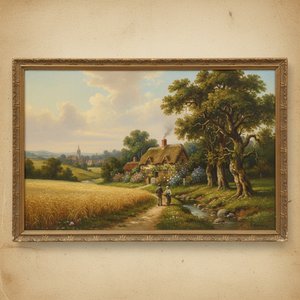
The scene depicted in "At Elmore, Gloucester" is one of serenity and tranquility. A couple, with a woman holding a baby, is seen walking towards a house or farm building, surrounded by animals such as dogs, horses, and cows. The presence of birds flying overhead adds to the sense of peace and harmony that pervades the atmosphere. This painting is a testament to Edward Smith's skill in capturing the beauty of everyday life.Other Notable Works by Edward Smith
Some of Edward Smith's other notable works include River Scene with Anglers, the Leadon, Gloucestershire, Southgate Street, Gloucester, and The Quay and Docks, Gloucester, 1878. These paintings can be found on OriginalUniqueArt.com, where art enthusiasts can discover and purchase handmade oil painting reproductions of these masterpieces.- Handmade oil painting reproductions of "At Elmore, Gloucester" and other works by Edward Smith are available on OriginalUniqueArt.com.
- The Museum of Gloucester is home to an impressive collection of artworks, including those by Edward Smith.
- For more information on Edward Smith and his works, visit OriginalUniqueArt.com's artist page.
The captivating scene depicted in "At Elmore, Gloucester" is a testament to Edward Smith's skill as an artist and his ability to capture the essence of rural life in the late 19th century.
В кой музей се намира At Elmore, Gloucester?
Museum of Gloucester
Глостър, United Kingdom
Викторианско убежище на историята и изкуството: Разкриване на съкровищата на Глостър Разположен в величествена викторианска сграда, вписана в списъка на паметниците от II степен — първоначално била Залата на паметта на Прайс на Обществото за наука и изкуство на Глостър — Museum of Gloucester предлага необикновено пътуване през времето, което е свидетелство за вечната сила на наследството и художественото изразяване. Завършена през 1893 г. от F.S.


Изображения с висока резолюция на At Elmore, Gloucester

Protected by copyright: these files are for personal reference, not a licence to republish.
Edward Smith, At Elmore, Gloucester (1879), Museum of Gloucester.
Отговори на въпроси относно At Elmore, Gloucester
Къде може да бъде видяно „At Elmore, Gloucester“ на Edward Smith днес?
Оригиналът на „At Elmore, Gloucester“ на Edward Smith се съхранява в Museum of Gloucester, Глостър, United Kingdom. Репродукцията позволява произведението да бъде изложено у дома.
В коя година е създадено „At Elmore, Gloucester“ на Edward Smith?
Създаването на „At Elmore, Gloucester“ на Edward Smith датира от 1879.
Какви са размерите на оригиналната творба "At Elmore, Gloucester"?
Размерите на оригиналната творба „At Elmore, Gloucester“ на Edward Smith са 31 x 46 cm. Репродукции могат да бъдат поръчани в други размери, като се запазват същите пропорции.
Намира ли се „At Elmore, Gloucester“ на Edward Smith в обществено достояние?
Що се отнася до авторското право, „At Elmore, Gloucester“ е в все още е защитено с авторско право.
Кой е създал "At Elmore, Gloucester"?
„At Elmore, Gloucester“ е създадена от Edward Smith. Информацията на тази страница описва оригиналната творба на Edward Smith.
Намира ли се "At Elmore, Gloucester" в страната на своя създател?
Не – произведението се намира в чужбина. Родината на Edward Smith е Kingdom of Great Britain, а оригиналът на „At Elmore, Gloucester“ се съхранява в музей в United Kingdom.
За художника Edward Smith

Kingdom of Great Britain
Edward Smith
The Visionary Landscapes of Edward Smith Edward Smith (1850 – 1912) stands as a singular figure in Victorian British art, recognized primarily for his monumental canvases depicting mythological scenes—particularly the biblical Flood—and expansive landscapes imbued with an almost unsettling grandeur. While overshadowed by contemporaries like Turner and Constable during his lifetime, Smith’s distinctive style has garnered renewed appreciation in recent decades, cementing his place as a pivotal artist of the era and influencing subsequent generations of painters. His work transcends mere representation; it strives to convey profound emotional resonance and philosophical contemplation, reflecting the anxieties and aspirations of a society grappling with scientific advancements alongside spiritual yearning. Born in Hanley, Staffordshire, Smith’s upbringing amidst a family of potters instilled an appreciation for craftsmanship and detail—traits that would become hallmarks of his artistic practice.
Други творби на Edward Smith
 Market House, Dursley, Gloucestershire1879
 An Angling Party (The Willyams Family at Carnanton )1773
 Edward Rushton (1795–1851)1840
 Spa Grounds, Gloucester1875
Есеи по темата At Elmore, Gloucester
 Alfred I. Glendening: Capturing Rural England's Poetic EssenceExplore the captivating rural landscapes of Alfred I. Glendening, a master of British sporting paintings. Discover his life, artistic style…
 Masterpieces of the Countryside: Top 25 Sir Alfred James Munnings ArtworksImmerse yourself in the vibrant world of Sir Alfred James Munnings. Explore 25 iconic equestrian paintings and English landscapes that defi…
 25 Must-See Masterpieces at the Smithsonian American Art MuseumExplore 25 iconic works from the Smithsonian American Art Museum. From Hopper to O'Keeffe, find museum-quality art on OriginalUniqueArt.com.