

 Представи си го
 Изпрати
 Сподели
 Детайли

 Изтегляне
 Подобни
 Рентгенова снимка
 Слайдшоу
 Статистика
Dealer with jugs
 Oil On Canvas
- WallArt
- Expressionism and Fauvism
 1914
1914 20.0 x 26.0 cm
 Прочетете повече
Ръчно изработена маслена репродукция
Ръчно рисувана маслена картина върху платно във вашия размер и рамка, изработена по поръчка от нашите художници. ( Превключване към принт Превключване към дигитално изображение)




P118B $10

P118H $10

P118W $10

P438Z $10

P508JH $12

P508YH $12

P805H $10

P805Z $10

P919BZ $10

P919G $10

P919XJ $10

P959ZH $10

P968JZ $12

W106C $8

W218G $10

W218JH $8

W218Y $10

W307PJ $10

W316G $10

W316PJ $8

W316Y $10

W398PJ $8

W4111J $10

W500HY $15

W500JH $15

W692G $12

W849H $8

W940BG $15

W953PJ $8




Изберете от предварително зададените размери, които съответстват на оригиналните пропорции на произведението.

Можете да въведете свои собствени размери, за да пасне на конкретна рамка или пространство. Ако избраният от вас размер не съответства на пропорциите на оригиналното изображение, ние ще изрежем произведението или ще удължим картината с допълнителни ръчно рисувани елементи. Дигитален макет ще бъде изпратен за ваше одобрение преди започване на производството.
Моля, обърнете внимание, че прегледът на екрана не отразява действителното изрязване или разширяване. Само макетът ще покаже точно финалния състав.
Въпреки че са налични персонализирани размери, препоръчваме да изберете размер от предварително дефинирания списък, за да запазите оригиналните пропорции.
След поръчка, екипът на OriginalUniqueArt.com ще изпрати имейл на клиента за инструкции и ще предостави преглед на макет.
Доставка по целия свят () в рамките на 3/4 седмици вместо стандартните 5 седмици. (11 Септември). Без компромис с качеството.

Безплатна експресна доставка по целия свят

Висококачествено ленено платно

Пълно застраховане при доставка

Гаранция за възстановяване на митнически такси

Гаранция за цветова точност

Политика за връщане в рамките на 100 дни (само при дефекти)

100% Гаранция за връщане на парите

Предложение за отстъпка при поръчка на едро
 Стъклото е налично само в размери под 110 см

Dealer with jugs
Репродукционен метод
Размер на репродукцията
-


Обща цена
$ 300
August Macke’s “Dealer with Jugs”: A Window into Expressionist Intimacy
- The watercolor painting "Dealer with Jugs," created in 1914 by August Macke, is more than just a depiction of a shopkeeper and his wares; it's a potent distillation of the burgeoning Expressionist movement’s fascination with raw emotion and subjective experience. Measuring a modest 20 x 26 cm, this piece immediately draws the viewer into its surprisingly complex composition – a busy tableau of vases, jugs, and a solitary figure rendered with an almost unsettling intensity. Macke, tragically cut short at the beginning of World War I, was already a pivotal voice in German art, and “Dealer with Jugs” exemplifies his unique ability to translate personal feeling into visual form.
- Macke’s artistic lineage is fascinatingly layered. While deeply rooted in Impressionism and Post-Impressionism – particularly the vibrant color palettes of Fauvism – he pushed beyond mere representation, employing bold brushstrokes and a deliberate flattening of perspective to convey an emotional urgency. The warm hues dominating the scene – ochres, reds, and yellows – aren’t simply decorative; they evoke a sense of intimacy, warmth, and perhaps even a quiet melancholy. This careful manipulation of color is key to understanding Macke's artistic intent.
Style and Technique: A Fauvist Echo with Expressionist Depth
- The painting’s technique is characterized by loose, gestural brushwork, a hallmark of both Fauvism and the early Expressionists. Macke doesn't meticulously render each vase or jug; instead, he uses broad strokes to suggest form and texture, creating a sense of movement and energy within the scene. The composition itself feels deliberately unbalanced, contributing to the painting’s overall feeling of unease and intensity – a common thread in Expressionist art.
- Notice the deliberate lack of traditional perspective. Macke prioritizes emotional impact over realistic representation, placing the viewer directly into the dealer's world. This flattening of space forces us to confront the scene head-on, amplifying its psychological effect. The artist’s use of watercolor further enhances this impression, allowing for subtle gradations of color and a luminous quality that adds to the painting’s ethereal feel.
Historical Context and Symbolism
- Created in 1914 – a year of immense political and social upheaval – “Dealer with Jugs” reflects the anxieties and uncertainties of the era. The seemingly mundane subject matter—a simple shopkeeper and his merchandise—becomes imbued with symbolic weight, perhaps representing the fragility of everyday life in the face of impending conflict. Macke’s focus on the individual within a crowded scene speaks to the growing sense of alienation felt by many during this period.
- The arrangement of the vases and jugs themselves is significant. They aren't merely objects; they are presented as symbols of abundance, value, and perhaps even the fleeting nature of material possessions. The variety in size and shape adds to the painting’s visual complexity and reinforces its sense of dynamism.
Owning a Piece of Art History
- Handmade oil painting reproductions of August Macke's “Dealer with Jugs” are available on OriginalUniqueArt.com, offering art enthusiasts the opportunity to acquire a stunning piece of art history. These meticulously crafted reproductions capture the essence of Macke’s original work, allowing you to bring this captivating artwork into your home or office.
- For more information about August Macke and his artistic legacy, visit OriginalUniqueArt.com's artist page. Explore a wider collection of Macke’s paintings, including “Garden on Lake Thun” and “Tunis landscape with a sedentary Arabs,” also available as high-quality reproductions.
Биография на художника
A Life Cut Short: The Vibrant World of August Macke
August Robert Ludwig Macke, a name now inextricably linked to the brief but intensely vibrant flowering of German Expressionism, lived a life tragically curtailed by the horrors of the First World War. Born in 1887 in Meschede, a small town nestled within the Westphalian countryside, his artistic journey was one of rapid evolution and profound exploration – a relentless pursuit of capturing not just what he *saw*, but how he *felt* about the world around him. Macke’s early years were marked by a restless spirit and an insatiable curiosity, leading him to move with his family to Bonn, where he received his initial education and began to nurture his burgeoning talent. Despite being formally trained at the Düsseldorf Art Academy from 1904-1906 under Adolf Maennchen, it was through independent study, travel, and a deep engagement with contemporary artistic movements that his unique voice truly began to emerge. These formative years were characterized by an absorption of Impressionist and Post-Impressionist techniques – not merely as imitation, but as a foundation upon which he would build his own distinctive style. He supplemented his income through stage design work, honing his compositional skills and developing a keen eye for color and light, essential tools in his future artistic endeavors.Influences and Artistic Development: A Synthesis of Styles
Macke’s artistic trajectory was profoundly shaped by encounters with key figures and movements that defined the early 20th century. The pivotal moment arrived in Paris in 1912, where he met Robert Delaunay, a leading proponent of Orphism – a branch of Cubism focused on pure abstraction and the ecstatic harmony of color. This encounter proved transformative, introducing Macke to the revolutionary concept of *simultaneous contrast* – the idea that colors can influence each other’s perception, creating dynamic visual effects. He began experimenting with broken planes of color, fragmented forms, and a deliberate rejection of traditional perspective, seeking to convey not just what he saw, but how he *felt* about it. Simultaneously, his close friendship with Franz Marc, a fellow artist and a central figure in the influential group Der Blaue Reiter (The Blue Rider), drew him into the orbit of Wassily Kandinsky and other avant-garde thinkers. While Macke’s style remained distinct from Kandinsky's more purely abstract explorations – he retained a grounding in representational form – he embraced the group’s spirit of artistic freedom, spiritual inquiry, and their belief in art as a vehicle for expressing profound emotions. The influence of Henri Matisse, whose bold use of color and simplified forms captivated Macke during his visits to Paris in 1909, further shaped his approach, encouraging him to embrace brighter, more expressive hues and broad brushstrokes. He also absorbed elements from Fauvism – the deliberate use of non-naturalistic colors for emotional impact – and Futurism’s emphasis on dynamism and movement.The Blue Rider and Beyond: A Unique Expressionist Vision
As an integral member of Der Blaue Reiter, Macke contributed significantly to the group's exhibitions and publications, helping to disseminate its radical ideas about art and spirituality. However, he wasn’t simply a follower; he forged his own unique path within the movement. Unlike some of his colleagues who leaned towards darker, more angst-ridden themes – often reflecting the anxieties of the time – Macke consistently sought to portray beauty and harmony in the world around him. His paintings, such as *Bathing Girls with Town in the Background*, exemplify this approach – vibrant colors, simplified forms, and a sense of idyllic tranquility characterize his work. He masterfully blended elements from Fauvism, Cubism, and Futurism into a distinctly personal style, creating compositions that are both visually striking and emotionally resonant. *Woman in a Green Jacket*, painted in 1913, is another prime example – a portrait radiating warmth and vitality through its bold color palette and confident brushwork. He wasn’t interested in depicting the suffering of war or the despair of modern life; instead, he focused on capturing moments of joy, connection, and beauty—the simple pleasures of everyday existence. His later works, like *Türkisches Café*, demonstrate his luminist approach – a subtle exploration of light and shadow that imbues his scenes with an almost dreamlike quality.Major Achievements and Artistic Style
Macke’s artistic style can be described as a remarkably personal synthesis of various influences. He was particularly adept at capturing the emotional resonance of landscapes, often depicting them in broad, luminous washes of color – a technique he developed through observation of Impressionist masters like Monet and Pissarro. His use of line was equally distinctive: strong, confident strokes that conveyed both energy and stability. He avoided the rigid geometric forms of Cubism, instead favoring more fluid, organic shapes that seemed to pulse with life. Macke’s work is characterized by a remarkable sense of optimism—a belief in the inherent beauty of the world and the potential for human connection. This is evident in his depictions of families, children playing, and intimate moments between lovers – scenes imbued with warmth, affection, and a quiet joy. His paintings are not simply representations of reality; they are expressions of feeling, filtered through his unique artistic sensibility. He was also a skilled watercolorist, using the medium to capture fleeting moments of light and color with remarkable delicacy.A Tragic End and Lasting Legacy
The outbreak of World War I brought a sudden and devastating end to Macke’s promising career. Driven by patriotic fervor – a sentiment tragically common among many artists at the time – he volunteered for military service in 1914. Tragically, he was killed in action just weeks later, on September 26th, at the front near Champagne, France, at the young age of 27. His final painting, *Farewell*, poignantly captures the somber mood that descended upon Europe as war engulfed the continent – a haunting image of figures bidding each other farewell against a bleak and desolate landscape. Despite his tragically short life, August Macke left behind a body of work that continues to captivate and inspire. He remains a significant figure in the history of Expressionism, celebrated for his vibrant colors, dynamic compositions, and optimistic vision. His paintings offer a glimpse into a world on the cusp of change – a world grappling with modernity, industrialization, and the looming threat of war—imbued with a sense of beauty and hope amidst growing uncertainty. Exploring his works today reveals an artist who not only captured the spirit of his time but also offered a timeless message of joy, connection, and the enduring power of art to illuminate the human experience.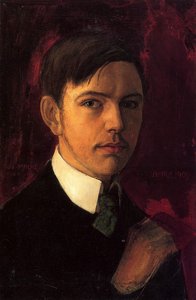
Август Макке
1887 - 1914 , Германия
Бързи факти
- Artistic Movement Or Style: Изразяване
- Artists Or Movements Influenced By This Artist: ['Der Blaue Reiter']
- Artists Who Influenced This Artist:
- Роберт Делаunay
- Франц Марк
- Date Of Birth: 3 януари 1887 г.
- Date Of Death: 26 септ. 1914 г.
- Full Name: August Robert Ludwig Macke
- Nationality: Германец
- Notable Artworks:
- Женско лице в зелено
- Басейни с град на заден план
- Туркско кафене
- Вход към градина
- Place Of Birth: Меседе, Германия
Всички статии

Топ 10 шедьоври на акварела, променили изкуството завинаги | OriginalUniqueArt.com
Разгледайте топ 10 шедьоври на акварела от Turner, Monet и Sargent! Открийте историите зад тези емблематични картини, техниките им и как промениха изкуството. Купете висококачествени репродукции за вашия дом в OriginalUniqueArt.com.
August Macke: Expressionist Visions of Harmony & Modern Life
Explore the vibrant Expressionist paintings of August Macke (1887-1914). Discover his key role in Der Blaue Reiter, Fauvist influences, and captivating depictions of modern life. A comprehensive guide for art enthusiasts & collectors.

Ephemeral Visions: Exploring the History & Emotional Resonance of Watercolor Painting
Explore the captivating history of watercolor painting, from ancient techniques to modern masters like Kandinsky & Blake. Discover essential artists, collecting tips & the emotional power of this luminous medium. Expert insights for art enthusiasts.

Ephemeral Visions: Exploring the Artistic Legacy & Contemporary Practice of Watercolor Painting
Explore the captivating world of watercolor painting! Discover its rich history, essential techniques, influential artists & collecting tips. A comprehensive guide for art enthusiasts from OriginalUniqueArt.
Топ 25 шедьовъра на Ренуар: Красота, светлина и импресионизъм за вашия дом
Разгледайте топ 25 шедьовъра на Ренуар – импресионизъм, светлина и красота във всяка картина! Историята зад творбите, техниките и емоциите. Купете висококачествени репродукции на картини от Ренуар за вашия дом в OriginalUniqueArt.com.


