Превключване към принт
 Прочети повече







































 За произведения на изкуството или репродукции, чийто размер е над 105 см (приблизително 41 инча) във всяка страна, рамката ще бъде изпратена в разглобен вид като комплект за сглобяване. Този метод гарантира безопасна доставка и предотвратява повреди по време на транспортиране.


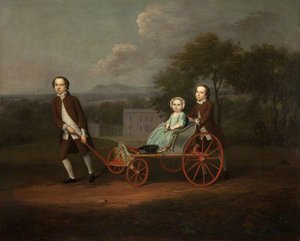
Thomas Hunt III (1721–1788): A Portrait of Dignified Reflection
Arthur William Devis’s “Thomas Hunt III” stands as a quintessential example of the conversation piece—a genre that flourished in Georgian England and captured the spirit of its age. Executed around 1743, this oil painting transcends mere likeness; it embodies an idealized vision of gentlemanly virtue and intellectual pursuits, reflecting the values championed by the Enlightenment.
The subject himself is presented with remarkable composure—Thomas Hunt III, a prominent barrister and landowner, occupies center stage within a richly appointed interior. Devis skillfully employs linear perspective to establish depth, guiding the viewer’s gaze across the room towards a distant windowpane. The muted palette of browns, blacks, and whites contributes to an atmosphere of solemn dignity, mirroring the seriousness of Hunt’s expression.
- Composition: Devis’s masterful arrangement emphasizes Hunt's figure against a backdrop of wooden paneling and windows, creating a sense of contained grandeur.
- Technique: The artist demonstrates meticulous attention to detail through visible brushstrokes—a hallmark of traditional oil painting—allowing texture to convey the materiality of fabric and wood surfaces.
- Lighting: Light emanates from the left side of the canvas, casting subtle shadows that accentuate Hunt’s form and imbue the scene with warmth and dimension.
- Style: Rooted in classical portraiture, “Thomas Hunt III” adheres to conventions established by artists like Rembrandt and Rubens, prioritizing realism and conveying an inner psychological state.
Beyond its technical prowess, the painting resonates with symbolic significance. Hunt’s posture—seated at a desk with a book in his left hand—represents erudition and moral responsibility – ideals central to Georgian society. The inclusion of classical motifs—such as the urn—references humanist philosophy and elevates Hunt's status within the intellectual landscape.
“Thomas Hunt III” continues to captivate viewers today not only for its aesthetic beauty but also for its ability to transport us back to a pivotal moment in British history. It serves as a testament to Devis’s artistic vision and his enduring legacy as one of England's most celebrated portraitists.
Въпроси и отговори
Как се препоръчва да бъде отпечатана творбата "Thomas Hunt III (1721–1788)" – какъв размер и каква ориентация?
Препоръчителният размер за печат на „Thomas Hunt III (1721–1788)“ на Артур Уилям Девис е Large с ориентация Portrait.
Какъв е препоръчителният размер за печат на "Thomas Hunt III (1721–1788)"?
За произведението „Thomas Hunt III (1721–1788)“ се препоръчва печат с размер Large. Налични са и други размери със същите пропорции.
Мога ли да видя „Thomas Hunt III (1721–1788)“ на Артур Уилям Девис под различно осветление?
„Thomas Hunt III (1721–1788)“ може да бъде разгледан слой по слой на страницата Рентгенови лъчи на произведението – интерактивен преглед, вдъхновен от светлинната маса на реставратор, предлагащ единадесет оптични слоя на изображението.
 Преглед в реален мащаб
 Изпрати
 Сподели
 Детайли
 Ръководство

 Изтегляне
 Подобни артикули
 Рентгенова снимка
 Слайдшоу
 Q&A
Q&A Статистика