

 Преглед в реален мащаб
 Сподели
 Сподели
 Подробности
 Ръководство

 Изтегляне
 Подобни артикули
 Рентгенова снимка
 Слайдшоу
 Статистика
Misty Moonlight
 Oil On Canvas
- WallArt
- Tonalism & Symbolism
 1885
1885- 19th Century
 28.0 x 29.0 cm
 Crystal Bridges Museum of American Art
 Разгърни целия текст
Жикле / Художествен принт
Giclée печат или принт върху платно с музейно качество, бързо производство и гъвкави опции за завършен вид. ( Поръчайте ръчно рисувано репродукция на този колекционерски предмет Превключване към дигитално изображение)




P118B €10

P118H €10

P118W €10

P438Z €10

P508JH €12

P508YH €12

P805H €10

P805Z €10

P919BZ €10

P919G €10

P919XJ €10

P959ZH €10

P968JZ €12

W106C €8

W218G €10

W218JH €8

W218Y €10

W307PJ €10

W316G €10

W316PJ €8

W316Y €10

W398PJ €8

W4111J €10

W500HY €15

W500JH €15

W692G €12

W849H €8

W940BG €15

W953PJ €8




Изберете от нашите предварително зададени размери, които съответстват на оригиналните пропорции на произведението.

Въведете необходимата ширина и височина, за да паснат на вашата рамка или стена. Принтовете могат само да се изрязват, но никога не могат да бъдат по-големи от оригиналната картина, така че при размер с различен формат част от изображението ще бъде загубена. Преди да започнем печат, ще ви изпратим дигитален мок업 за одобрение. Изображението, показано на тази страница, не показва реалното изрязване — само мок업ът го показва.
Доставка по целия свят () в рамките на 2 седмици вместо стандартните 4/5 седмици. (25 Октомври)

Безплатна експресна доставка по целия свят

Висококачествено ленено платно

Пълно застраховане на доставката

Гаранция за възстановяване на митнически такси

Гаранция за пълно съответствие на цветовете

Политика за връщане в рамките на 100 дни (само при дефекти)

100% Гаранция за връщане на сумата

Отстъпка при поръчка на повече произведения
 Опцията със стъкло е налична само за размери под 110 см

Misty Moonlight
Жикле / Художествен принт
Размер на репродукцията
-


Крайна цена
€ 70
A Nocturne of Shadows and Light
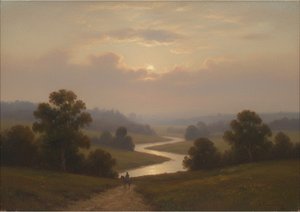
In the quietude of the late nineteenth century, few artists captured the ephemeral essence of the American night as profoundly as Albert Pinkham Ryder. His masterpiece, Misty Moonlight (1885), serves as a hauntingly beautiful window into the soul of Tonalism, offering much more than a mere depiction of a seascape. The painting presents a serene yet melancholic vision of a nocturnal world, where a solitary sailing ship drifts through a sea of deep blacks and greenish grays. A luminous crescent moon hangs suspended in the hazy atmosphere, casting a soft, ethereal glow that seems to dissolve the boundaries between the water and the sky. This is not a scene of action, but one of profound stillness, inviting the viewer into a state of meditative contemplation.
The emotional resonance of this work lies in its ability to evoke a sense of mystery and longing. The sparse composition—a delicate dance of geometric forms including the rectangular expanse of the sea, the triangular silhouette of the vessel, and the circular moon—prevents any specific narrative from taking hold. Instead, the viewer is left to wander through the artist's dreamscape, feeling the weight of the heavy, damp air and the rhythmic, silent pulse of the tide. For the collector or interior designer, this piece offers a sophisticated anchor for a room, providing a focal point that commands attention through subtlety rather than spectacle.
The Alchemy of Unconventional Technique
To understand the mesmerizing texture of Misty Moonlight, one must look closely at Ryder’s radical approach to the medium. Eschewing the polished, academic precision favored by his contemporaries, Ryder embraced a method of deliberate instability. He was known for applying successive layers of oil paint while the underlying coats were still wet, a technique that allowed colors to bleed and merge in unpredictable ways. This process created the "gauzy" and atmospheric quality that defines his most celebrated works.
This layering does more than just create visual depth; it imbues the canvas with a physical materiality that feels alive. The resulting surface is often thick and textured, capturing light in a way that mimics the shifting mists of a coastal night. This mastery of atmosphere—achieved through what some might call "controlled chaos"—is precisely what makes a high-quality reproduction of this work so captivating. When rendered with care, the interplay of dark tones and soft highlights can transform a modern living space into a sanctuary of historical depth and artistic intrigue.
A Legacy of Symbolism and Inspiration
Ryder’s inspiration was deeply rooted in his formative years in New Bedford, Massachusetts, a bustling whaling port where the sea was an ever-present character in daily life. The maritime motifs found in Misty Moonlight are not merely decorative; they are echoes of a childhood spent amidst salt spray and moonlight. This connection to the American coast lends the painting an authentic, grounded spirit, even as it drifts into the realms of Symbolism.
As a pioneer of American Symbolism, Ryder used the landscape to represent internal emotional states. The ship, often a recurring motif in his oeuvre, can be seen as a symbol of the human journey through the unknown, navigating the murky waters of existence under the watchful eye of a distant, celestial light. For those seeking to decorate with purpose, incorporating such a piece allows for the introduction of profound storytelling into an environment. It is an invitation to look beyond the surface and find beauty in the shadows, making it an enduring choice for any curated collection of fine art.
Въпроси и отговори
Каква цветова хармония демонстрира „Misty Moonlight“ на Алберт Пинкъм Райдер?
„Misty Moonlight“ на Алберт Пинкъм Райдер демонстрира Unified Palette цветова хармония.
Кой цвят доминира в композицията на „Misty Moonlight“ на Алберт Пинкъм Райдер?
Доминиращият цвят на „Misty Moonlight“ на Алберт Пинкъм Райдер е Phthalo Green (#2d2c27).
Каква е наситеността на цветовете в „Misty Moonlight“ на Алберт Пинкъм Райдер?
„Misty Moonlight“ на Алберт Пинкъм Райдер е заснето с Subtle Color наситеност.
Биография на художника
Early Life and Artistic Beginnings
Albert Pinkham Ryder, born March 19, 1847, in New Bedford, Massachusetts, remains a somewhat enigmatic figure in American art history. Details of his childhood are scarce, shrouded in the mists that would later become so characteristic of his paintings. However, it is known that he began to explore his artistic inclinations early on, capturing the landscapes of his native New Bedford with nascent skill. This coastal upbringing, steeped in the atmosphere of a bustling whaling port, undoubtedly left an indelible mark on his imagination and would resurface throughout his career as a recurring source of inspiration.Little is documented about Ryder’s formative years. He was born into a family of Methodists who adhered to strict Quaker traditions regarding women's dress. His paternal grandparents resided in Cape Cod, where the seafaring heritage profoundly shaped his worldview.
From an early age, Ryder demonstrated an aptitude for drawing and painting—activities he pursued independently before formal artistic training began.
Formal Training and European Influences
Ryder’s formal art education commenced with studies under William Edgar Marshall in New York City. He subsequently enrolled at the National Academy of Design between 1870 and 1875, where he debuted his work in 1873 and forged a lifelong friendship with fellow artist Julian Alden Weir. These formative years provided him with a solid foundation in traditional techniques and introduced him to the established art world.However, Ryder’s artistic vision transcended conventional academic boundaries. Between 1877 and 1903, he undertook four expeditions to Europe—to Paris, London, Holland, and Belgium—immersing himself in the artistic currents of the Old World. He was particularly captivated by the French Barbizon school, which championed naturalism and plein air painting, and the Dutch Hague School, renowned for its atmospheric landscapes and muted color palettes.
These influences profoundly shaped Ryder’s aesthetic sensibilities, contributing to the development of his distinctive style—characterized by expansive brushstrokes, luminous tonal harmonies, and a preoccupation with spiritual themes.
A Unique Artistic Vision: Style and Themes
Ryder's artistic signature is instantly recognizable—a captivating blend of Symbolism, Tonalist Influences, and a deeply personal vision. His paintings are not mere representations of reality but rather evocative interpretations of nature infused with mood, mystery, and spiritual resonance.He favored broad, often ill-defined shapes and stylized figures set within dreamlike landscapes or seascapes, creating an atmosphere that is both ethereal and haunting. Light plays a crucial role in Ryder’s work—often depicted as diffuse and melancholic—illuminating his scenes with dim sunlight filtering through eerie clouds or the soft glow of moonlight.
Ryder skillfully manipulated color to create subtle variations and atmospheric effects, frequently employing a limited palette to maximize emotional impact. His paintings are imbued with symbolism—references to mythology and religious iconography—reflecting his profound engagement with spiritual ideas.
Major Achievements and Legacy
Ryder achieved considerable acclaim during his lifetime for his visionary landscapes and seascapes. Critics recognized his ability to convey complex emotions through understated visual language, establishing him as a pivotal figure in American Symbolist art.
Notable works such as Misty Moonlight—inspired by his childhood memories of coastal New Bedford—exemplify Ryder’s capacity to transform personal experiences into universal expressions of longing and contemplation. Other significant paintings, like Siegfried & The Rhine Maidens, demonstrate his fascination with mythology and symbolism.
His influence extended beyond his immediate contemporaries; Jackson Pollock acknowledged Ryder as a precursor to Abstract Expressionism—a testament to Ryder’s enduring legacy as an innovator who reshaped the contours of American art history.
Ryder passed away on March 28, 1917, leaving behind a body of work that continues to captivate audiences today. A memorial exhibition held at the Metropolitan Museum of Art in New York in 1918 solidified his reputation as a major figure in American art.

Алберт Пинкъм Райдер
1847 - 1917 , Съединени американски щати
Бързи факти
- Artistic Movement Or Style: Тонализъм и Символизъм
- Artists Who Influenced This Artist:
- Уилям Еджър Маршал
- Дж. Алден Уейр
- Date Of Birth: Марч 19, 1847
- Date Of Death: Марч 28, 1917
- Full Name: Albert Pinkham Ryder
- Nationality: Американски
- Notable Artworks:
- Мъглист Лунна Светлина
- Сигифрид и Рейнската Девойка
- Place Of Birth: Ню Бърдфорд, САЩ
Свързани статии

Топ 10 шедьоври на Американския реализъм: Изкуство за вашия дом от OriginalUniqueArt
Разгледайте топ 10 шедьоври на Американския реализъм – Хопър, Едуард Хомър и други. Открийте историите зад картините, техниките и емоциите им. Купете висококачествени репродукции за вашия дом в OriginalUniqueArt.com!

Grant Wood & American Regionalism: Identity, Myth & the Rural Landscape
Explore the world of Grant Wood & American Regionalism with OriginalUniqueArt. Discover the symbolism behind 'American Gothic', recurring themes, and the movement's lasting impact on art history. High-quality reproductions available.
Atmospheric Visions: Exploring Tonalism in American Painting
Explore the captivating world of American Tonalism! Discover its history, key artists like Whistler & Inness, techniques, and lasting influence on art. Expert insights for collectors & enthusiasts.

Albert Bierstadt: Luminosity, Landscape & the American Ideal
Explore the breathtaking landscapes of Albert Bierstadt, master of the American West & a leading figure in the Hudson River School. Discover his luminous style and iconic paintings – a timeless investment for art lovers.

American Regionalism: A Crucible of Identity – Exploring Themes of Place, Labor & Social Commentary
Explore American Regionalism's powerful depiction of the American heartland during the Great Depression. Discover Grant Wood, Thomas Hart Benton & more. Expert analysis & high-quality art reproductions at OriginalUniqueArt.
