

 Преглед в реален мащаб
 Сподели
 Сподели
 Подробности
 Ръководство

 Изтегляне
 Подобни артикули
 Рентгенова снимка
 Слайдшоу
 Статистика
René Vallery-Radot


 Разгърни целия текст
Жикле / Художествен принт
Giclée печат или принт върху платно с музейно качество, бързо производство и гъвкави опции за завършен вид. ( Поръчайте ръчно рисувано репродукция на този колекционерски предмет Превключване към дигитално изображение)




P118B €10

P118H €10

P118W €10

P438Z €10

P508JH €12

P508YH €12

P805H €10

P805Z €10

P919BZ €10

P919G €10

P919XJ €10

P959ZH €10

P968JZ €12

W106C €8

W218G €10

W218JH €8

W218Y €10

W307PJ €10

W316G €10

W316PJ €8

W316Y €10

W398PJ €8

W4111J €10

W500HY €15

W500JH €15

W692G €12

W849H €8

W940BG €15

W953PJ €8




Изберете от нашите предварително зададени размери, които съответстват на оригиналните пропорции на произведението.

Въведете необходимата ширина и височина, за да паснат на вашата рамка или стена. Принтовете могат само да се изрязват, но никога не могат да бъдат по-големи от оригиналната картина, така че при размер с различен формат част от изображението ще бъде загубена. Преди да започнем печат, ще ви изпратим дигитален мок업 за одобрение. Изображението, показано на тази страница, не показва реалното изрязване — само мок업ът го показва.
Доставка по целия свят () в рамките на 2 седмици вместо стандартните 4/5 седмици. (26 Октомври)

Безплатна експресна доставка по целия свят

Висококачествено ленено платно

Пълно застраховане на доставката

Гаранция за възстановяване на митнически такси

Гаранция за пълно съответствие на цветовете

Политика за връщане в рамките на 100 дни (само при дефекти)

100% Гаранция за връщане на сумата

Отстъпка при поръчка на повече произведения
 Опцията със стъкло е налична само за размери под 110 см

René Vallery-Radot
Жикле / Художествен принт
Размер на репродукцията
-


Крайна цена
€ 70
The Canvas as a Window: Albert Edelfelt’s Portrait of René Vallery-Radot
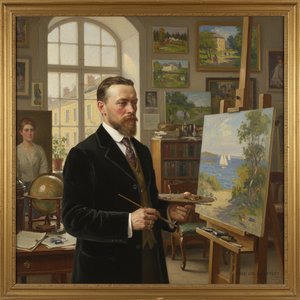
Albert Edelfelt's 1888 painting, “Portrait of René Vallery-Radot,” isn’t merely a likeness; it’s a carefully constructed tableau that speaks volumes about the man himself and the era in which he lived. Within the confines of a modestly sized canvas—measuring just over 45 by 31 centimeters—Edelfelt has captured not simply a face, but an entire life subtly interwoven with intellectual curiosity and familial devotion. The painting immediately draws the eye to René Vallery-Radot himself, seated at his desk, bathed in the soft glow of diffused light. His posture is relaxed yet attentive, suggesting a man deeply absorbed in thought – perhaps reviewing research notes or contemplating the implications of his scientific work alongside his role as husband and father.
Edelfelt’s masterful technique reveals a deliberate balance between realism and impressionistic sensitivity. He employs a meticulous attention to detail, evident in the rendering of René's features—the thoughtful furrow of his brow, the subtle lines around his eyes, and the precise brushstrokes defining his mustache. Yet, he avoids a photographic likeness, instead opting for a looser, more atmospheric approach to color and light. The background is deliberately muted, allowing the focus to remain firmly on the subject, while still hinting at the domestic setting—a testament to Edelfelt’s ability to capture not just what is seen but also the essence of a scene.
A Life in Science and Family: Contextualizing the Portrait
To fully appreciate “Portrait of René Vallery-Radot,” it's crucial to understand the context surrounding his life. René Vallery-Radot was a prominent figure in the scientific community, renowned for his work alongside Louis Pasteur in establishing pasteurization—a process that revolutionized food preservation and public health. He wasn’t simply an assistant; he played a vital role in developing and refining this groundbreaking technique. Simultaneously, he was a devoted husband to Marie-Louise Pasteur (Louis Pasteur's daughter) and a loving father to three children. Edelfelt skillfully portrays these dual roles—the scientist and the family man—without resorting to simplistic stereotypes.
The painting’s composition subtly reinforces this duality. The desk, laden with books, immediately establishes René’s intellectual pursuits. However, the inclusion of a small child's toy – a simple wooden horse – nestled amongst the scholarly volumes hints at his familial responsibilities and the joys of family life. This juxtaposition speaks to the harmonious balance he sought between his scientific endeavors and his personal relationships.
Symbolism and Emotional Resonance
Beyond its straightforward depiction, “Portrait of René Vallery-Radot” is rich in symbolic detail. The books on the desk represent knowledge, learning, and intellectual legacy—a direct reflection of René’s contributions to science. The muted colors and soft lighting evoke a sense of quiet contemplation and domestic tranquility. There's an underlying feeling of warmth and stability, suggesting a man grounded in his family and deeply committed to his work. The careful arrangement of the objects on the desk – from the inkwell to the writing implements—creates a visual rhythm that draws the eye inward, inviting the viewer to share in René’s focused attention.
Furthermore, the painting can be interpreted as a celebration of the Victorian ideal of domesticity. While acknowledging the scientific advancements of the era, Edelfelt subtly emphasizes the importance of family and intellectual pursuits within a stable home environment. It's a portrait that speaks to the values of hard work, dedication, and familial love—qualities highly esteemed in 19th-century society.
A Timeless Masterpiece: Reproductions and Artistic Legacy
Albert Edelfelt’s “Portrait of René Vallery-Radot” remains a captivating work of art, offering a glimpse into the life of a remarkable scientist and devoted family man. Reproductions of this painting are available in various sizes and formats, allowing art enthusiasts to bring this evocative image into their homes or offices. Whether displayed as a statement piece in a study or a thoughtful addition to a living room, this portrait continues to resonate with its quiet dignity, intellectual depth, and subtle emotional power—a testament to Edelfelt’s enduring artistic legacy.
Въпроси и отговори
Използва ли „René Vallery-Radot“ на Алберт Еделфелт силни контрасти или меки хармонии?
В „René Vallery-Radot“ Bold контрастът е съчетат с Strong Color Unity хармония.
Къде мога да купя дигитален образ на „René Vallery-Radot“ на Алберт Еделфелт?
За да получите цифров файл на „René Vallery-Radot“ на Алберт Еделфелт, поръчайте дигитално изтегляне на изображение с висока резолюция на неговата страница Дигитален образ.
В коя стая се препоръчва да бъде изложена "René Vallery-Radot", като се вземе предвид нейната палитра?
Цветовете от Earthy палитрата на „René Vallery-Radot“ на Алберт Еделфелт се гарнират с препоръчаното пространство: Living Room.
Биография на художника
Albert Edelfelt – Pioneer of Finnish Realism
Albert Gustaf Aristides Edelfelt (1854–1905) stands as one of Finland’s most celebrated artists, recognized for his unwavering commitment to realism and his profound ability to capture the spirit of his homeland through vivid depictions. Born in Porvoo, Sweden, on July 21st, 1854, Edelfelt descended from a Swedish-speaking aristocratic lineage – his father, Carl Albert Edelfelt, was an architect who had established himself in Finland since his youth, and his mother, Alexandra Edelfeldt née Brandt, possessed a keen interest in literature and art. Despite facing considerable financial hardships following his father’s untimely death, Alexandra steadfastly encouraged Edelfelt's artistic inclinations, enrolling him at the Drawing School of the Finnish Art Society in Helsinki where he honed his skills under Adolf von Becker’s guidance.- Early Artistic Influences: From a young age, Edelfelt demonstrated an innate talent for drawing and painting, nurtured by his mother's unwavering support. His fascination with art propelled him to pursue formal studies at the Drawing School of the Finnish Art Society in Helsinki and later at the Royal Academy of Fine Arts in Antwerp, Belgium.
- Antwerp Years – Mastering History Painting: In 1873-74, Edelfelt immersed himself in the study of history painting at Antwerp, absorbing the stylistic principles championed by Jean-Léon Gérôme. This formative period solidified his understanding of artistic technique and cemented his dedication to portraying historical narratives with meticulous detail.
- Parisian Breakthrough – Impressionism’s Embrace: Recognizing the dominant influence of Impressionism in Parisian art circles, Edelfelt relocated to Paris in 1874, seeking inspiration from fellow artists like Jules Bastien-Lepage. He embraced plein air painting—capturing landscapes and scenes directly from nature—a stylistic choice that would define his artistic output for years to come.
Notable Works – A Reflection of Finnish Identity
Edelfelt’s oeuvre is characterized by a remarkable sensitivity to the nuances of Finnish culture and landscape, reflecting his deep connection to his homeland. His paintings are not merely aesthetically pleasing; they serve as powerful visual records of Finland's history, traditions, and natural beauty. Among his most iconic creations are:- Portrait of Louis Pasteur (1886): This portrait exemplifies Edelfelt’s mastery of capturing the essence of his subject—Louis Pasteur—a renowned French biologist whose groundbreaking discoveries revolutionized scientific understanding.
- Young Woman in Her Boudoir (circa 1878): Executed with exquisite detail and imbued with a palpable sense of intimacy, this painting portrays a young woman in her private sanctuary, capturing the subtleties of feminine grace and emotion.
- Under the Birches (1883): This landscape masterpiece embodies Edelfelt’s signature style—a harmonious blend of realism and lyrical beauty—depicting a serene Finnish birch grove bathed in dappled sunlight. It is considered one of Finland's most beloved paintings.
- The Inauguration of Turku Academy (1896): Commissioned by the state to commemorate the founding of Turku University, Edelfelt’s monumental fresco showcases his artistic ambition and technical prowess—a testament to his enduring legacy as a Finnish artist.
Influence and Legacy – Shaping Finnish Art
Edelfelt's artistic vision profoundly impacted subsequent generations of Finnish painters, fostering a movement known as Finnish Realism. Artists like Akseli Gallen-Kallela and Gunnar Berndtson acknowledged Edelfelt’s influence, adopting his stylistic approach and exploring themes rooted in Finnish folklore and landscape. His unwavering dedication to portraying the natural world with honesty and sensitivity established him as a cornerstone of Finnish artistic heritage—a figure whose work continues to inspire admiration and scholarly study today.Museum Collections – Preserving Edelfelt's Artistic Heritage
Edelfelt’s paintings are proudly displayed in prominent museums across Finland, including Ateneum Museum in Helsinki, where visitors can immerse themselves in the splendor of his artistic achievements. The Ateneum houses a comprehensive collection of Edelfelt’s works—spanning portraits, landscapes, and genre scenes—providing invaluable insight into his creative process and artistic sensibilities. His legacy is commemorated through various initiatives, including a €100 commemorative coin issued in 2004 to celebrate his 150th birth anniversary – ensuring that Albert Edelfelt's contribution to Finnish art history remains vividly remembered for years to come.
Алберт Еделфелт
1854 - 1905 , Финландия
Бързи факти
- Artistic Movement Or Style: Realist
- Artists Or Movements Influenced By This Artist: ['Akseli Gallen-Kallela']
- Artists Who Influenced This Artist: ['Jean-Léon Gérôme']
- Date Of Birth: July 21, 1854
- Date Of Death: August 18, 1905
- Full Name: Albert Gustaf Aristides Edelfelt
- Nationality: Finnish
- Notable Artworks:
- Portrait of Louis Pasteur
- Young woman in her boudoir
- Under the birches
- Place Of Birth: Porvoo, Finland
Свързани статии

Romantic Realism's Finest: 10 Masterpieces for Your Home | OriginalUniqueArt
Explore 10 defining masterpieces of Romantic Realism! Discover Courbet, Millet & Daumier's powerful paintings—capturing emotion and social realities. Find museum-quality reproductions for your home at OriginalUniqueArt.com.

The Evocative Embrace of Reality: Exploring Romantic Realism in 19th-Century Painting
Explore the captivating world of Romantic Realism! Discover key artists like Courbet & Millet, masterpieces, and the social context behind this influential art movement. Expert insights for collectors at OriginalUniqueArt.
Albert Edelfelt: A Pioneer of Finnish Realism & International Impressionist Circles
Explore the life & work of Albert Edelfelt, a pioneering Finnish Realist painter who bridged Impressionism & national identity. Discover his masterpieces and lasting influence on art history.
Realism in Art: A Professional Guide to Authentic Detail and Lifelike Masterpieces for Large-Scale Interior Projects
Master the use of Realism in professional interiors. This expert guide explores 19th-century masterpieces, offering procurement managers and designers technical insights into selecting authentic, hand-painted oil reproductions for high-end hotel and corporate projects.

Echoes of Society: Exploring Social Realism's Enduring Legacy in Art
Explore the powerful world of Social Realism art! Discover key artists, masterpieces & its profound social commentary. Expert insights into this influential movement's history and enduring legacy.
