

 Преглед в реален мащаб
 Сподели
 Сподели
 Подробности
 Ръководство

 Изтегляне
 Подобни артикули
 Рентгенова снимка
 Слайдшоу
 Статистика
Abstract Painting
 Oil On Canvas
- WallArt
- Abstract Expressionism
 1966
1966- Modern
 31.0 x 31.0 cm
 Музей на модерното изкуство (MoMA)
 Разгърни целия текст
Изкуството, представено на тази страница, е защитено от законите за авторско право, което означава, че не можем законно да създаваме или продаваме идентични репродукции. Тази защита се прилага съгласно международни споразумения като Бернска конвенция и от националното законодателство, включително разпоредбите на Закон за авторското право на САЩ – Раздел 17.
Като уважителна и законна алтернатива, ние предлагаме изработени по поръчка, ръчно рисувани произведения на изкуството, вдъхновени от оригинала. Нашите умени и професионални артисти внимателно изучават стила, настроението и артистичната същност на оригиналното произведение, за да създадат ново, уникално творческо произведение, което предизвиква същото чувство – оставайки в същото време самостоятелно оригинално творение.
Този метод е напълно съвместим с законите за авторско право, тъй като не включва копиране или дублиране на защитеното произведение. Вместо това става въпрос за творческа реинтерпретация – нова картина, която е вдъхновена от оригинала, но не е идентична с него.
Ръчно изработена маслена репродукция
Ръчно рисувана маслена картина върху платно във вашия размер и рамка, изработена по поръчка от нашите художници. ( Избор на принт Превключване към дигитално изображение)




P118B €10

P118H €10

P118W €10

P438Z €10

P508JH €12

P508YH €12

P805H €10

P805Z €10

P919BZ €10

P919G €10

P919XJ €10

P959ZH €10

P968JZ €12

W106C €8

W218G €10

W218JH €8

W218Y €10

W307PJ €10

W316G €10

W316PJ €8

W316Y €10

W398PJ €8

W4111J €10

W500HY €15

W500JH €15

W692G €12

W849H €8

W940BG €15

W953PJ €8




Изберете от нашите предварително зададени размери, които съответстват на оригиналните пропорции на произведението.

Можете да въведете свои собствени размери, за да паснат на конкретна рамка или пространство. Ако избраният от вас размер не съответства на пропорциите на оригиналното изображение, ние ще изрежем произведението или ще разширим картината с допълнителни ръчно рисувани елементи. Дигитален макет ще бъде изпратен за ваше одобрение преди започване на производството.
Моля, обърнете внимание, че предпрогледа на екрана не отразява действителното изрязване или разширяване. Само макетът ще покаже точно финалната композиция.
Въпреки че са налични персонализирани размери, препоръчваме да изберете размер от предварително дефинирания списък, за да запазите оригиналните пропорции.
След получаване на поръчка, екипът на OriginalUniqueArt.com ще изпрати имейл до клиента с инструкции и ще предостави примерен макет за преглед.
Доставка по целия свят () в рамките на 3-4 седмици вместо стандартните 5 седмици. (8 Октомври). Без компромис с качеството.

Безплатна експресна доставка по целия свят

Висококачествено ленено платно

Пълно застраховане на доставката

Гаранция за възстановяване на митнически такси

Гаранция за пълно съответствие на цветовете

Политика за връщане в рамките на 100 дни (само при дефекти)

100% Гаранция за връщане на сумата

Отстъпка при поръчка на повече произведения
 Опцията със стъкло е налична само за размери под 110 см

Abstract Painting
Техника на репродукция
Размер на репродукцията
-


Крайна цена
€ 258
The Architecture of Silence: Ad Reinhardt’s Monochromatic Vision
To stand before Ad Reinhardt’s 1966 Abstract Painting is to enter a realm where the noise of the modern world dissolves into a profound, meditative stillness. This work, a masterclass in reductive abstraction, does not seek to represent the external world but rather to exist as an end in itself. At first glance, the viewer is met with a monumental black square that dominates the canvas, a void so deep it seems to pull the gaze inward. Yet, upon closer inspection, this is not merely a flat expanse of darkness. Through a meticulous application of oil paint, Reinhardt has layered subtle gradations and textures that catch the light in unexpected ways, revealing a hidden topography of grey and charcoal tones. The thin, pale beige border acts as a quiet threshold, a delicate frame that emphasizes the weight and presence of the central dark form, creating a sense of balanced tension between the void and the edge.
The technique employed here is one of extreme discipline, reflecting Reinhardt’s radical pursuit of what he termed "Art-as-Art." Moving away from the emotive turbulence of Abstract Expressionism, Reinhardt sought to strip away all traces of subjectivity, biography, and illusion. His process involved a uniform layering of pigment that prioritizes the inherent qualities of the medium over any representational goal. There are no sweeping gestures or dramatic highlights to distract the eye; instead, the beauty lies in the subtle manipulation of surface texture and the interplay of near-invisible tonal shifts. This approach transforms the canvas into a tactile object, where the very substance of the oil paint becomes the subject, inviting a slow, rhythmic engagement from anyone fortunate enough to contemplate it.
A Legacy of Purest Essence
Historically, this painting represents the pinnacle of Reinhardt’s "ultimate" period, a time when he believed he was approaching the final, most perfected stage of painting. Influenced by the philosophical rigor of thinkers like Heidegger and Wittgenstein, Reinhardt viewed the act of painting as a monastic endeavor—a rejection of the superficial in favor of the essential. By eliminating recognizable figures, landscapes, or even vibrant colors, he challenged the viewer to confront pure visual sensation. This period of his work serves as a bridge between the expressive energy of the mid-century and the austere intellectualism of Minimalism, making it a cornerstone of post-war American art history.
For the discerning collector or interior designer, this piece offers more than just aesthetic value; it provides an emotional anchor for a space. The painting’s ability to evoke both mystery and peace makes it a versatile yet commanding presence in any sophisticated environment. Whether placed in a minimalist gallery setting or used as a focal point in a contemporary living space, the work radiates a sense of timelessness and authority. It is a piece that does not demand attention through loudness, but rather commands respect through its unwavering, quiet strength—a true masterpiece of monochromatic meditation.
Въпроси и отговори
На кой художник се приписва "Abstract Painting"?
„Abstract Painting“ се приписва на Ад Рехандарт.
Кога е създадено "Abstract Painting"?
"Abstract Painting" датира от 1966. Тази дата поставя произведението в контекста на кариерата на Ад Рехандарт и неговата епоха.
От какво е направена "Abstract Painting" и в какъв стил е?
"Abstract Painting" е изработена в Oil On Canvas, в стил Abstract Expressionism.
Какви са форматът и размерът на "Abstract Painting"?
„Abstract Painting“ на Ад Рехандарт е с размерите на Square произведение с 31 x 31 cm.
Как може да бъде използвано „Abstract Painting“ на Ад Рехандарт в интериорния декор?
„Abstract Painting“ на Ад Рехандарт се препоръчва за Mood, идеално в Office. Начинът на използване и пространството заедно подсказват къде е най-подходящо да бъде поставена репродукцията.
На колко години е бил Ад Рехандарт, когато е създал „Abstract Painting“ през 1966?
Ад Рехандарт създава „Abstract Painting“ на възраст 53. Художникът е роден през 1913, а датировката на произведението е 1966.
Колко наситени са цветовете на "Abstract Painting"?
Цветовете на „Abstract Painting“ на Ад Рехандарт показват Muted наситен цвят с Monochromatic интензивност.
Биография на художника
A Life Dedicated to the Essence of Art
Ad Reinhardt, born Adolph Friedrich Reinhardt in Buffalo, New York, on December 24, 1913, was a figure who dedicated his life not merely to creating art, but to defining what art *could* be. His early years were marked by a familial mobility—his father’s work led the family to New York City—and a close bond with his cousin Otto. Even as a child, Reinhardt displayed an exceptional talent for drawing and painting, winning accolades in school that hinted at the rigorous artistic journey ahead. He wasn't simply interested in *making* images; he was driven by a need to understand the very foundations of visual expression. This intellectual curiosity led him to Columbia University where he studied art history under the influential Meyer Schapiro, an experience that profoundly shaped his thinking about aesthetics and the role of the artist. Further training at Columbia’s Teachers College, the American Artists School with Carl Holty and Francis Criss, and portraiture studies at the National Academy of Design under Karl Anderson solidified his technical skills—skills he would later deliberately attempt to transcend. Reinhardt believed he had mastered traditional techniques early on, freeing him to pursue a more conceptual path.From Geometric Beginnings to the “Ultimate” Black
Reinhardt’s artistic evolution was far from linear. He began with works rooted in geometric abstraction, exploring form and color with a precision that demonstrated his technical mastery. However, this early work served as a stepping stone toward something more radical. His involvement with the WPA Federal Art Project during the 1930s provided him with crucial support and exposure, allowing him to hone his craft while contributing to public art initiatives. The 1940s saw Reinhardt become an active member of American Abstract Artists (AAA), a group he considered pivotal to his development. He found kinship with fellow artists who shared a commitment to non-representational art, exhibiting regularly alongside them and engaging in lively debates about the future of painting. His association with Betty Parsons Gallery further cemented his place within the burgeoning New York art scene. Throughout the 1950s, Reinhardt embarked on a series of paintings exploring subtle variations within single hues—all red, all blue, all white—a deliberate reduction that foreshadowed his most iconic works. It was in the 1960s, however, that he achieved what many consider his defining achievement: the “black” paintings. These weren’t simply black canvases; they were meticulously crafted explorations of near-black shades, subtle gradations and textures designed to challenge perception and push the boundaries of painting itself. He referred to them as his "ultimate" paintings, suggesting a culmination of artistic endeavor—a point beyond which further progress was impossible.Art-as-Art: A Philosophy of Pure Aestheticism
Central to understanding Reinhardt’s work is his philosophy of *Art-as-Art*. He vehemently believed in the autonomy of art, rejecting any notion that it should serve political, social, or narrative purposes. For Reinhardt, the value of a painting lay solely in its aesthetic qualities—its form, color, composition, and the way it engaged with the viewer on a purely visual level. This conviction led him to critique what he saw as problematic tendencies within the art world, particularly artists who prioritized messaging over aesthetics. He expressed these critiques through satirical cartoons and writings, often challenging prevailing artistic norms with wit and intellectual rigor. His friendships with Robert Lax and Thomas Merton, both of whom explored themes of simplicity in their respective fields, further informed his aesthetic principles. Reinhardt’s work resonated with a growing interest in minimalism and conceptual art, influencing artists who sought to strip away extraneous elements and focus on the essential qualities of their medium. He wasn't merely creating paintings; he was articulating a theoretical position about the nature of art itself.The “Black Paintings” and Their Significance
Reinhardt’s “black” paintings represent perhaps his most enduring legacy. These large-scale canvases, typically five feet by three and a half feet, were not painted with black pigment but rather with carefully layered shades of gray, creating an illusion of darkness that was both profound and unsettling. He insisted they were devoid of any representational content—no trees, no figures, no landscapes—simply pure abstraction. Yet, within this apparent emptiness, viewers often found themselves confronted with a complex interplay of light, shadow, and texture, prompting questions about perception, materiality, and the very nature of seeing. The paintings weren’t intended to evoke emotion or tell a story; rather, they were designed to be experienced as objects of pure aesthetic contemplation—a testament to Reinhardt's belief that art should exist for its own sake. The series was not just a technical achievement but a philosophical statement, challenging the conventional expectations of what painting could be.A Lasting Legacy: Minimalism, Conceptualism, and Beyond
Ad Reinhardt’s influence extends far beyond his own body of work. His “black” paintings are now recognized as seminal contributions to minimalist and monochrome painting, challenging conventional notions of representation and pushing the boundaries of visual perception. His writings on *Art-as-Art* continue to be studied by artists and critics alike, sparking debate about the role of art in society and the relationship between form and content. Though he was a key figure within Abstract Expressionism through his association with AAA and Betty Parsons Gallery, Reinhardt ultimately transcended categorization, paving the way for subsequent generations of conceptual and minimalist artists. He taught at numerous institutions—Brooklyn College, California School of Fine Arts, University of Wyoming, Yale University, and Hunter College—imparting his rigorous intellectual approach to aspiring artists. Even his involvement in protests – against MoMA in the 1940s, with “The Irascibles” against the Metropolitan Museum of Art in the 1950s, and through a lithograph for Artists and Writers Protest Against the Vietnam War in 1967—demonstrated a commitment to artistic freedom and social responsibility. Ad Reinhardt died on August 30, 1967, in New York City, leaving behind a legacy that continues to inspire and provoke. His work remains a powerful testament to the enduring power of abstract art and the importance of questioning fundamental assumptions about the nature of creativity itself. The Ad Reinhardt Estate is currently represented by David Zwirner Gallery, ensuring his continued presence within the contemporary art world.
Ад Рехандарт
1913 - 1967 , Съединени Американски Щати
Бързи факти
- Artistic Movement Or Style: Абстрактен експресионизъм, Минимализъм
- Artists Or Movements Influenced By This Artist:
- Концептуален арт
- Минимализъм
- Artists Who Influenced This Artist:
- Майер Шапиро
- Робърт Лакс
- Томас Мърнтон
- Date Of Birth: 24 декември 1913
- Date Of Death: 30 август 1967
- Full Name: Adolph Friedrich Reinhardt
- Nationality: Американски
- Notable Artworks:
- Черни картини
- Крас и сив
- Номер - (107)
- Place Of Birth: Будапешт, САЩ
Свързани статии

Top 25 Masterpieces by Christian Noiret: A Journey Through Abstract Texture and Light
Immerse yourself in the textured world of Christian Noiret. Explore our curated list of 25 iconic abstract masterpieces, celebrating light, color, and form. Find museum-quality art reproductions for your space. Discover all masterpieces on OriginalUniqueArt.com.

Top 25 Masterpieces by Laurent Fabre: A Journey Through Neo-Abstract Geometry
Immerse yourself in the luminous world of Laurent Fabre. Explore 25 iconic Neo-Abstract masterpieces defined by geometric precision and chromatic harmony. Find inspiration for your space with museum-quality art reproductions. Discover all masterpieces on OriginalUniqueArt.com.
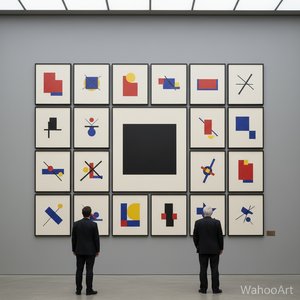
Казимир Малевич: Топ 25 шедьовъра на абстрактното изкуство за вашия дом | OriginalUniqueArt.com
Открийте топ 25 шедьовъра на Казимир Малевич – пионер на абстрактното изкуство и супрематизма. Разгледайте историите зад „Черно квадратче“ и други емблематични творби. Висококачествени репродукции за вашия дом в OriginalUniqueArt.com!

Top 25 Masterpieces by Laurent Fabre: The Essence of Neo-Abstract Geometry
Immerse yourself in the luminous world of Laurent Fabre. Explore 25 iconic Neo-Abstract masterpieces, from geometric precision to vibrant color fields. Find museum-quality art reproductions and curated decor inspiration. Discover all masterpieces on OriginalUniqueArt.com.

Mastering Abstraction: The Top 25 Essential Works by Wassily Kandinsky
Journey through the soul of abstraction with our curated guide to the top 25 Wassily Kandinsky masterpieces. Explore the vibrant colors and spiritual forms that defined modern art. Find museum-quality reproductions and decor inspiration. Discover all masterpieces on OriginalUniqueArt.com.