Early Life, Family and Training
Johan Jacob Bennetter was born on September 30, 1822, in Oslo (Kristiania) to Andreas Bennetter and Berthe C. Hansen. His early years were defined by the maritime environment of Pipervika, a district in Oslo known for its seafaring and craft traditions. This upbringing was no accident of geography; it was a direct inheritance of his family's background. By the age of 11, Bennetter had already begun his life at sea, embarking on his first voyage alongside his father. This early exposure to the mechanics of sailing provided a practical foundation that most painters of his era could only attempt through observation or imagination.
The transition from sailor to artist was driven by a specific encounter with the visual arts. After spending years at sea, Bennetter took his mate's examination in 1840. His trajectory shifted when he met the painter Johan Gørbitz, whose work inspired a departure from a life of navigation toward a life of depiction. This shift was solidified when he was discovered by the enthusiast Colonel Kaltenborn, who recognized his talent for drawing and facilitated his formal entry into art education.
From 1844 to 1848, Bennetter attended Den kongelige Tegneskole, where his technical skills were sharpened under rigorous instruction. He studied under a specific group of instructors, including David Arnesen, Johannes Flintoe, Heinrich August Grosch, and Johan Fredrik Eckersberg. It was during this period of formal training that he began to move beyond simple sketching, eventually experimenting with oil colors and developing the technical precision required for the marine subjects that would define his career.
Artistic Training and Career in Europe
Bennetter’s transition from a sailor to a professional painter was driven by a rigorous period of study across Europe's major art centers. After his initial training in Norway, he moved to The Hague, where he studied under Louis Meijeer from 1849 to 1851. This technical foundation prepared him for the competitive atmosphere of Paris. He spent significant portions of his career in the French capital, residing there between 1852 and 1871, and again from 1872 to 1880. During these years, he refined his command of the marine genre under the instruction of Lazar Meyer and Théodore Gudin.
His presence in the Parisian art scene was marked by consistent participation in the Salon, exhibiting there from 1857 through 1873. This was not merely a period of study but a sustained professional engagement with the European art establishment. His work gained international visibility through his participation in the 1867 Universal Exhibition in Paris. These exhibitions provided the necessary platform for a marine painter to establish a reputation beyond his Norwegian origins, cementing his status within the mid-19th-century maritime tradition.
Technique and Artistic Style
Bennetter’s work is defined by a technical precision that only comes from lived experience. Having spent fifteen years at sea, he did not merely observe the ocean; he understood its mechanics. This seafaring background allowed him to move beyond generic maritime imagery to produce highly accurate depictions of naval architecture and the physics of water. His paintings focus heavily on the seascape genre, prioritizing the structural integrity of ships and the chaotic movement of the sea during heavy weather.
His style is characterized by a focus on drama and historical tension. He specialized in capturing the violent energy of storms, the wreckage of shipwrecks, and the organized chaos of naval battles. Rather than focusing on static calm, he frequently chose to depict high-stakes maritime conflict. These scenes often drew from both ancient and modern history, using specific naval engagements to ground his compositions in a sense of historical reality. The result is a body of work that favors the visceral reality of maritime struggle over mere decorative scenery.
- Sjøslag i Lagoa-bukten, Madagaskar, 1799 (1863)
- Ship in Sunset (1879)
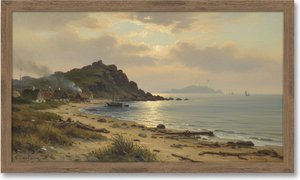
- Beach with Boats (1888)
Key Works and Notable Paintings
Bennetter’s output is defined by a preoccupation with the mechanics and violence of maritime life. His early focus on technical accuracy is evident in Skipsreparasjon (1851) and Kystlandskap med seilskuter og sjøfugler (1853). These works demonstrate a command of nautical detail that stems from his own fifteen years spent at sea. He moved from these observational studies toward more dramatic, historical compositions. His 1863 depiction of the Sjøslag i Lagoa-bukten, Madagaskar captures a specific naval engagement from 1799, utilizing the scale and tension required to render large-scale maritime conflict.
The artist frequently balanced the stillness of the ocean against sudden, chaotic movement. He explored the quietude of the sea in Marine par temps calme au clair de lune (1860) and Seilskuter i stilla (1884), providing a necessary counterpoint to his more aggressive subjects. This range allowed him to tackle diverse themes, from the historical weight of Bastillen (1869) to the more aggressive Vikingtokt (1887). Even in his later years, the tension remained high, as seen in Båter i stormfullt hav (1887), where the struggle against the elements remains his most reliable subject matter.
- Sjøslag i Lagoa-bukten, Madagaskar, 21.-22. sept. 1799 (1863)
- Vikingtokt (1887)
- Båter i stormfullt hav (1887)
- Skipsreparasjon (1851)
Later Years and Death
Bennetter’s long residency in Paris ended in 1880 when he returned to Norway. This final chapter of his life saw him settling in Sola Municipality. He applied his technical skill to local architecture, notably decorating the Sola ruinkirke. His presence in the region was marked by a shift from the international art hubs back to his Norwegian roots.
His personal life was anchored by his marriage to Wilhelmine Caroline Fischer, whom he wed in 1868. The couple remained together until her death in 1904. Bennetter’s own life concluded the same year, passing away on March 29, 1904, in Sola Municipality. He left behind a body of work defined by the maritime precision he honed during his years at sea and in European studios.
Where to See the Works Today
Bennetter’s maritime canvases are distributed across several major institutions, reflecting the international reach of his seafaring subject matter. In Norway, his work is held by the Nasjonalmuseet in Oslo and the Bergen Billedgalleri. These collections preserve his specific approach to naval history and the mechanics of the sea. His presence in Scandinavia extends to the Nationalmuseum in Stockholm, where his paintings remain part of the permanent record.
The reach of his output extends well beyond Northern Europe. In Sweden, the Göteborg Konstmuseum maintains his works within its holdings. His influence is also documented in Australia, where the National Gallery of Victoria in Melbourne and the Ballarat Art Gallery both hold his paintings. These pieces represent the specific genre of dramatic seascape that defined his career and continues to be studied in these diverse collections.
الأسئلة والأجوبة
أين يمكنني العثور على إحصائيات حول أعمال Johan Jacob Bennetter؟
توجد صفحة إحصائيات الزيارات خاصة بـ Johan Jacob Bennetter، تعرض إحصائيات حول أعمال الفنان على هذا الموقع.
أين يمكنني مشاهدة أعمال Johan Jacob Bennetter الفنية مرتبة حسب الأجواء؟
تستعرض صفحة ركن الأجواء الخاصة بالفنان أعمال Johan Jacob Bennetter الفنية مرتبة حسب أجوائها.
كم عدد الأعمال الفنية المتاحة لـ Johan Jacob Bennetter؟
يمكنك تصفح 4 أعمال فنية من أعمال Johan Jacob Bennetter في صفحة كافة الأعمال الفنية.
هل يوجد عرض شامل لجميع الموضوعات التي رسمها Johan Jacob Bennetter؟
تستعرض صفحة دليل المواضيع أعمال Johan Jacob Bennetter الفنية مصنفة حسب الموضوع.