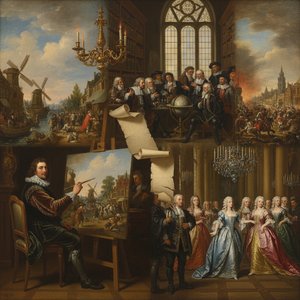
The Precision of the Dutch Landscape
Hubert van Steel remains a figure defined by the quiet, disciplined observation of the natural world. His work does not rely on grand gestures or dramatic shifts in light to command attention. Instead, he focused on the structural reality of the Netherlands. From his origins in Waddinxveen, his output reflects a commitment to the tangible elements of rural life and the specific textures of the Dutch terrain. He was a painter and a draftsperson who understood that a landscape is built from small, repetitive details rather than singular, sweeping movements.
His technical approach favored clarity. Whether documenting the movement of livestock or the frozen stillness of a winter scene, his hand remained steady. He captured the atmosphere of the Dutch countryside with a directness that avoids unnecessary ornamentation. This clarity is most evident in his ability to render specific seasonal shifts, moving from the lushness of a meadow to the starkness of ice.
Core Subject Matter and Compositional Focus
The catalog of his known works reveals a consistent preoccupation with the intersection of animal life and the environment. He did not seek to idealize these subjects, but rather to document them as they existed within their specific settings. His compositions often center on the following themes:
- The rhythmic patterns of livestock in pastoral settings.
- The structural geometry of ornamental friezes.
- The atmospheric qualities of winter landscapes and ice.
- The daily labor associated with dairy farming.
His 1880 work, Frieze of Running Vine Ornament, demonstrates a capacity for decorative precision that contrasts with his later, more expansive landscapes. By 1892, his focus had solidified into the depiction of cows in meadows and the social activity of ice skaters on frozen water. This progression shows an artist refining his ability to balance large-scale environmental elements with the intimate details of farm life, such as those seen in Milking Cows.
A Legacy of Observational Accuracy
Van Steel’s significance lies in his refusal to embellish. He worked through the late nineteenth century, a period where many artists were moving toward more subjective interpretations of light and form. He stayed grounded in the physical reality of his surroundings. His work provides a visual record of a specific way of life and a specific way of seeing the Dutch landscape. He died in Voorburg, leaving behind a body of work that prioritizes the integrity of the subject over the ego of the painter.
الأسئلة والأجوبة
أين يمكنني مشاهدة أعمال Hubert van Steel الفنية في معرض ثلاثي الأبعاد؟
يمكنكم القيام بزيارة افتراضية: حيث تستعرض صفحة متحف ثلاثي الأبعاد الخاصة بـ Hubert van Steel أعمال الفنان في معرض ثلاثي الأبعاد.
أين يمكنني استعراض جميع أعمال Hubert van Steel الفنية؟
يمكن تصفح جميع أعمال Hubert van Steel على هذا الموقع عبر صفحة كافة الأعمال الفنية الخاصة بالفنان.
كم عدد الأعمال الفنية المتاحة لـ Hubert van Steel؟
يمكنك تصفح 4 أعمال فنية من أعمال Hubert van Steel في صفحة كافة الأعمال الفنية.
إلى أي حقبة تاريخية ينتمي Hubert van Steel؟
أبدع Hubert van Steel خلال حقبة 19th Century، وهي الفترة التي تضع نشاط الفنان في سياقه التاريخي.