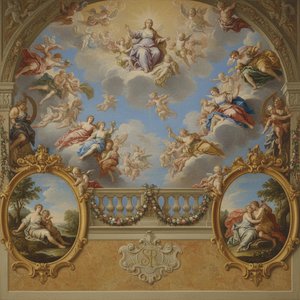
A Veronese Hand
Born in Verona in 1542, Felice Riccio entered a world defined by the heavy traditions of his father, Domenico Riccio. Known to many by the pseudonym Il Brusasorci, he did not merely inherit a profession but a specific way of seeing. His early years were spent absorbing the Mannerist language of his lineage, yet there was a distinct softness in his approach that set him apart from the sharper edges of his contemporaries. He moved through the late-Renaissance period with a quiet technical authority, eventually finding his way to Florence, where his presence was noted as late as 1597.
His work often sought a delicate balance between light and form. In pieces such as the Annunciation on the organ shutters of the church of the Madonna di Campagna, one finds a painterly, gentle version of Mannerism. He possessed a particular skill for working on touchstone, using slate to catch the light in ways that traditional canvas could not. This preference for texture and subtle luminism allowed him to create figures that felt less like statues and more like living presences within the shadows.
Evolution of Style
As the decades progressed, Riccio’s brushwork began to shed its rigid Mannerist constraints. The later years of his life, particularly from 1598 toward his death in 1605, saw a shift toward a style that anticipated the Baroque. This transition was marked by an increase in emotional weight and a more intense religious feeling. In works like the Giusti Altarpiece, he experimented with agitated gestures, even as he maintained a sense of normal proportion.
The movement of his art can be traced through specific subjects:
- The Finding of Moses (1584), which remains in Verona at Castelvecchio.
- The Flagellation of Christ, where he utilized a delicate luminism to transform familiar gestures.
- Religious compositions for the church of San Michele Extra, including the Four Saints on the organ shutters.
A Lasting Influence
While his own life ended in 1605, the technical foundations he laid continued through his students. He was a teacher to several painters who would go on to define the Veronese Baroque, including Alessandro Turchi and Pasquale Ottini. These pupils carried forward his sensitivity to color and his meticulous approach to composition. His legacy is found not in grand declarations, but in the quiet, refined tones that populated the churches of Verona and the collections of Bolzano.
الأسئلة والأجوبة
هل يمكنني استكشاف أعمال Felice Riccio حسب الموضوع؟
تُعد دليل المواضيع الخاصة بـ Felice Riccio صفحةً تستعرض أعمال الفنان وتصنفها وفقاً لموضوعاتها.
ما هي المدارس الفنية التي ينتمي إليها Felice Riccio؟
يمكن الاطلاع على المدارس الفنية التي عمل بها Felice Riccio عبر صفحة جميع المدارس الفنية الخاصة بالفنان، والتي تجمع الأعمال الفنية حسب كل مدرسة فنية.
هل يوجد تسلسل زمني لمسيرة Felice Riccio؟
تتجلى المسيرة المهنية لـ Felice Riccio مرحلة تلو الأخرى في صفحة مسيرة فنية: وهي عبارة عن خط زمني أفقي للأعمال الفنية، مُصنفة ضمن فصول تمثل كل حقبة من مسيرته.
أين يمكنني مشاهدة المخطط اللوني لأعمال Felice Riccio؟
يمكنكم الاطلاع على المخطط اللوني لأعمال Felice Riccio عبر صفحة بصمة الألوان الفنية الخاصة بالفنان.