نسخة زيتية
 كل ما يخص Molnar







































 بالنسبة للأعمال الفنية أو النسخ المطبوعة التي يتجاوز طول أي من أضلاعها 105 سم (حوالي 41 بوصة)، سيتم شحن الإطار كمجموعة مفككة؛ حيث تضمن هذه الطريقة سلامة التوصيل وتمنع حدوث أي أضرار أثناء النقل.


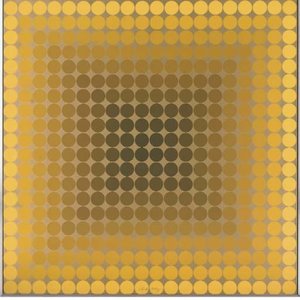
A Symphony of Circles: Unveiling Victor Vasarely’s “Molnar”
Victor Vasarely's "Molnar" is more than just a painting; it’s an invitation into the mesmerizing world of Op Art, a realm where perception itself becomes the subject. This striking composition – a dominant red circle enveloped by a constellation of smaller circles in vibrant hues – immediately captivates with its dynamic energy and illusionistic depth. The work, echoing Vasarely's pioneering explorations of optical art, demonstrates a masterful manipulation of color and form to create an experience that transcends simple visual representation.
The Genesis of Optical Illusions
Born in 1906 in Pécs, Croatia (then part of Austria-Hungary), Károly Vaszary – later known as Victor Vasarely – initially pursued a medical career before dedicating himself to the burgeoning field of visual art. His formative years were deeply influenced by the Bauhaus movement and Sándor Bortnyik’s “Műhely” workshop, where he absorbed the principles of functional design and geometric abstraction. This training provided the foundation for his revolutionary approach: to explore how the human eye perceives and interprets shapes and colors. "Molnar" exemplifies this philosophy perfectly, drawing upon techniques developed by Vasarely and other pioneers of Op Art – artists who sought to challenge traditional notions of representation by directly engaging with the viewer’s visual system.
Decoding the Composition
The painting's intricate arrangement is a deliberate exercise in controlled chaos. The large, red circle acts as an anchor, drawing the eye inward while simultaneously creating a sense of space and depth. The smaller circles, rendered in a spectrum of colors – green, yellow, pink, brown, and blue – are not randomly scattered; they’re meticulously positioned to create a dynamic interplay of light and shadow, further enhancing the illusion of three-dimensional form. This technique, characteristic of Vasarely's work, relies on the principles of optical mixing, where adjacent colors appear to blend together due to the way our eyes perceive them. The overall effect is one of constant movement and shifting perspective, a testament to the artist’s understanding of visual perception.
Symbolism and Emotional Resonance
"Molnar" transcends mere aesthetic appeal; it speaks to fundamental questions about reality and perception. Vasarely's work often explored themes of order and chaos, suggesting that these two forces are inextricably linked within the human experience. The circles themselves can be interpreted as representing wholeness, unity, or even the infinite – concepts frequently explored in geometric abstraction. Beyond its intellectual depth, "Molnar" evokes a powerful emotional response, inviting viewers to lose themselves in its mesmerizing patterns and contemplate the nature of visual reality. It’s a piece that demands attention, stimulating the senses and challenging our assumptions about how we see the world.
الأسئلة والأجوبة
هل لوحة Molnar مرسومة يدوياً أم مطبوعة؟
مرسومة يدوياً: يقوم رسام محترف بمحاكاة Molnar بالألوان الزيتية على قماش الكتان.
ما الحجم الذي يجب أن أختاره لـ Molnar؟
تتراوح المقاسات من 31.6 x 31.7 cm (E£10955) إلى 239.2 x 240.1 cm (E£113436)؛ ويوضح الجدول الموجود في هذه الصفحة الخطوات الأساسية وأسعارها.
كم تستغرق عملية التوصيل؟
تستغرق عملية التوصيل من 4 إلى 5 أسابيع، مع خدمة الشحن السريع المجاني لجميع أنحاء العالم؛ كما يتوفر خيار الإنتاج المستعجل في هذه الصفحة. يمكنك إرجاع العمل الفني خلال 100 يوم واسترداد كامل المبلغ دون أي شروط.
ما هي الوسائط التي استخدمها فكتور فازاريلي في عمله Molnar؟
Acrylic On Canvas
 معاينة الحجم الواقعي

 مشاركة
 مشاركة
 التفاصيل
 ورقة الحقائق


 تحميل الملف
 قطع مشابهة
 الأشعة السينية
 عرض شرائح
 الأسئلة والأجوبة

 الإحصائيات