
 معاينة الحجم الحقيقي
 مشاركة
 مشاركة
 التفاصيل

 تحميل الملف
 قطع مشابهة
 الأشعة السينية
 عرض شرائح
Living Fire


 عرض المزيد
احصل على صورة رقمية عالية الدقة ومعزّنة، بجودة تفوق بكثير المعاينة عبر الإنترنت.
يتم إعداد كل ملف بعناية فائقة من قبل متخصصينا الداخليين باستخدام أدوات متقدمة ولمسات يدوية خبيرة. نضمن أن تتمتع كل صورة بوضوح استثنائي، ودقة لونية متناهية، وتفاصيل دقيقة.
يتم تسليم الملف النهائي عبر البريد الإلكتروني في غضون 72 ساعة، وهو مُحسَّن للاستخدام الفوري في المجالات المهنية والتحريرية ومجالات الطباعة. هذه هي ذات الجودة التي تعتمد عليها كبرى استوديوهات التصميم ودور النشر والمعارض الفنية المرموقة.
صورة رقمية
حمّل ملفاً عالي الدقة للعرض الشخصي، والطباعة، والمشاريع الإبداعية. ( اشترِ نسخة مطبوعة اشترِ لوحة مرسومة يدويًا)
مزايا مُضمّنة في كل طلب صورة رقمية
تسليم رقمي احترافي، مضمون
عندما تختار OriginalUniqueArt.com، فأنت لا تحصل على مجرد صورة فحسب، بل ستحصل على عمل فني رقمي مُحسّن باحترافية، صُمم بدقة متناهية ومصحوب بضمان الرضا. إليك كل ما يتضمنه طلبك تلقائياً:

تسليم سريع عبر البريد الإلكتروني
ستصلك ملفات صورك الرقمية عالية الدقة عبر البريد الإلكتروني في غضون 72 ساعة من إتمام الطلب - لتكون جاهزة للاستخدام الفوري.

ملف رقمي مُحسّن بالذكاء الاصطناعي
يتم تحسين عملك الفني باحترافية باستخدام أدوات الذكاء الاصطناعي المتقدمة والتحرير اليدوي، لضمان أقصى درجات التفاصيل والوضوح ودقة الألوان.

إعادة إرسال مجانية مدى الحياة
هل حذفت ملفك أو فقدته عن طريق الخطأ؟ لا تقلق - سنعيد إرساله إليك في أي وقت، ومجاناً.

بدون رسوم استيراد - على الإطلاق
استمتع بأعمالك الفنية فوراً دون أي رسوم جمركية أو ضرائب أو مصاريف شحن - فالتحميلات الرقمية دائماً ما تكون معفاة من الضرائب.

ضمان دقة الألوان
نحن نضمن أن تعكس صورتك الرقمية الألوان الأصلية بأقصى قدر ممكن من الدقة، وذلك باستخدام أدوات احترافية وتقنيات إدارة الألوان.

ضمان الرضا لمدة 60 يومًا
إذا لم تكن راضياً عن صورتك الرقمية، فسنقوم بتعديلها أو استرداد 100% من قيمتها خلال 60 يوماً - دون أي أسئلة.

ضمان استعادة الأموال بنسبة % 100
لم تكن راضياً؟ احصل على استرداد كامل المبلغ خلال 60 يومًا من استلام ملفك الرقمي - دون أي أسئلة.

خصومات الطلبات الكبيرة
اشتري 3 صور، ووفر 10% - اشتري 5، ووفر 15% - اشتري +10، ووفر 20%. مثالية للمشاريع الإبداعية، والمعارض، والوكالات.
وصف المقتنى الفني
A Visionary Descent into the Mystical
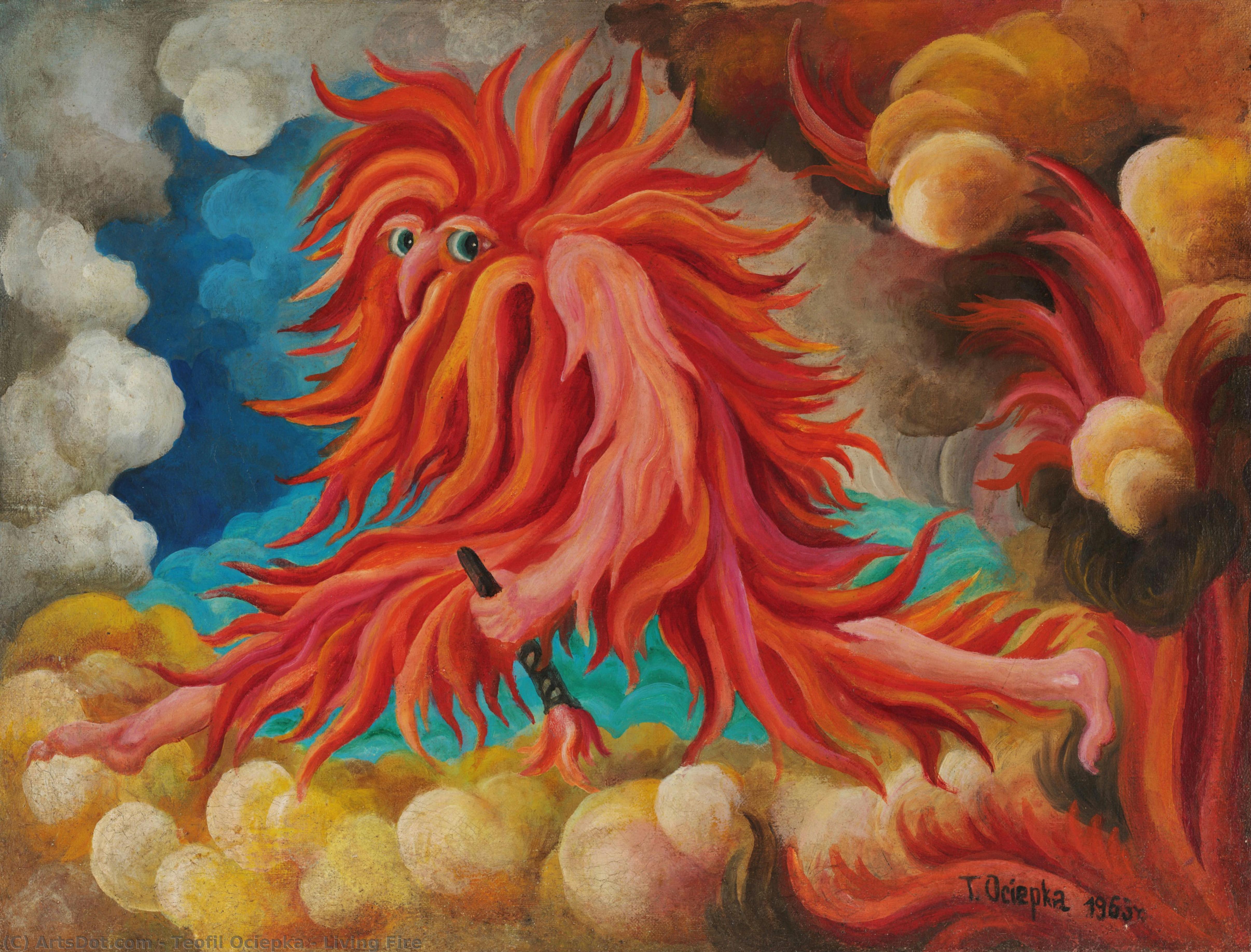
In the hauntingly beautiful Living Fire, created in 1963, we encounter the profound and enigmatic world of Teofil Ociepka, a master of Polish Primitivism. This large-scale oil on canvas serves as a window into a realm where the boundaries between the physical and the spiritual dissolve. At the heart of this composition sits a formidable red creature, a being of mythic proportions that commands the viewer's immediate attention. With its long, flowing hair and imposing horns, the figure evokes the primal energy of a dragon or a demonic entity, yet there is an unexpected, humanizing touch in the pipe held within its mouth. This singular detail introduces a surreal, almost whimsical tension to an otherwise fearsome subject, inviting us to contemplate the duality of nature—the coexistence of the wild and the domestic, the terrifying and the mundane.
The painting’s atmosphere is thick with the esoteric energy that defined Ociepka’s life and work. As a self-taught artist, occultist, and theosophist, Ociepka did not merely paint scenes; he channeled visions. The composition is far from static; it is a dynamic tapestry where smaller, indistinct figures drift through the background like echoes of a forgotten dream. These secondary figures, disconnected from the central beast, create a sense of vast, populated mythos, suggesting that the main creature is but one inhabitant of a much larger, unseen spiritual landscape. For the collector or interior designer, this piece offers more than just visual interest; it provides a profound narrative depth that can serve as a powerful focal point in any curated space.
Technique and the Language of Symbolism
Ociepka’s technique is a masterful study in the power of Primitivism. Eschewing the complex anatomical precision of academic realism, he utilizes bold colors and strikingly flat forms to achieve a heightened emotional resonance. The use of vibrant reds and deep, saturated tones in Living Fire creates a sense of heat and movement, making the canvas feel as though it is pulsing with life. His brushwork, while seemingly simple, possesses a rhythmic quality that guides the eye through the swirling textures of the creature's mane and the mysterious depths of the background. This stylistic choice allows the symbolic weight of the imagery to take precedence over literal representation, forcing the viewer to engage with the painting on an intuitive, rather than purely intellectual, level.
The symbolism within the work is deeply rooted in Ociepka’s fascination with the occult and theosophical doctrines. Every element—from the fiery hue of the central figure to the enigmatic presence of the smaller spirits—functions as a sigil or a symbol within a larger cosmic drama. The painting acts as a bridge between folk art traditions and high mysticism, making it an extraordinary piece for those who appreciate art that explores the hidden layers of reality. To possess a reproduction of Living Fire is to bring a fragment of this spiritual exploration into one's own environment, offering a constant source of introspection and a striking aesthetic statement that transcends the fleeting trends of modern decor.
السيرة الذاتية للفنان
The Mystical Vision of Teofil Ociepka
In the quiet corners of Polish art history, few figures possess the enigmatic allure of Teofil Ociepka. Born on April 22, 1891, in Janów Śląski, Poland, Ociepka was far more than a mere painter; he was a seeker, an occultist, and a dedicated theosophist whose brush served as a conduit for the unseen realms. As a self-taught primitivist, his work emerged not from formal academic training, but from a profound, internal necessity to translate spiritual truths onto canvas. His life, which spanned until 1978 in Bydgoszcz, was a continuous journey through the layers of the subconscious and the esoteric, leaving behind a body of work that vibrates with a dreamlike, otherworldly energy.
Ociepka’s artistic development was deeply intertwined with his spiritual pursuits. His fascination with the occult and theosophy provided him with a unique visual vocabulary, one where the boundaries between the physical landscape and the metaphysical plane are perpetually blurred. Unlike many of his contemporaries who sought to capture the external reality of the Polish countryside, Ociepka looked inward. His early life in Poland, marked by a deep immersion in folk traditions and mystical philosophies, allowed him to cultivate a style that felt both ancient and deeply personal. This fusion of folk art simplicity and complex esoteric symbolism created a tension in his work that continues to captivate modern viewers.
A Language of Symbols and Color
The aesthetic power of Ociepka’s paintings lies in their striking, unadorned clarity. His technique was characterized by the use of bold, saturated colors and remarkably flat, simplified forms—a hallmark of the Primitivist movement. However, beneath this deceptive simplicity lies a dense web of meaning. Every stroke and every shape often carries a weight of symbolic significance, reflecting his preoccupation with the hidden forces of the universe. His landscapes and still-life compositions are rarely just depictions of nature; they are sacred spaces populated by motifs that whisper of cosmic order and spiritual mystery.
When observing his most celebrated works, such as "The Garden" or "The Mountain," one is struck by the following elements:
- Bold Color Palettes: The use of vibrant, often non-naturalistic hues to evoke emotional and spiritual states.
- Symbolic Motifs: The integration of esoteric symbols that bridge the gap between the earthly and the divine.
- Flatness of Form: A rejection of traditional perspective in favor of a more direct, iconographic presentation.
- Dreamlike Atmosphere: A sense of stillness and transcendence that invites the viewer into a meditative state.
Legacy and Historical Significance
Teofil Ociepka stands alongside legendary figures like Nikifor and Henri Rousseau as a master of the Primitivist tradition. While his work shares the raw, intuitive quality found in Rousseau’s jungles, Ociepka’s focus on theosophy gives his oeuvre a distinctively spiritual gravity. He did not merely paint what he saw; he painted what he felt to be true in the higher vibrations of existence. His ability to weave the humble aesthetics of Polish folk art into a grander narrative of universal mysticism has secured his place as one of Poland's most fascinating and enduring artistic voices.
Today, the legacy of Ociepka is preserved through collections in prestigious institutions, including the National Museum in Wrocław and the Museum of Folk Architecture in Sanok. His work remains a vital touchstone for anyone interested in the intersection of art, spirituality, and the human psyche. To encounter an Ociepka painting is to step into a realm where the veil between worlds is thin, offering a glimpse into the profound mysteries that the artist spent his entire life attempting to illuminate.

Teofil Ociepka
1891 - 1978 , Poland
لمحة سريعة
- Artistic Movement Or Style: Primitivism
- Artists Or Movements Influenced By This Artist:
- Nikifor
- Henri Rousseau
- Artists Who Influenced This Artist:
- Nikifor
- Henri Rousseau
- Date Of Birth: April 22, 1891
- Date Of Death: January 15, 1978
- Full Name: Teofil Ociepka
- Nationality: Polish
- Notable Artworks:
- The Garden
- The Mountain
- Place Of Birth: Janów Śląski, Poland

