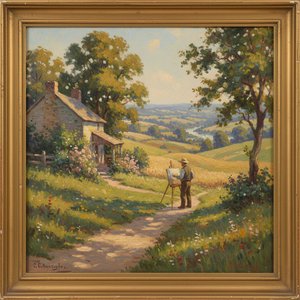
نسخة زيتية
 كل ما يخص Small Landscape with Weir







































 بالنسبة للأعمال الفنية أو النسخ المطبوعة التي يتجاوز طول أي من أضلاعها 105 سم (حوالي 41 بوصة)، سيتم شحن الإطار كمجموعة مفككة؛ حيث تضمن هذه الطريقة سلامة التوصيل وتمنع حدوث أي أضرار أثناء النقل.


Identification of the Landscape Painting
Small Landscape with Weir is a 19th Century genre work by the German painter Albert Lang. Created about 1873, the piece captures a quiet moment of rural stillness. The artist, born in Karlsruhe, brings a sense of structured observation to this intimate scene.
The painting focuses on a specific intersection of nature and human utility. It depicts a weir, a structure designed to manage the flow of water, set within a tranquil landscape. This work belongs to a period when the artist was refining his ability to translate the physical world into a language of light and shadow.
The scale of the work is modest, offering a private view of the water's edge. It remains a quiet fragment of the artist's early development. A single wooden beam anchors the composition against the mist.
Visual Composition and Subject Matter
A long wooden beam cuts through the space, creating a sharp diagonal from the upper left toward the center-right. This structural line anchors the eye against the soft, organic forms of the landscape. Below this beam, a dark foreground structure meets the middle-ground body of water. The water flows quietly, framed by the weight of man-made elements integrated into the earth. In the distance, hills recede into a pale horizon, layering the depth of the rural scene.
The subject is a quiet, rural landscape centered on a weir. This water management structure sits within the natural terrain, a silent intersection of human utility and the wild. The composition relies on these layers—the heavy timber, the moving water, and the distant slopes—to establish a sense of perspective. Everything remains still. The scene captures a moment of solitude where the only movement is the implied flow of the stream.
Artistic Style and Technical Details
The work is an Impressionistic study executed in oil on a small support, likely board or canvas. A strictly grayscale palette governs the surface, relying on a precise arrangement of black, white, and gray to define the scene. This monochromatic approach strips away the distraction of color to focus entirely on the weight of the air and the subtle shifts in light. The artist uses these tones to build a sense of mist and overcast stillness.
Visible, textured brushstrokes define the physical presence of the paint. These marks are loose and expressive, capturing the rhythmic movement of water as it passes through the weir. The paint is applied with a tactile quality that suggests the organic, irregular forms of the surrounding foliage. Every stroke works to translate the specific atmosphere of a quiet, rural moment into a tangible layer of pigment. The light does not merely sit upon the landscape; it seems to emerge from the interplay of gray and white.
The composition relies on the interplay of light and shadow to establish depth. Through the layering of dark foreground elements against the receding, lighter hills, a sense of space is carved out of the grayscale. The brushwork remains unhurried, prioritizing the sensation of the environment over fine, sharp detail. It is a quiet study of light and shadow.
الأسئلة والأجوبة
هل لوحة Small Landscape with Weir مرسومة يدوياً أم مطبوعة؟
مرسومة يدوياً: يقوم رسام محترف بمحاكاة Small Landscape with Weir بالألوان الزيتية على قماش الكتان.
ما الحجم الذي يجب أن أختاره لـ Small Landscape with Weir؟
أبعاد العمل الأصلي هي 14.5 x 10.0cm. تتراوح المقاسات من 38.2 x 26.1 cm (E£11074) إلى 243.9 x 166.7 cm (E£84163)؛ ويوضح الجدول الموجود في هذه الصفحة الخطوات الأساسية وأسعارها.
كم تستغرق عملية التوصيل؟
تستغرق عملية التوصيل من 4 إلى 5 أسابيع، مع خدمة الشحن السريع المجاني لجميع أنحاء العالم؛ كما يتوفر خيار الإنتاج المستعجل في هذه الصفحة. يمكنك إرجاع العمل الفني خلال 100 يوم واسترداد كامل المبلغ دون أي شروط.
أين توجد النسخة الأصلية من Small Landscape with Weir؟
النسخة الأصلية ضمن مجموعة مجموعات بافاريا الحكومية للرسم في ميونخ.
ما هي الوسائط التي استخدمها ألبرت لانج في عمله Small Landscape with Weir؟
Oil On Board
 معاينة الحجم الواقعي

 مشاركة
 مشاركة
 التفاصيل
 ورقة الحقائق


 تحميل الملف
 قطع مشابهة
 الأشعة السينية
 عرض شرائح
 الأسئلة والأجوبة

 الإحصائيات