نسخة زيتية
 كل ما يخص Thomas Mifflin







































 بالنسبة للأعمال الفنية أو النسخ المطبوعة التي يتجاوز طول أي من أضلاعها 105 سم (حوالي 41 بوصة)، سيتم شحن الإطار كمجموعة مفككة؛ حيث تضمن هذه الطريقة سلامة التوصيل وتمنع حدوث أي أضرار أثناء النقل.


Portrait of Thomas Mifflin by John Trumbull
This miniature portrait of Thomas Mifflin, painted by John Trumbull in 1790, offers a quiet glimpse into the life of a significant figure from colonial Pennsylvania. Mifflin was a man of considerable influence during the formative years of the American republic. He served as a member of the legislature and eventually held the position of governor of the state. His presence in the political landscape of the era was marked by a steady, formal dignity.
Trumbull captures Mifflin from the chest up, presenting him within an elegant oval frame. The subject is depicted with a sense of gravitas, his attire reflecting the status and respectability of a prominent statesman. There is a certain introspection in his expression, a quality that invites closer observation of the fine details Trumbull has rendered. It is a small work, yet it carries the weight of the history it represents.
Composition and Visual Elements of the Portrait
The composition is centered upon the face and upper torso of Thomas Mifflin, presented from the chest up. While the subject occupies the heart of the arrangement, he is positioned slightly off-center within the oval frame, a subtle choice that lends a sense of movement to an otherwise formal posture. This slight asymmetry prevents the portrait from feeling static, providing a quiet dynamism to his presence. The background remains relatively plain, ensuring that no external distractions pull the eye away from the sitter.
The lighting is soft and diffused, appearing to originate from an unseen source above and slightly to the left. This gentle illumination creates subtle shadows that define the contours of his features and the texture of his clothing. Because of the nature of this miniature, the perspective is relatively flat, typical of the medium. Depth is achieved not through spatial recession, but through the careful layering of tonal variations, where the face appears to sit slightly forward of the clothing.
Technique and Materials Used in the Work
In this miniature portrait, the artist utilizes a meticulous approach to capture the likeness of Thomas Mifflin. The medium is likely watercolor or gouache applied to ivory, a choice that allows for a delicate, luminous quality. Through the use of fine brushstrokes, Trumbull achieves subtle gradations of tone that define the contours of the face and the texture of the hair. This careful layering of tones is essential to the work, as it creates a sense of depth and form within such a small scale. The piece measures 9 x 7 cm, requiring a high degree of precision to execute the details of the cravat and the lapels of the suit.
The physical presence of the original work is captured here through a photograph. The soft, diffused lighting suggests an unseen source from above and to the left, casting gentle shadows that give the subject a sense of quiet introspection. The organic shapes of the face and the voluminous texture of the wig are rendered with a controlled hand, contrasting with the geometric oval of the frame. Every detail, from the fine lines of the facial features to the shading of the skin, relies on the artist's ability to manipulate pigment with extreme restraint.
Related Works by John Trumbull
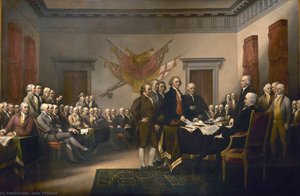
Trumbull’s career was defined by a profound connection to the American Revolution, a period he witnessed firsthand. His ability to capture the gravity of historical moments is evident in his larger compositions, such as his depictions of the Death of General Mercer at the Battle of Princeton and The Resignation of General Washington. These works demonstrate his capacity to translate significant political and military events into visual narratives. He also applied his skill to the monumental Declaration of Independence in 1817, a piece that helped shape the visual memory of the nation's founding.
Beyond these large-scale historical scenes, the artist was a prolific creator of smaller, more intimate works. He produced approximately 250 miniatures throughout his life, demonstrating a remarkable precision in a much more delicate format. This versatility allowed him to move between the grand scale of history painting and the meticulous detail required for private portraiture. His portraits of key figures, such as his 1790 depiction of George Washington and his 1805 portrait of Alexander Hamilton, reflect the same dedication to likeness and character that defines his broader body of work.
الأسئلة والأجوبة
هل لوحة Thomas Mifflin مرسومة يدوياً أم مطبوعة؟
مرسومة يدوياً: يقوم رسام محترف بمحاكاة Thomas Mifflin بالألوان الزيتية على قماش الكتان.
ما الحجم الذي يجب أن أختاره لـ Thomas Mifflin؟
أبعاد العمل الأصلي هي 9 x 7 cm. تتراوح المقاسات من 35.0 x 28.6 cm (E£10779) إلى 243.3 x 198.7 cm (E£95505)؛ ويوضح الجدول الموجود في هذه الصفحة الخطوات الأساسية وأسعارها.
كم تستغرق عملية التوصيل؟
تستغرق عملية التوصيل من 4 إلى 5 أسابيع، مع خدمة الشحن السريع المجاني لجميع أنحاء العالم؛ كما يتوفر خيار الإنتاج المستعجل في هذه الصفحة. يمكنك إرجاع العمل الفني خلال 100 يوم واسترداد كامل المبلغ دون أي شروط.
أين توجد النسخة الأصلية من Thomas Mifflin؟
النسخة الأصلية ضمن مجموعة متحف المتروبوليتان للفنون في نيويورك.
ما هي الوسائط التي استخدمها جون ترمبل في عمله Thomas Mifflin؟
Watercolor
 معاينة الحجم الواقعي

 مشاركة
 مشاركة
 التفاصيل
 ورقة الحقائق


 تحميل الملف
 قطع مشابهة
 الأشعة السينية
 عرض شرائح
 الأسئلة والأجوبة

 الإحصائيات