نسخة زيتية
 كل ما يخص John Maunsell







































 بالنسبة للأعمال الفنية أو النسخ المطبوعة التي يتجاوز طول أي من أضلاعها 105 سم (حوالي 41 بوصة)، سيتم شحن الإطار كمجموعة مفككة؛ حيث تضمن هذه الطريقة سلامة التوصيل وتمنع حدوث أي أضرار أثناء النقل.


Identification of the Portrait of John Maunsell
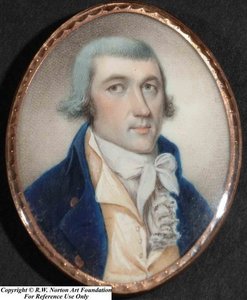
This miniature portrait by John Ramage depicts the British general John Maunsell. Executed in 1785, the work captures the likeness of the subject shortly after his return to New York State from a voluntary exile in Ireland during the revolution. Maunsell, who lived from 1724 to 1795, is presented in a formal manner that reflects his military standing.
Ramage, an Irish-born artist who became a prominent figure in the colonial American art scene, produced this piece during a period of significant political upheaval. The sitter's presence in the portrait is defined by his attire and the specific timing of the commission, which follows his relocation from Ireland to the American colonies.
Composition and Visual Elements
The subject is centered within an oval space, dominating the frame in a strict frontal view. This perspective offers no sense of depth beyond the immediate plane, focusing entirely on the sitter's likeness. He is presented in a red military-style coat layered over a white frilled shirt, establishing a formal silhouette against the background.
A circular copper frame encloses the portrait, featuring a delicate scrolled border. The color palette is restrained, dominated by reds, whites, and browns. These tones emphasize the sitter's attire and the formal dignity of the presentation.
Technique and Physical Materials
Executed in oil on panel, this miniature measures 4 x 3 cm. The artist employed fine brushes to achieve exceptional detail, utilizing meticulously controlled lines to define the subject's facial features and the folds of the red military-style coat. The precision of the brushwork allows for a clear rendering of the white frilled shirt and the textures of the sitter's attire.
The portrait is encased within a circular copper frame. This housing features a delicate scrolled border and includes a pin attached to the reverse for hanging. The composition is contained within this oval space, focusing the viewer's attention on the central figure.
Related Works by John Ramage
Ramage’s practice during the late eighteenth century focused heavily on the intimate scale of portrait miniatures. His ability to capture the likeness of the era's social and political elite is evident in several contemporary commissions. In 1785, he produced a portrait of Governor George Clinton, and by 1787, he had painted William Few. These works reflect the same technical precision used to render the features of prominent figures within the burgeoning American social landscape.
The artist’s reach extended to the highest levels of leadership during the early years of the new nation. In 1789, he received a commission to paint George Washington, becoming the first artist to portray the president while in office. This period of high-profile portraiture also included his work on Mrs. James Bleecker (Elizabeth Garland Bache) in 1788. Through these varied subjects, Ramage documented the faces of a changing society, from political leaders to private citizens.
الأسئلة والأجوبة
هل لوحة John Maunsell مرسومة يدوياً أم مطبوعة؟
مرسومة يدوياً: يقوم رسام محترف بمحاكاة John Maunsell بالألوان الزيتية على قماش الكتان.
ما الحجم الذي يجب أن أختاره لـ John Maunsell؟
أبعاد العمل الأصلي هي 4 x 3 cm. تتراوح المقاسات من 37.3 x 26.8 cm (E£10818) إلى 248.7 x 178.3 cm (E£88710)؛ ويوضح الجدول الموجود في هذه الصفحة الخيارات المتاحة وأسعارها.
كم تستغرق عملية التوصيل؟
تستغرق عملية التوصيل من 4 إلى 5 أسابيع، مع خدمة الشحن السريع المجاني لجميع أنحاء العالم؛ كما يتوفر خيار الإنتاج المستعجل في هذه الصفحة. يمكنك إرجاع العمل الفني خلال 100 يوم واسترداد كامل المبلغ دون أي شروط.
أين توجد النسخة الأصلية من John Maunsell؟
النسخة الأصلية ضمن مجموعة متحف المتروبوليتان للفنون في نيويورك.
ما هي الوسائط التي استخدمها جون راميج في عمله John Maunsell؟
Oil On Panel
 معاينة الحجم الواقعي

 مشاركة
 مشاركة
 التفاصيل
 بطاقة المعلومات


 تحميل الملف
 قطع مشابهة
 الأشعة السينية
 عرض شرائح
 الأسئلة والأجوبة

 الإحصائيات