


1

教堂里的三位妇女
这幅精美绝伦的画作捕捉到了三位女性在宁静教堂中潜心阅读的静谧时刻。画面流露出一种虔诚与内省的气息,引导观者去思考日常生活的深刻纯真以及精神上的奉献。艺术家大师般地描绘了女性们的表情与姿态,强调了她们丰富的内心世界以及那份共享的、宁静的交谊。

更新于 November 2026 · 基于我们的流行度评分排名(每件作品的搜索量、访问量及订单量) · 67 件 威廉·莱布尔 作品收录于我们的目录中
简而言之
在 威廉·莱布尔 留下的所有原作中,最著名的当属收藏于 汉堡 汉堡美术馆 的《教堂里的三位妇女》。 紧随其后的是 Interior (1897) 和 Portrait of a boy with a large ruff (1869)。 我们的目录收录了 威廉·莱布尔 的 67 件作品;画廊完整保留了 61 件享誉世界的杰作,并为每一件作品详细标注了创作日期、馆藏机构及其背后的故事。
这幅精美绝伦的画作捕捉到了三位女性在宁静教堂中潜心阅读的静谧时刻。画面流露出一种虔诚与内省的气息,引导观者去思考日常生活的深刻纯真以及精神上的奉献。艺术家大师般地描绘了女性们的表情与姿态,强调了她们丰富的内心世界以及那份共享的、宁静的交谊。

A heavy, somber stillness settles over the room, where the air feels thick with the scent of old wood and damp earth. To the right, a woman stands partially swallowed by deep, velvety shadows, her presence felt more through the sudden brightness of her white apron than through any sharp detail of her features. She exists in a moment of profound solitude, a solitary figure caught in the dimness of…

In this oil on canvas, titled Portrait of a boy with a large ruff, the artist Wilhelm Leibl presents a quiet study of youth. Created about 1869, the work captures a specific moment of stillness through a careful application of paint. The scale of the piece, measuring 75.8 x 61.0cm, allows for an intimate encounter with the subject, inviting a close observation of the textures present on the surface.

Women from Dachau (Girl with a black headscarf) is a portrait executed by Wilhelm Leibl in 1879. The work originated in Berbling, located in the Voralpenland region. Leibl produced this piece during a period of intense creative focus, capturing a subject who was the daughter of a local resident living near the artist's own residence.

A formal, realistic portrait of a man, rendered in a traditional academic style. The subject is positioned slightly off-center, facing towards the viewer's right while his gaze is directed forward. A dark, somber background and clothing provide a stark contrast to the warm, natural flesh tones of the face. The composition is a bust-length portrait, capturing the subject with a direct, eye-level perspective that establishes an immediate connection.

A somber, three-quarter view portrait emerges from a dark, indistinct background, focusing on the head and upper torso of a middle-aged man. The composition relies heavily on chiaroscuro, with light entering from the upper left to strike the subject's forehead and hands, leaving the remainder of the figure in deep shadow. This directional lighting creates a profound sense of three-dimensional volume, carving the man's features out of the gloom. He…

The painting titled Dachau Woman and Child is a significant work by the German realist Wilhelm Leibl. Created around 1873 or 1874, this oil on panel work captures a quiet, intimate moment from the Bavarian countryside. The subjects are not anonymous figures of a generic scene, but rather the miller’s wife of Plon, depicted with a directness that defines the artist's approach to his subjects.

In this intimate portrait titled Farmboy, the artist Wilhelm Leibl presents a quiet, unadorned moment from the late 19th century. Created about 1876, the work captures a sense of stillness that feels both immediate and deeply personal. The subject is a shy boy, appearing somewhat awkward and vulnerable as he slouches in a chair that seems slightly too large for his frame. There is a certain heaviness to his posture,…

In "Man in a Top Hat" by Wilhelm Leibl, a middle-aged or elderly man meets the viewer's gaze from an eye-level perspective. The subject's head and shoulders fill most of the frame in a close-up bust portrait, creating an immediate sense of presence. He wears a top hat that casts a soft shadow over his features, while a full beard covers his weathered face. His expression remains somber and contemplative,…

The artwork is titled Portrait Study of a Young Bearded Man, a monochrome portrait study by the German artist Wilhelm Leibl. Created about 1870, the piece captures a singular moment of observation. It focuses on the face of a young man, rendered in a palette of black, grey, and bright white highlights.
 The Critics1868
12
 Head Portrait of a Young Man1866
13
 Portrait of a Lady in Black Dress with White Ruff1870 · 卡尔斯鲁厄州立美术馆
14
 Portrait of Lina Kirchdorffer1871 · 巴伐利亚州绘画收藏馆
15
 The Painter Sattler with dogge1870 · 巴伐利亚州绘画收藏馆
16
 Pastoral Scene (after Rubens)1870 · 巴伐利亚州绘画收藏馆
17
 Portrait of Mrs Gedon1869 · 巴伐利亚州绘画收藏馆
18
 Portrait of Johann Heinrich Pallenberg1871 · 壁拉夫·莱克哈茨美术馆
19
 The Painter Victor Müller1870 · 壁拉夫·莱克哈茨美术馆
20
 Young Parisian woman1869 · 壁拉夫·莱克哈茨美术馆
21
 Rosine Fischler, Countess Treuberg1877
22
 The painter Johann Sperl1872 · 壁拉夫·莱克哈茨美术馆
23
 Portrait of Freiherr Max von Perfall auf Greifenstein (1814-1877)1877 · 巴伐利亚州绘画收藏馆
24
 The painter Jean Paul Selinger1880 · 巴伐利亚州绘画收藏馆
25
 a Farmer couple1879
26
 Head of a youth1879
27
 Head of a Man1879 · 哈佛艺术博物馆
28
 The Newspaper Reader1891
29
 Peasant Boy1888
30
 In a farmhouse interior1890 · 巴伐利亚州绘画收藏馆
31
 Julius Mayr1890 · 新画廊
32
 Boy's Head1896 · 伦巴赫美术馆
33
 Portrait of a Young Man with Hat on Green Background1896
34
 Head of peasant girl1897
35
 Girl standing at a window1899 · 壁拉夫·莱克哈茨美术馆
36
 Portrait of the Artist's Sister, Katharina (later Frau Kirchdorffer)卡尔斯鲁厄州立美术馆
37
 Left Hand1867 · 卡尔斯鲁厄州立美术馆
38
 Head of a Blind Man伦巴赫美术馆
39
 The Chemist J Jais国家博物馆
40
 Death's-head Hawkmoth with Mushroom on White Cloth1868 · 卡尔斯鲁厄州立美术馆
41
 Skull with Shroud1868 · 卡尔斯鲁厄州立美术馆
42
 Left Hand of the "Girl with the Carnation"1880 · 卡尔斯鲁厄州立美术馆
43
 Right Hand of the "Girl with the Carnation"1880 · 卡尔斯鲁厄州立美术馆
44
 Peasant Girl with a White Headcloth1885 · 大都会艺术博物馆
45
 Two Hands with Red Cloth on Blue Apron1890
46
 Friedrich rauert
47
 Big Portrait Privy Councillor Seeger
48
 Savoyard boy sleeping冬宫博物馆
49
 Portrait Of Mrs Helene Auspitz
50
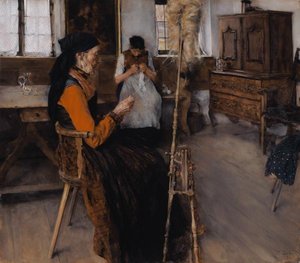 Die Spinnerin
51
 Countess Rosine Treuberg
52
 Portrait of Carl Schuch巴伐利亚州绘画收藏馆
53
 The Old Farmer
54
 Girl With A White Headscarf巴伐利亚州绘画收藏馆
55
 The Village Politicians
56
 Kopf eines Bauernmaedchens德累斯顿国家艺术收藏馆
57
 The Dissimilar Couple施泰德美术馆
58
 Portrait of Pal Szinyei Merse布达佩斯美术博物馆
59
 The Veterinarian Dr. Reindl in an Arbor伦巴赫美术馆
60
 Head of a Peasant Girl
61
 The spinner
这些原作中反复出现的四个主题,各有一个最杰出的范例。
收藏了本页中大部分画作的 8 家博物馆。
| 博物馆 | 城市 | 威廉·莱布尔 的作品 | 此列表中的画作 |
|---|---|---|---|
 巴伐利亚州绘画收藏馆 |
慕尼黑 | 11 | Interior, Portrait Study of a Young Bearded Man, Portrait of Lina Kirchdorffer |
 卡尔斯鲁厄州立美术馆 |
卡尔斯鲁厄 | 8 | Portrait of Ernst Schoenlin (?), Portrait of a Lady in Black Dress with White Ruff, Portrait of the Artist's Sister, Katharina (later Frau Kirchdorffer) |
 壁拉夫·莱克哈茨美术馆 |
科隆 | 5 | Portrait of Johann Heinrich Pallenberg, The Painter Victor Müller, Young Parisian woman |
 伦巴赫美术馆 |
慕尼黑 | 4 | The Painter Julius Bodenstein, Boy's Head, Head of a Blind Man |
 老国家美术馆 |
柏林 | 3 | Women from Dachau (Girl with a black headscarf), Dachau Woman and Child, Farmboy |
 汉堡美术馆 |
汉堡 | 1 | 教堂里的三位妇女 |
 Germanisches Nationalmuseum |
纽伦堡 | 1 | Portrait of a boy with a large ruff |
| Ernest Zmeták Art Gallery | 诺维扎姆基 | 1 | Man in a Top Hat |
选择一个年代,探索定义该时代的原创杰作。
In this oil on canvas, titled Portrait of a boy with a large ruff, the artist Wilhelm Leibl presents a quiet study of youth. Created about 1869, the work captures a specific moment of stillness through a careful application of paint. The scale of the piece, measuring 75.8 x 61.0cm, allows for an intimate encounter with the subject, inviting a close observation of the textures present on the surface.
Women from Dachau (Girl with a black headscarf) is a portrait executed by Wilhelm Leibl in 1879. The work originated in Berbling, located in the Voralpenland region. Leibl produced this piece during a period of intense creative focus, capturing a subject who was the daughter of a local resident living near the artist's own residence.

The gaze of the viewer meets the quiet presence of The painter Jean Paul Selinger, a work that captures a specific moment of stillness. This oil on canvas portrait presents the artist Jean Paul Selinger, rendered with a directness that feels immediate. The subject sits in a moment of introspection, his features defined by the steady hand of the painter Wilhelm Leibl. One senses the weight of the man's presence…
A heavy, somber stillness settles over the room, where the air feels thick with the scent of old wood and damp earth. To the right, a woman stands partially swallowed by deep, velvety shadows, her presence felt more through the sudden brightness of her white apron than through any sharp detail of her features. She exists in a moment of profound solitude, a solitary figure caught in the dimness of…
教堂里的三位妇女,汉堡美术馆, 汉堡。紧随其后的是 Interior (1897) 和 Portrait of a boy with a large ruff (1869)。
教堂里的三位妇女, Interior, Portrait of a boy with a large ruff, Women from Dachau (Girl with a black headscarf), The Painter Julius Bodenstein, Portrait of Ernst Schoenlin (?), Dachau Woman and Child, Farmboy, Man in a Top Hat 及 Portrait Study of a Young Bearded Man。上方排名显示了每件作品的创作年份及馆藏机构。
我们的目录收录了 67 件 威廉·莱布尔 的作品,创作年代从 1866 年至 1899 年。
多见于 巴伐利亚州绘画收藏馆 (慕尼黑), 卡尔斯鲁厄州立美术馆 (卡尔斯鲁厄) 及 壁拉夫·莱克哈茨美术馆 (科隆)。上方的博物馆列表列出了所有相关机构。
在 1870s 期间:本页 61 件作品中有 18 件创作于该时期,其中包含 Women from Dachau (Girl with a black headscarf) 件作品。
在本页面中,最早的作品创作于 Portrait of Ernst Schoenlin (?) (1866),最晚的创作于 Girl standing at a window (1899)。
Man (23), Portrait (20) 及 Woman (15),共计 61 件作品。
Oil On Canvas,共计 27 件(本页共有 61 件作品)。
根据本页面的原作,Realism
Interior, Portrait Study of a Young Bearded Man 及 Portrait of Lina Kirchdorffer:巴伐利亚州绘画收藏馆, 慕尼黑收藏了本页中 11 件作品。


