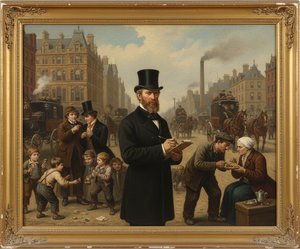
A Pioneer of the British Nude: The Life and Art of William Etty
William Etty, a name perhaps less instantly recognizable than his contemporaries like Turner or Constable, nevertheless occupies a pivotal position in 19th-century British art. Born in York on March 10, 1787, above his father’s bakery, Etty's journey from humble beginnings to Royal Academician was one marked by relentless dedication, artistic innovation, and no small measure of controversy. His early life offered little indication of the path he would forge. Apprenticed at age twelve to a printer in Hull, seven years were spent immersed in the practicalities of typography – a world far removed from the canvases that would eventually bear his signature. Yet, even amidst the mechanical demands of printmaking, Etty nurtured a burgeoning passion for drawing, an impulse that ultimately propelled him towards London and the hallowed halls of the Royal Academy Schools in 1807. There, under the tutelage of Thomas Lawrence, he honed his skills through diligent copying, laying the foundation for a career defined by masterful depictions of the human form.
His Artistic Beginnings & Influences
Etty’s formative years instilled within him a profound appreciation for observation and anatomical accuracy—qualities that would become central to his artistic vision. Like many artists of his time, he was deeply affected by the Romantic movement, which championed emotion, imagination, and individualism. Artists such as Titian and Rubens – masters whose Venetian paintings captivated Etty’s youthful sensibilities during his travels in Italy – served as enduring models for his technique and compositional style. These influences shaped his approach to portraying human figures with unprecedented realism, prioritizing emotional intensity alongside meticulous anatomical detail. The desire to capture the sublime—the awe-inspiring grandeur of nature—also resonated within him, informing his later historical paintings and contributing to a broader aesthetic preoccupation with beauty and moral contemplation.
The Rise to Prominence: Nudes and Controversy
Etty’s breakthrough arrived in 1821 with
Cleopatra's Arrival in Cilicia, a painting that immediately ignited both admiration and scandal. The work, teeming with nude figures, was exhibited to widespread acclaim, yet simultaneously earned him a reputation for indecency. This duality would become a defining characteristic of his career. He wasn’t merely depicting nudity; he was exploring the human form with an unprecedented realism and anatomical precision for a British artist of that era. His commitment to accurately rendering flesh tones, light, and shadow – influenced by his study of Venetian masters like Titian and Rubens during travels in Italy and France – set him apart. He continued to produce historical scenes populated with nudes, often drawn from classical mythology or literature, such as
The Sirens and Ulysses. These works were commercially successful, allowing Etty to thrive despite the constant criticism leveled against his subject matter. In 1828, he was elected a Royal Academician, solidifying his position within the established art world, even as whispers of impropriety followed him.
Beyond the Nude: Portraits and Still Life
While Etty is most celebrated for his nudes, his artistic range extended beyond this controversial domain. Recognizing the need to broaden his appeal – and perhaps secure a more stable income – he ventured into portraiture during the 1830s. Though not as groundbreaking as his figure paintings, these portraits demonstrate his technical skill and ability to capture character. Furthermore, Etty became one of the first English painters to seriously engage with still life, demonstrating an eye for detail and a sensitivity to texture that rivaled the Dutch masters he admired. This diversification reveals a pragmatic side to Etty’s artistic practice, a willingness to adapt to market demands while remaining true to his core aesthetic principles. He continued, however, to return to the nude form throughout his life, driven by an unwavering fascination with its beauty and expressive potential.
Legacy and Rediscovery
William Etty died in York on November 13, 1849, leaving behind a substantial body of work that initially enjoyed considerable popularity. However, tastes shifted in the decades following his death, and his paintings fell into relative obscurity. By the late 19th century, his once-celebrated works were largely forgotten, dismissed as outdated or simply too shocking for Victorian sensibilities. A remarkable rediscovery began in the early 21st century. His inclusion in Tate Britain’s landmark
Exposed: The Victorian Nude exhibition (2001–2002) sparked renewed interest in his art, prompting critical reevaluation and a reassessment of his place in British art history. The restoration of
The Sirens and Ulysses in 2010 further cemented this revival, revealing the brilliance of his technique and the enduring power of his vision. Today, William Etty is recognized as a pioneering figure who challenged artistic conventions, celebrated the human form with unparalleled realism, and left an indelible mark on the landscape of British art. His works stand as testaments to his skill, dedication, and unwavering commitment to capturing the beauty and complexity of the human experience.
Key Works
- Cleopatra's Arrival in Cilicia (1821): The painting that launched Etty’s career and established his reputation for depicting nudes.
- The Sirens and Ulysses (1837): A dramatic depiction of Homer’s epic, showcasing Etty’s mastery of composition and anatomy.
- Reverend William Jay (c. 1836-40): An example of his portraiture work, demonstrating a keen eye for character.
- Standing Female Nude (date unknown): A study showcasing Etty’s exceptional skill in rendering realistic flesh tones and form.
问答详情
如何按年份顺序浏览 威廉·艾蒂 的作品?
威廉·艾蒂 的作品时间轴已上线:在艺术家的 作品时间轴 页面中,所有作品均按创作日期排序。
可以按媒介类型浏览 威廉·艾蒂 的作品吗?
全部媒介 页面按技法对 威廉·艾蒂 的作品进行了分类。
威廉·艾蒂 的出生地和出生年份是?
威廉·艾蒂 于 1787 出生于 约克。