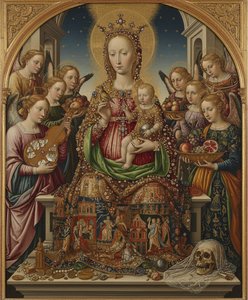
Madonna and Child Enthroned with Two Angels and a Donor
Also known as:
克里韦利
Vittorio Crivelli
Crivelli
Mediums: 木板蛋彩画
Corpus themes:
gothic and renaissance synthesis
flemish glazing techniques
venetian renaissance style
gothic and renaissance traditions
flemish painting influence
Vittore Crivelli: A Venetian Echo of Gothic Mysticism
Vittore Crivelli (b. ca. 1440, Venezia, d. 1501/2, Venezia) stands as a fascinating figure within the Venetian Renaissance—a painter who simultaneously embraced the grandeur of his era and retained traces of the expressive fervor characteristic of Gothic art. Born in Venice around 1440, he emerged from a family steeped in artistic tradition, notably linked to Carlo Crivelli, his brother, whose distinctive style profoundly shaped Vittorio’s oeuvre. While Carlo's work leaned towards dramatic narratives infused with symbolic depth—often depicting saints and biblical figures bathed in ethereal light—Vittore pursued a more restrained aesthetic, prioritizing meticulous detail and psychological realism. This duality reflects the broader artistic currents of Venice during the fifteenth century, where Gothic influences persisted alongside burgeoning humanist ideals.
Early Life & Training: Little is known about Vittorio’s formative years beyond his birthplace and familial connections. He likely received training within the Crivelli workshop, absorbing Carlo's stylistic sensibilities while developing his own artistic voice. This apprenticeship undoubtedly instilled a deep appreciation for expressive color palettes and compositional complexity—elements that would become hallmarks of his later paintings.
Notable Works: Vittorio’s artistic output is relatively modest compared to contemporaries like Titian or Tintoretto, yet several pieces demonstrate remarkable skill and sensitivity. Among his most celebrated works are “St Louis of France,” a monumental altarpiece commissioned for Saint Louis Cathedral in Bordeaux (1481-1502), showcasing Crivelli’s mastery of perspective and drapery—a technique heavily indebted to Flemish painting. Similarly, "Saint Michel," housed at the Musée du Petit Palais in Avignon, exemplifies his meticulous attention to detail and psychological portrayal of religious figures.
Style & Technique: Vittorio's style distinguishes itself through a careful balance between Gothic and Renaissance conventions. He employed luminous glazing techniques—inherited from Flemish masters—to achieve atmospheric depth and imbue his canvases with an otherworldly glow. However, unlike Carlo Crivelli’s theatrical compositions, Vittorio favored more contemplative scenes, focusing on conveying inner emotion rather than grand spectacle. His meticulous rendering of textures—particularly drapery folds—reveals a dedication to realism that anticipates the stylistic developments of Mannerism.
Influence & Legacy: Vittorio Crivelli's artistic legacy resides primarily in his contribution to Venetian painting’s evolving aesthetic landscape. He served as an important conduit between Gothic and Renaissance traditions, demonstrating how artists could synthesize disparate influences into a cohesive visual language. Although overshadowed by more flamboyant figures of his time, Vittorio’s paintings continue to captivate viewers with their serene beauty and profound psychological insight—testaments to the enduring power of Venetian art history.
Later Years & Death: Information regarding Vittorio Crivelli's later life is scarce. He died in Venice around 1501 or 1502, leaving behind a modest but significant body of work that reflects his artistic vision and secures his place as a noteworthy artist of the Venetian Renaissance.
Museum Collections Featuring Vittorio Crivelli’s Artworks
Vittore Crivelli's paintings grace several prominent museums across Italy and internationally, offering invaluable insights into Venetian art during the fifteenth century. Notable holdings include:
These institutions safeguard masterpieces that exemplify Crivelli’s distinctive style and contribute to a broader understanding of Venetian artistic innovation.
Explore the captivating world of Carlo Crivelli, a Renaissance master blending Gothic detail with profound symbolism. Discover his unique style & lasting influence on Venetian art history.