


1

维纳斯、丘比特和时间(情欲寓言)
步入阿尼奥罗·布隆齐诺(Agnolo Bronzino)的“维纳斯、丘比特与时间 (情欲寓言)”这个引人入胜的世界,这是一幅16世纪的杰作,它巧妙地将神话叙事与艺术创新融为一体。这幅精致的作品邀请观赏者探索其丰富的象征意义、鲜艳的色彩和动态构图,使其成为任何艺术收藏品或精致室内装饰的永恒补充。

更新于 October 2026 · 基于我们的流行度评分排名(每件作品的搜索量、访问量及订单量) · 189 件 布龙齐诺 作品收录于我们的目录中
简而言之
维纳斯、丘比特和时间(情欲寓言) (1540) 是 布龙齐诺 最受瞩目的画作;原作收藏于 伦敦 的 国家美术馆。 随后,目光会移向 埃莱奥诺拉·达·托莱多肖像 (1555) 和 Venus, Cupido and Satyr。 在 布龙齐诺 的 189 件作品中,这 100 件最为闻名;每一件都是独一无二的原作,并附有创作年份、馆藏机构及其经久不衰的原因。
步入阿尼奥罗·布隆齐诺(Agnolo Bronzino)的“维纳斯、丘比特与时间 (情欲寓言)”这个引人入胜的世界,这是一幅16世纪的杰作,它巧妙地将神话叙事与艺术创新融为一体。这幅精致的作品邀请观赏者探索其丰富的象征意义、鲜艳的色彩和动态构图,使其成为任何艺术收藏品或精致室内装饰的永恒补充。

凝视 安尼奥·布龙齐诺 的 《埃莱奥诺拉·达·托莱多肖像》,仿佛直接步入了 盛期文艺复兴 时期佛罗伦萨那高雅脱俗的氛围之中。这幅创作于1555年的杰作,早已超越了单纯的面部写实;它是一座精心构建的丰碑,诉说着地位、权力和极致的优雅。画中主角 埃莱奥诺拉·达·托莱多 散发出一种近乎触手可及的贵族尊严。 布龙齐诺 笔下的她不仅是一位女性,更是美第奇家族影响力的象征——她的仪态举止无不彰显着通过数代赞助与政治博弈所积累的显赫财富。她那件华丽的红色长袍,点缀着闪耀的 金边饰纹,其意义远不止于衣着本身;它更是在向世人宣告,她在科西莫一世·德·美第奇的宫廷圈层中那崇高的社会地位。

A pale, reclining figure occupies the center of the frame, her skin possessing the cool, polished sheen of marble. This is Venus, the goddess of love, draped in a way that emphasizes the tension between soft flesh and the hard edges of the composition. Beside her, Cupid clings to her form, a small, fleshy presence that embodies the sudden, sharp sting of passion. Their limbs are elongated, stretching toward one…

In the grand theater of the Italian Mannerist period, few images command the eye with such authoritative grace as Agnolo Bronzino’s Portrait of Andrea Doria as Neptune. This is not merely a portrait of a man, but a profound exercise in political allegory and divine projection. The subject, the legendary Genoese admiral Andrea Doria, is stripped of the heavy silks and velvet doublets typical of sixteenth-century aristocratic portraiture. Instead, Bronzino…

The figure of St. John the Baptist emerges from the shadows, rendered with a muscular intensity by the Florentine master Bronzino. This depiction captures the patron saint of Florence in a moment of profound spiritual tension. Created about 1542 - 1545, the work possesses a striking verticality that speaks to its original purpose. It does not exist in isolation but remains a fragment of a larger sacred narrative, having once…

“Deposition,” painted in 1565 by the Florentine master Agnolo Bronzino, is not merely a religious scene; it's a meticulously crafted tableau of restrained emotion and profound psychological depth. Commissioned for the Observant Monastery in Cosmopoli, this work transcends simple narrative to become a meditation on grief, loss, and the delicate balance between earthly sorrow and divine grace. Bronzino, renowned for his “reserved elegance,” achieved this through an almost unnervingly controlled…

To gaze upon this portrait is to step directly into the rarefied atmosphere of mid-sixteenth-century Florence, a world governed by the subtle power plays and exquisite tastes of the Medici court. Agnolo Bronzino, the master chronicler of such elite circles, captured not merely a likeness, but an entire social stratum. The sitter, though anonymous to us today, embodies the controlled elegance expected of those who moved within the gilded cage…

The gaze of the Grand Duke of Tuscany, Cosimo I de' Medici, meets the viewer through the work titled Cosimo de Medici in Armour. Created by the Florentine artist Bronzino, this portrait captures the ruler in a moment of poised authority. The image emerges from the mid-16th century, dated about 1545, and presents a commanding presence through its structured composition. It exists as a significant version of the painting held…

In this portrait, we encounter Cosimo I de' Medici, not merely as a ruler, but as the mythological musician Orpheus. He is positioned in a three-quarter view from behind, turning his gaze back toward us with a sense of psychological alertness. His body, rendered with a polished, marble-like texture, possesses an idealized beauty that speaks to the High Mannerist style. A single splash of crimson red drapery provides a sharp…

In this vertical half-length portrait, we encounter the Duchess of Florence, Eleonora of Toledo, and her son, Francesco de' Medici. The composition is defined by a controlled, almost sculptural stillness. Eleonora stands slightly behind the young boy, her hand resting upon his shoulder in a gesture that is both protective and formal. There is a certain aristocratic detachment in their expressions, a cool composure that characterizes the Florentine Mannerist style.…
 Portrait of Eleonora di Toledo, Bust1560 · 德累斯顿国家艺术收藏馆
12
 Eleonora di Toledo1560 · 国家美术馆
13
 Venus cupid time国家美术馆
14
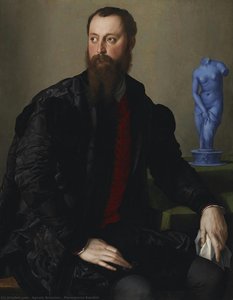 Pierantonio Bandini1555 · 加拿大国家美术馆
15
 Deposition from the Cross1545
16
 Holy Family1540 · 乌菲兹美术馆
17
 Eleonora di Toledo1543 · 国家美术馆 (Národní Galerie)
18
 Portrait of Lucrezia Panciatichi1540 · 乌菲兹美术馆
19
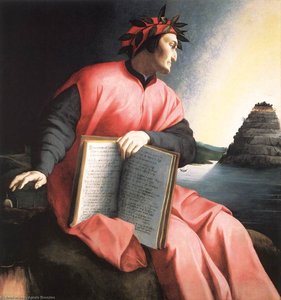 Allegorical Portrait of Dante1530
20
 Ugolino Martelli1535
21
 Cosimo I de' Medici in Armour1550 · Museo degli Argenti
22
 Pope Leo X1555 · 乌菲兹美术馆
23
 Saint Sebastian1533 · 萨尔瓦多·达利博物馆
24
 Venus, Cupid and Jealousy1550 · 布达佩斯美术博物馆
25
 Eleonora of Toledo with her son Giovanni de' Medici1544 · 乌菲兹美术馆
26
 Venus, Cupid and Time (detail)1540 · 国家美术馆
27
 Don Garcia de' Medici1550 · 普拉多博物馆
28
 Eleonora da Toledo1543 · National Gallery Prague
29
 Portrait of Eleanora di Toledo1560 · 国家美术馆
30
 Miracle of the Brazen Serpent1542 · 维奇奥宫
31
 Portrait of Lucrezia Panciatichi (detail)1540 · 乌菲兹美术馆
32
 Portrait of a Young Man1540 · 大都会艺术博物馆
33
 Martyrdom of St Lawrence1569 · 圣洛伦佐大殿
34
 Adoration of the Shepherds1539 · 布达佩斯美术博物馆
35
 Eleonora da Toledo1562
36
 The Miracle of the Spring1543 · 维奇奥宫
37
 Gathering of the Manna1543 · 维奇奥宫
38
 Galatea and Pygmalion1530
39
 Portrait of Ludovico Capponi1551 · 弗里克收藏
40
 Portrait of Cosimo I de' Medici1545 · 乌菲兹美术馆
41
 Costanza da Sommaia1540 · 底特律艺术学院
42
 Crossing of the Red Sea1542 · 维奇奥宫
43
 St John the Baptist1550 · 博尔盖塞美术馆
44
 Portrait of a Lady in Red (detail)1530 · 施泰德尔博物馆
45
 Portrait of a boy1540 · 博德博物馆
46
 The Feast Given by Joseph for His Brothers1550 · 沃尔特斯艺术博物馆
47
 Portrait of a Man, presumably a member of the Medici Family1545 · 斯泰恩斯博物馆艺术馆
48
 Portrait of a Lady with a Puppy1534
49
 Don Giovanni de’Medici1551 · 托莱多艺术博物馆
50
 Portrait of an Elderly Lady1540 · 旧金山美术馆
51
 Portrait of Lorenzo the Magnificent1560
52
 Portrait of a Young Man1550 · 国家美术馆
53
 Madonna and Child with Saint John the Baptist1540 · 底特律艺术学院
54
 Portrait of a Lady in Green1530 · 皇家收藏馆
55
 Virgin and Child with the Young Saint John the Baptist1528 · 芝加哥艺术学院
56
 Portrait of a young Man in black with a book1526
57
 portrait of a gentleman with his dog1527
58
 Portrait of Francesco I de Medici1527
59
 Madonna and Child with St. John the Baptist1530 · National Museum in Wrocław
60
 Guidobaldo della Rovere1531
61
 Eleonora di Toledo with her son Francesco1549
62
 Portrait of a Baby Boy1540 · 沃尔特斯艺术博物馆
63
 Portrait of Cosimo I de' Medici in armour1545 · The National Museum in Poznań
64
 View of the Chapel of Eleonora da Toledo1440 · 维奇奥宫
65
 Portrait of Giovanna Chevara and Giovanni Montalvo1562 · 伍斯特艺术博物馆
66
 Portrait of the dwarf Nano Morgantе (Back)1552
67
 Descent of Christ Into Limbo1552
68
 Portrait of a Woman1550 · 克利夫兰艺术博物馆
69
 Portrait of Cosimo I de' Medici, Grand Duke of Tuscany1550 · Gemäldegalerie Alte Meister im Schloss Wilhelmshöhe
70
 Portrait of a Young Man1560 · 柏林国家美术馆
71
 Piero de Medici il Gottoso1560 · 国家美术馆
72
 Portrait of Francesco I de' Medici1551
73
 Portrait of Bartolomeo Panciatichi1540 · 乌菲兹美术馆
74
 Portrait of a man (copy)1700 · 阿姆斯特丹博物馆
75
 Moses strikes water from the wall rocks1544
76
 Altarpiece1540 · 维奇奥宫
77
 The Dead Christ with the Virgin and St. Mary Magdalene1530
78
 Venus, Cupid and Envy1548 · 布达佩斯美术博物馆
79
 Saint John the Baptist1553
80
 Portrait of a Lady in Green1530 · 皇家收藏馆
81
 Portrait of Pope Clement VII1564 · 乌菲兹美术馆
82
 untitled (4490)1532
83
 The Holy Family1545
84
 Portrait of Francesco de’ Medici1560 · USC Fisher Museum of Art
85
 Lucrezia Panciatichi1540
86
 Adoration of the Shepherds (detail)1539 · 布达佩斯美术博物馆
87
 A Young Woman and Her Little Boy1540 · 国家美术馆
88
 The Holy Family1528 · 国家美术馆
89
 St Matthew1525
90
 Portrait of Lorenzo Lenzi1528
91
 St Mark1525
92
 Scenes of allegories of the cardinal virtues1544
93
 Adoration of the Shepherds (detail) (11)1539 · 布达佩斯美术博物馆
94
 The Israelites crossing the Red Sea1542
95
 Christ in Limbo1552
96
 Portrait of Nano Morgante1552
97
 The Crossing of the Red Sea1555
98
 The Panciatichi Holy Family (detail)
99
 Portrait of Guidubaldo della Rovere1532 · 帕拉蒂纳美术馆
100
 Stigmatization of St. Francis1544
这些原作中反复出现的四个主题,各有一个最杰出的范例。
收藏了本页中大部分画作的 8 家博物馆。
| 博物馆 | 城市 | 布龙齐诺 的作品 | 此列表中的画作 |
|---|---|---|---|
 乌菲兹美术馆 |
佛罗伦萨 | 18 | Holy Family, Portrait of Lucrezia Panciatichi, Pope Leo X |
 维奇奥宫 |
佛罗伦萨 | 11 | Miracle of the Brazen Serpent, The Miracle of the Spring, Gathering of the Manna |
 布达佩斯美术博物馆 |
布达佩斯 | 8 | Venus, Cupid and Jealousy, Adoration of the Shepherds, Venus, Cupid and Envy |
 国家美术馆 |
伦敦 | 5 | 维纳斯、丘比特和时间(情欲寓言), Venus cupid time, Venus, Cupid and Time (detail) |
 国家美术馆 |
华盛顿 | 4 | Eleonora di Toledo, Portrait of Eleanora di Toledo, A Young Woman and Her Little Boy |
 底特律艺术学院 |
底特律 | 2 | Costanza da Sommaia, Madonna and Child with Saint John the Baptist |
 沃尔特斯艺术博物馆 |
巴尔的摩 | 2 | The Feast Given by Joseph for His Brothers, Portrait of a Baby Boy |
 皇家收藏馆 |
伦敦 | 2 | Portrait of a Lady in Green, Portrait of a Lady in Green |
选择一个年代,探索定义该时代的原创杰作。

In this Mannerist oil painting, three figures occupy a vertical, tightly cropped arrangement against a dark, near-black background. The Virgin Mary is positioned centrally, her form defined by elongated lines and a graceful neck. She holds the Christ Child upon her lap. Beside them, the young Saint John the Baptist is present within the immediate group. The skin of the subjects appears smooth and porcelain-like, creating a contrast against the…
In this portrait, we encounter Cosimo I de' Medici, not merely as a ruler, but as the mythological musician Orpheus. He is positioned in a three-quarter view from behind, turning his gaze back toward us with a sense of psychological alertness. His body, rendered with a polished, marble-like texture, possesses an idealized beauty that speaks to the High Mannerist style. A single splash of crimson red drapery provides a sharp…
步入阿尼奥罗·布隆齐诺(Agnolo Bronzino)的“维纳斯、丘比特与时间 (情欲寓言)”这个引人入胜的世界,这是一幅16世纪的杰作,它巧妙地将神话叙事与艺术创新融为一体。这幅精致的作品邀请观赏者探索其丰富的象征意义、鲜艳的色彩和动态构图,使其成为任何艺术收藏品或精致室内装饰的永恒补充。
凝视 安尼奥·布龙齐诺 的 《埃莱奥诺拉·达·托莱多肖像》,仿佛直接步入了 盛期文艺复兴 时期佛罗伦萨那高雅脱俗的氛围之中。这幅创作于1555年的杰作,早已超越了单纯的面部写实;它是一座精心构建的丰碑,诉说着地位、权力和极致的优雅。画中主角 埃莱奥诺拉·达·托莱多 散发出一种近乎触手可及的贵族尊严。 布龙齐诺 笔下的她不仅是一位女性,更是美第奇家族影响力的象征——她的仪态举止无不彰显着通过数代赞助与政治博弈所积累的显赫财富。她那件华丽的红色长袍,点缀着闪耀的 金边饰纹,其意义远不止于衣着本身;它更是在向世人宣告,她在科西莫一世·德·美第奇的宫廷圈层中那崇高的社会地位。
“Deposition,” painted in 1565 by the Florentine master Agnolo Bronzino, is not merely a religious scene; it's a meticulously crafted tableau of restrained emotion and profound psychological depth. Commissioned for the Observant Monastery in Cosmopoli, this work transcends simple narrative to become a meditation on grief, loss, and the delicate balance between earthly sorrow and divine grace. Bronzino, renowned for his “reserved elegance,” achieved this through an almost unnervingly controlled…
维纳斯、丘比特和时间(情欲寓言) (1540),国家美术馆, 伦敦。紧随其后的是 埃莱奥诺拉·达·托莱多肖像 (1555) 和 Venus, Cupido and Satyr。
37岁:维纳斯、丘比特和时间(情欲寓言)创作于1540年,布龙齐诺出生于1503年。
维纳斯、丘比特和时间(情欲寓言), 埃莱奥诺拉·达·托莱多肖像, Venus, Cupido and Satyr, Portrait of Andrea Doria as Neptune, St. John the Baptist, Deposition, Portrait of a Young Man, Cosimo de Medici in Armour, Portrait of Cosimo I de' Medici as Orpheus 及 Portrait of Eleonora of Toledo and Her Son, Francesco de'Medici。上方排名显示了每件作品的创作年份及馆藏机构。
我们的目录收录了 189 件 布龙齐诺 的作品,创作年代从 1525 年至 1569 年。
多见于 乌菲兹美术馆 (佛罗伦萨), 维奇奥宫 (佛罗伦萨) 及 布达佩斯美术博物馆 (布达佩斯)。上方的博物馆列表列出了所有相关机构。
在 1540s 期间:本页 100 件作品中有 36 件创作于该时期,其中包含 维纳斯、丘比特和时间(情欲寓言) 件作品。
在本页面中,最早的作品创作于 St Matthew (1525),最晚的创作于 Martyrdom of St Lawrence (1569)。
Renaissance (34), Woman (16) 及 Portrait (16),共计 100 件作品。
Oil On Panel,共计 33 件(本页共有 100 件作品)。
根据本页面的原作,矫饰主义
Holy Family, Portrait of Lucrezia Panciatichi 及 Pope Leo X:乌菲兹美术馆, 佛罗伦萨收藏了本页中 8 件作品。
是的,作为复制品:原作仍保存在博物馆中,但您可以通过该画作的专属页面,为您定制任何一幅此页面上的手绘作品,每一件均为您量身打造。


