塞斯·伊斯特曼 肖像

37 幅最著名的 塞斯·伊斯特曼 作品,画廊精选

更新于 November 2026 · 基于我们的流行度评分排名(每件作品的搜索量、访问量及订单量) · 37 件 塞斯·伊斯特曼 作品收录于我们的目录中

简而言之

在 塞斯·伊斯特曼 留下的所有原作中,最著名的当属收藏于 波士顿 波士顿美术馆 的《Sioux Indians Breaking Up Camp (1848)》。 紧随其后的是 Dakotah village 和 Gathering Wild Rice。 我们的目录收录了 塞斯·伊斯特曼 的 37 件作品;画廊完整保留了 37 件享誉世界的杰作,并为每一件作品详细标注了创作日期、馆藏机构及其背后的故事。

1808 – 1875, 布伦瑞克 Hudson river school 藏品最多:Crocker Art Museum

塞斯·伊斯特曼 的十大名画:画廊精选

1
Sioux Indians Breaking Up Camp (1848) 由 塞斯·伊斯特曼

Sioux Indians Breaking Up Camp

1848 · Oil On Canvas · 波士顿美术馆, 波士顿

The scene unfolds in Sioux Indians Breaking Up Camp, a work painted by Seth Eastman. The air feels heavy with the movement of a people in transition, as the community prepares to leave their current site. This painting, dating to about 1848, captures a specific moment of departure across the expansive prairie. The figures move with purpose, tending to their belongings and animals under a vast, shifting sky.

2
Dakotah village 由 塞斯·伊斯特曼

Dakotah village

Painting

Dakotah village by Seth Eastman presents a detailed view of a Native American settlement. The scene is set within a grassy area where several people are positioned in various states of movement and rest. A group of individuals sits on the ground beneath umbrellas, which provide shade or protection from the elements. Around them, other people stand or walk through the village, contributing to a sense of constant motion. The…

3
Gathering Wild Rice 由 塞斯·伊斯特曼

Gathering Wild Rice

Oil

Gathering Wild Rice by Seth Eastman depicts three individuals navigating a traditional canoe through a marsh or riverine environment. The vessel features a pointed bow and stern, a design characteristic of boats intended for maneuverability in shallow waterways. Tall grasses surround the canoe, rising from the water to create a dense, vegetated setting. The person positioned at the stern uses an oar to steer the craft through the vegetation.

4
Ballplay of the Dakota on the St. Peters River in Winter (1848) 由 塞斯·伊斯特曼

Ballplay of the Dakota on the St. Peters River in Winter

1848 · Oil · 阿蒙·卡特美国艺术博物馆, 沃斯堡

In the quiet, biting chill of an 1848 winter, Seth Eastman captured more than just a landscape; he immortalized a vibrant pulse of life amidst the frost. Ballplay of the Dakota on the St. Peters River in Winter serves as a breathtaking window into a vanished era, where the frozen expanse of the river becomes a stage for communal joy and athletic prowess. The painting depicts a spirited game of…

5
Chippewa Encampment on the Upper Mississippi (1845) 由 塞斯·伊斯特曼

Chippewa Encampment on the Upper Mississippi

1845 · Watercolor · 圣路易斯艺术博物馆, 圣路易斯

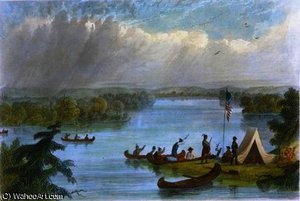
Seth Eastman captures a quiet moment of existence in "Chippewa Encampment on the Upper Mississippi." Painted about 1845, the work focuses on an indigenous encampment settled along a riverbank. Tall coniferous trees crowd the shoreline, their dark needles sheltering several tipis. The river flows through the scene, a steady presence beside the dwellings.

6
Buffalo Hunt (1848) 由 塞斯·伊斯特曼

Buffalo Hunt

1848 · Oil On Canvas · 辛辛那提艺术博物馆, 辛辛那提

In Buffalo Hunt by Seth Eastman, the horizon is a heavy line of gold and ochre. Painted about 1848, the scene captures a moment of high-stakes pursuit across the vast, rolling prairie. Native American hunters move through the landscape, their figures locked in a desperate chase against the momentum of a massive buffalo herd. The air feels thick with the dust of the plains and the heat of a setting…

7
Ball Playing among the Sioux Indians (1851) 由 塞斯·伊斯特曼

Ball Playing among the Sioux Indians

1851 · Oil · 国家美术馆, 华盛顿

The painting titled Ball Playing among the Sioux Indians captures a communal moment in a lush, green field. Created in 1851, this work by Seth Eastman presents a scene of movement and social connection. The figures are scattered across the landscape, engaged in a traditional sport that defines a specific afternoon in the life of the Sioux community.

塞斯·伊斯特曼 系列持续更新,第 11 至 37 项

令 塞斯·伊斯特曼 驻足的创作主题

这些原作中反复出现的四个主题,各有一个最杰出的范例。

收藏有 塞斯·伊斯特曼 原作的博物馆

收藏了本页中大部分画作的 7 家博物馆。

博物馆 城市 塞斯·伊斯特曼 的作品 此列表中的画作
Crocker Art Museum, 萨克拉门托Crocker Art Museum 萨克拉门托 2 Gathering Grass Seed, San Joaquin Valley, California, Transporting Water and Grass Seed, Valley of San Joaquin, California
波士顿美术馆, 波士顿波士顿美术馆 波士顿 1 Sioux Indians Breaking Up Camp
阿蒙·卡特美国艺术博物馆, 沃斯堡阿蒙·卡特美国艺术博物馆 沃斯堡 1 Ballplay of the Dakota on the St. Peters River in Winter
圣路易斯艺术博物馆, 圣路易斯圣路易斯艺术博物馆 圣路易斯 1 Chippewa Encampment on the Upper Mississippi
辛辛那提艺术博物馆, 辛辛那提辛辛那提艺术博物馆 辛辛那提 1 Buffalo Hunt
国家美术馆, 华盛顿国家美术馆 华盛顿 1 Ball Playing among the Sioux Indians
明尼阿波利斯艺术学院, 明尼阿波利斯明尼阿波利斯艺术学院 明尼阿波利斯 1 The Falls of St. Anthony

塞斯·伊斯特曼 的年度历程:定义其艺术风格的原创之作

塞斯·伊斯特曼 在此精选作品中的创作跨度仅为 7 年,从 1845 年至 1851 年:这是一段短暂的艺术生涯,在此按年份逐一呈现。

年度作品数量

选择年份以查看原作。

藏家关于 塞斯·伊斯特曼 作品的常见问题

塞斯·伊斯特曼 最著名的作品是哪一件?揭晓答案

Sioux Indians Breaking Up Camp (1848),波士顿美术馆, 波士顿。紧随其后的是 Dakotah village 和 Gathering Wild Rice。

创作 Sioux Indians Breaking Up Camp 时,塞斯·伊斯特曼 是多少岁?揭晓答案

40岁:Sioux Indians Breaking Up Camp创作于1848年,塞斯·伊斯特曼出生于1808年。

塞斯·伊斯特曼 最著名的十幅画作是什么?揭晓答案

Sioux Indians Breaking Up Camp, Dakotah village, Gathering Wild Rice, Ballplay of the Dakota on the St. Peters River in Winter, Chippewa Encampment on the Upper Mississippi, Buffalo Hunt, Ball Playing among the Sioux Indians, Lake itsaca, Wabeno Songs, from 'Information Respecting 及 Indian Burial,。上方排名显示了每件作品的创作年份及馆藏机构。

塞斯·伊斯特曼 留下了多少幅画作?揭晓答案

我们的目录收录了 37 件 塞斯·伊斯特曼 的作品,创作年代从 1845 年至 1851 年。

塞斯·伊斯特曼 的杰作收藏在哪些博物馆中?揭晓答案

多见于 Crocker Art Museum (萨克拉门托), 波士顿美术馆 (波士顿) 及 阿蒙·卡特美国艺术博物馆 (沃斯堡)。上方的博物馆列表列出了所有相关机构。

塞斯·伊斯特曼 在哪些年份创作了最著名的作品?揭晓答案

在 1848 期间:本页 37 件作品中有 3 件创作于该时期,其中包含 Sioux Indians Breaking Up Camp 件作品。

塞斯·伊斯特曼 的首件与末件名作原件分别是哪几件?揭晓答案

在本页面中,最早的作品创作于 Chippewa Encampment on the Upper Mississippi (1845),最晚的创作于 Ball Playing among the Sioux Indians (1851)。

塞斯·伊斯特曼 最常创作的主题是什么?揭晓答案

Grass (4), People (4) 及 Sky (3),共计 37 件作品。

塞斯·伊斯特曼 最常用的技法是什么?揭晓答案

Oil,共计 3 件(本页共有 37 件作品)。

塞斯·伊斯特曼 属于哪种艺术流派?揭晓答案

根据本页面的原作,Hudson river school

哪些 塞斯·伊斯特曼 的作品在 Crocker Art Museum 展出?揭晓答案

Gathering Grass Seed, San Joaquin Valley, California 及 Transporting Water and Grass Seed, Valley of San Joaquin, California:Crocker Art Museum, 萨克拉门托收藏了本页中 2 件作品。

塞斯·伊斯特曼:生平与作品

The Dual Vision of a Frontier Chronicler

Seth Eastman lived a life defined by the striking duality of the sword and the brush. As a West Point graduate and a distinguished officer in the United States Army, his early years were forged in the crucible of military discipline and the rugged expanses of the American frontier. During the Mexican-American War, Eastman did not merely navigate challenging terrains as a soldier; he observed them with the keen, analytical eye of a mapmaker. This period of service, marked by bravery and leadership, provided him with a unique vantage point—a perspective that blended the strategic precision of a military officer with the profound sensitivity of an artist.

His journey through the Dakota Territory and his command positions within the expanding West allowed him to witness the dramatic shifts of a nation in motion. While his military career saw him rise through the ranks to become a Lieutenant Colonel, it was his quiet moments of observation that would ultimately secure his place in the annals of American art history.

A Witness to Vanishing Worlds

Perhaps Eastman’s most enduring contribution to the American identity is his role as an ethnographic chronicler. Tasked by Congress with documenting the lives of Native American tribes following the Treaty of Fort Laramie, he undertook arduous expeditions that were as much scientific endeavors as they were artistic ones. His work for Henry Rowe Schoolcraft’s monumental six-volume study stands as a testament to his commitment to accuracy and detail. Through his hundreds of illustrations, Eastman captured the rhythmic pulse of the Sioux tribes in Minnesota and South and Dakota—documenting hunting rituals, sacred ceremonies, and the dignified portraits of tribal elders with an uncompromising realism.

These works are more than mere illustrations; they are windows into a way of life that was being irrevocably altered by the tides of westward expansion. In his depictions of communal joy, such as the spirited ballplay of the Dakota on the frozen St. Peters River, or the quiet dignity of daily survival, Eastman imbued his subjects with a humanity that transcended the colonial gaze. He possessed a rare ability to translate the ephemeral moments of frontier life into permanent visual records, ensuring that the vibrant culture of the Plains peoples would not be lost to the shadows of history. His brush served as a bridge between the known and the unknown, capturing the essence of a world in transition.

The Hudson River Legacy and the Golden West

Artistically, Eastman was deeply rooted in the Hudson River School tradition, a movement characterized by its reverence for the sublime power of nature. His style reflected the meticulous attention to detail and the luminous quality of light that defined his contemporaries, such as Thomas Moran. This influence is evident in his ability to render the landscape not just as a backdrop, but as a living, breathing protagonist in the American story.

This mastery of light and texture extended even to his explorations of the California frontier. In his delicate watercolors depicting the Yokuts people within the San Joaquin Valley, Eastman demonstrated an extraordinary capacity for capturing the translucent layers of the natural world. Whether portraying the purposeful movement of women gathering grass seed or the sweeping vistas of a golden valley, his work remained anchored in a profound connection to the earth. Through this seamless blend of military precision and artistic lyricism, Seth Eastman remains a singular figure—a man who mapped the land and, in doing so, captured its very soul.