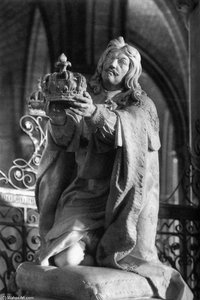
A Legacy in Stone: The Life and Art of Nicolas Coustou
Nicolas Coustou, a name synonymous with the grandeur of French
Baroque sculpture, emerged from the artistic heart of Lyon in 1658. His journey was one deeply interwoven with family, patronage, and an unwavering dedication to mastering his craft. Born into a lineage of artisans—his father, François Coustou, being a skilled woodcarver—the young Nicolas received his earliest training within the intimate setting of his family’s workshop. This foundational experience instilled in him not only technical proficiency but also a profound respect for the transformative power of artistic creation. A pivotal moment arrived with his relocation to Paris at the age of eighteen, where he entered the studio of his maternal uncle, the esteemed sculptor Charles
Antoine Coysevox.
Coysevox, then president of the newly established Académie royale de peinture et de sculpture, provided Coustou with access to the epicenter of French artistic innovation and a rigorous academic framework that would shape his future trajectory. This familial connection proved invaluable, opening doors to commissions and fostering an environment conducive to growth.
Rome and the Synthesis of Classical Ideals
Coustou’s burgeoning talent did not go unnoticed. In 1681, he was awarded the prestigious Colbert Prize—the Prix de Rome—a distinction that granted him a four-year sojourn at the French Academy in Rome. This period proved transformative. Immersed in the world of classical antiquity, Coustou meticulously studied the masterpieces of Michelangelo and Algardi, absorbing their distinct approaches to form and expression. He sought not merely to imitate these masters but to synthesize their strengths—Michelangelo’s dynamic energy and Algardi’s refined
classicism—into a style uniquely his own. The Roman experience instilled in him a deep appreciation for anatomical accuracy,
dramatic composition, and the power of sculpture to convey narrative and emotion. It was here that Coustou began to forge the artistic identity that would define his career, blending
Baroque exuberance with the timeless elegance of
classical ideals.
Royal Commissions and Collaborative Triumph
Upon his return to France, Coustou quickly established himself as a leading sculptor of the era. From 1700 onwards, he embarked on an extended period of collaboration with
Coysevox, working on ambitious projects at the palaces of Marly and Versailles—symbols of royal power and artistic magnificence. These commissions demanded not only exceptional technical skill but also an ability to translate the opulent vision of Louis XIV into tangible form. Coustou’s contributions to these grand residences were significant, encompassing allegorical figures, mythological scenes, and portrait busts that adorned the palace gardens and interiors. He rose through the ranks of the Académie royale de peinture et de sculpture, eventually becoming rector and chancellor, solidifying his position as a central figure in the
French art world. His collaborative spirit extended to his younger brother, Guillaume Coustou, also a renowned sculptor; their partnership often blurred the lines of authorship, resulting in works that showcased a harmonious blend of individual talents. Notable examples include *
Apollo pursuing Daphne*, a dynamic group embodying the
Baroque pursuit of
emotional intensity and dramatic movement.
Enduring Masterpieces and Lasting Influence
Despite the ravages of time and the destruction wrought by the French Revolution, several of Coustou’s masterpieces continue to inspire awe and admiration. *La Seine et la Marne*, a captivating allegorical sculpture representing two vital French rivers, stands as a testament to his ability to imbue stone with life and movement. The monumental *Descent from the Cross*, located behind the choir altar of Notre Dame de Paris, showcases his dramatic flair and technical prowess. *Le Passage du Rhin*, a bas-relief housed in
the Louvre, demonstrates his skill in narrative sculpture, capturing a pivotal moment in
French history with compelling detail. His portraits of Julius Caesar and Louis XV, also residing in
the Louvre, reveal his ability to capture both physical likeness and regal authority. Nicolas Coustou’s legacy extends beyond these individual works; he played a crucial role in shaping the aesthetic landscape of
Baroque sculpture in France, leaving an indelible mark on generations of artists who followed. He died in Paris on May 1st, 1733, having secured his place as one of the most celebrated sculptors of his time—a master whose artistry continues to resonate with viewers centuries later.