1

Ursula Tucher肖像
米歇爾·沃格穆特的《烏絲拉·圖赫畫作》,創作於1478年,是北歐文藝復興藝術的傑作,它不僅記錄了一位貴族女性的生活,更體現了當時紐倫堡社會的核心價值觀:虔誠、優雅和家庭榮譽。這幅畫作以其精湛的技巧和豐富的象征意義,成為了藝術家們學習和欣賞的典範。

更新于 November 2026 · 基于我们的流行度评分排名(每件作品的搜索量、访问量及订单量) · 15 件 迈克尔·沃尔格穆特 作品收录于我们的目录中
简而言之
在画廊看来,迈克尔·沃尔格穆特 最著名的作品是 Ursula Tucher肖像 (1478),其原作现收藏于 卡塞尔 的 Staatliche Museen。 Dance of Death (1493) 与 A Young Man (1486) 共同构成了那组令人过目不忘的艺术三部曲。 在我们的目录中,迈克尔·沃尔格穆特 共有 15 件作品,画廊为您精选了以下 15 件最著名的原作,并详细列出了每件作品的创作年份、馆藏机构及其独特之处。
米歇爾·沃格穆特的《烏絲拉·圖赫畫作》,創作於1478年,是北歐文藝復興藝術的傑作,它不僅記錄了一位貴族女性的生活,更體現了當時紐倫堡社會的核心價值觀:虔誠、優雅和家庭榮譽。這幅畫作以其精湛的技巧和豐富的象征意義,成為了藝術家們學習和欣賞的典範。

A stark, monochromatic scene unfolds in this 1493 woodcut, where the boundary between life and mortality dissolves into rhythmic chaos. Several skeletons engage in a lively, unsettling dance, their bony limbs caught in exaggerated, swirling poses. At the center of this macabre movement, a figure lies prone upon the ground, seemingly caught in the momentum of the skeletal procession. The composition utilizes a circular arrangement to emphasize the cyclical nature…

The portrait presents a bust-length view of a young man positioned slightly off-center, his gaze directed toward the right side of the frame. He wears a dark, somber headpiece and an outer garment of a similar deep black hue, which creates a sharp contrast against the pale, luminous skin of his face. Beneath the dark outer layer, a white undergarment with fine dark stripes is visible. His light brown hair…

Saint Lawrence and Archangel Michael with Sword and Scales by Michael Wolgemut presents a vertical and crowded composition. On the right, the Archangel Michael is rendered in full plate armor, his large, feathered wings spreading behind him. He holds a sword aloft in his right hand while his left hand balances a pair of scales. Within these scales, small, nude human figures are being weighed. To the left, Saint Lawrence…

The Portrait of the Nuremberg Apothecary Hans Perckmeister is a significant work by the German painter and printmaker Michael Wolgemut. Created in 1496, this portrait offers a direct encounter with a man of considerable civic standing in Nuremberg. The subject, Hans Perckmeister, was the son of the apothecary Conrad Perckmeister and inherited the family's professional legacy. He was a man deeply integrated into the social and political fabric of his…

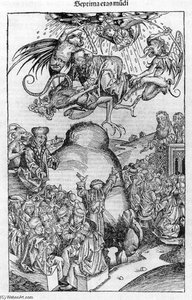
In this woodcut print from about 1493, Michael Wolgemut presents a scene of profound spiritual unrest. The work, titled Sermon of the Antichrist, depicts a religious and allegorical moment where the Antichrist delivers a sermon to a gathered audience. A large, ambiguous form dominates the middle ground, acting as a central mass around which the crowd is tightly packed. This central figure draws the eye, anchoring the chaotic energy of…

In this woodcut from 1493, we find ourselves drawn into a quiet, tense moment of maritime drama. The scene captures the mythological intersection of Circe and Ulysses, set upon the deck of a large, detailed vessel. There is a certain stillness to the composition, despite the inherent tension of the narrative. The central figure of Circe occupies a prominent position, her presence commanding the space around her as figures interact…

The composition settles into a vertical stillness, a ladder of holy figures rising toward the light. Saint Anne, the Virgin Mary, and the Christ Child occupy the center, their bodies forming a stable, sculptural pyramid. Deep reds and heavy blacks anchor the figures, while the soft pink of a drapery fold catches the light. Through the architectural pillars that frame the scene, a distant landscape unfolds in muted greens and…

The year is 1485, and within the bustling workshop of Michael Wolgemut in Nuremberg, a portrait emerges – a meticulously rendered depiction of Levinus Memminger, a prominent figure in the city's civic life. More than simply a likeness, this painting offers a captivating glimpse into the artistic sensibilities and social dynamics of early Renaissance Germany. Wolgemut’s work isn’t merely a representation; it’s an invitation to contemplate status, wealth, and the…

In the profound stillness of the late fifteenth century, Michael Wolgemut captured a moment of unparalleled cosmic significance. His Last Judgement is not merely a painting but a window into the medieval soul, a dramatic tableau where the temporal meets the eternal. The composition centers upon the majestic figure of Jesus Christ, serving as the ultimate arbiter of human destiny. Surrounding Him is a dense, emotive tapestry of humanity; men…
这些原作中反复出现的四个主题,各有一个最杰出的范例。
收藏了本页中大部分画作的 5 家博物馆。
| 博物馆 | 城市 | 迈克尔·沃尔格穆特 的作品 | 此列表中的画作 |
|---|---|---|---|
 Germanisches Nationalmuseum |
纽伦堡 | 4 | Portrait of the Nuremberg Apothecary Hans Perckmeister, The Virgin and Child with Saint Anne, Last Judgement |
 Staatliche Museen |
卡塞尔 | 1 | Ursula Tucher肖像 |
 底特律艺术学院 |
底特律 | 1 | A Young Man |
 提森·博爾涅米薩博物館 |
馬德里 | 1 | Portrait of Levinus Memminger |
 Brighton Museum & Art Gallery |
Brighton and Hove | 1 | Triptych with the Nativity and Saints |
选择一个年代,探索定义该时代的原创杰作。
Saint Lawrence and Archangel Michael with Sword and Scales by Michael Wolgemut presents a vertical and crowded composition. On the right, the Archangel Michael is rendered in full plate armor, his large, feathered wings spreading behind him. He holds a sword aloft in his right hand while his left hand balances a pair of scales. Within these scales, small, nude human figures are being weighed. To the left, Saint Lawrence…
米歇爾·沃格穆特的《烏絲拉·圖赫畫作》,創作於1478年,是北歐文藝復興藝術的傑作,它不僅記錄了一位貴族女性的生活,更體現了當時紐倫堡社會的核心價值觀:虔誠、優雅和家庭榮譽。這幅畫作以其精湛的技巧和豐富的象征意義,成為了藝術家們學習和欣賞的典範。
The portrait presents a bust-length view of a young man positioned slightly off-center, his gaze directed toward the right side of the frame. He wears a dark, somber headpiece and an outer garment of a similar deep black hue, which creates a sharp contrast against the pale, luminous skin of his face. Beneath the dark outer layer, a white undergarment with fine dark stripes is visible. His light brown hair…
A stark, monochromatic scene unfolds in this 1493 woodcut, where the boundary between life and mortality dissolves into rhythmic chaos. Several skeletons engage in a lively, unsettling dance, their bony limbs caught in exaggerated, swirling poses. At the center of this macabre movement, a figure lies prone upon the ground, seemingly caught in the momentum of the skeletal procession. The composition utilizes a circular arrangement to emphasize the cyclical nature…
In the profound stillness of the late fifteenth century, Michael Wolgemut captured a moment of unparalleled cosmic significance. His Last Judgement is not merely a painting but a window into the medieval soul, a dramatic tableau where the temporal meets the eternal. The composition centers upon the majestic figure of Jesus Christ, serving as the ultimate arbiter of human destiny. Surrounding Him is a dense, emotive tapestry of humanity; men…
The composition settles into a vertical stillness, a ladder of holy figures rising toward the light. Saint Anne, the Virgin Mary, and the Christ Child occupy the center, their bodies forming a stable, sculptural pyramid. Deep reds and heavy blacks anchor the figures, while the soft pink of a drapery fold catches the light. Through the architectural pillars that frame the scene, a distant landscape unfolds in muted greens and…
Ursula Tucher肖像 (1478),Staatliche Museen, 卡塞尔。紧随其后的是 Dance of Death (1493) 和 A Young Man (1486)。
44岁:Ursula Tucher肖像创作于1478年,迈克尔·沃尔格穆特出生于1434年。
Ursula Tucher肖像, Dance of Death, A Young Man, Saint Lawrence and Archangel Michael with Sword and Scales, Portrait of the Nuremberg Apothecary Hans Perckmeister, Sermon of the Antichrist, Circe and Ulysses, The Virgin and Child with Saint Anne, Portrait of Levinus Memminger 及 Last Judgement。上方排名显示了每件作品的创作年份及馆藏机构。
我们的目录收录了 15 件 迈克尔·沃尔格穆特 的作品,创作年代从 1459 年至 1510 年。
多见于 Germanisches Nationalmuseum (纽伦堡), Staatliche Museen (卡塞尔) 及 底特律艺术学院 (底特律)。上方的博物馆列表列出了所有相关机构。
在 1490s 期间:本页 15 件作品中有 4 件创作于该时期,其中包含 Dance of Death 件作品。
在本页面中,最早的作品创作于 Saint Lawrence and Archangel Michael with Sword and Scales (1459),最晚的创作于 The Virgin and Child with Saint Anne (1510)。
Man (3), Monochrome (2) 及 Black clothing (2),共计 15 件作品。
Woodcut,共计 4 件(本页共有 15 件作品)。
根据本页面的原作,Northern renaissance
Portrait of the Nuremberg Apothecary Hans Perckmeister, The Virgin and Child with Saint Anne 及 Last Judgement:Germanisches Nationalmuseum, 纽伦堡收藏了本页中 4 件作品。