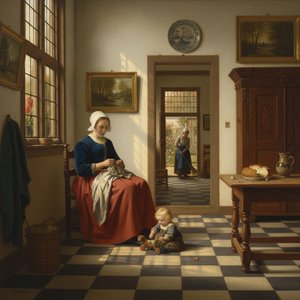
The Avian Majesty of Melchior de Hondecoeter
In the golden twilight of the Dutch Golden Age, few artists captured the vibrant pulse of the natural world as vividly as Melchior de Hondecoeter. A master of the Baroque era, his brush possessed a rare alchemy, capable of transforming mere pigment into the iridescent sheen of a peacock’s plume or the delicate, translucent down of a songbird. Born in Utrecht around 1636, Hondecoetter emerged not merely as a painter of animals, but as a storyteller of the exotic and the magnificent. His work serves as a window into a century defined by global exploration, where the arrival of rare species from distant lands ignited a profound fascination with the wonders of the natural order.
The foundation of his extraordinary talent was laid through rigorous discipline and an unwavering commitment to anatomical truth. Apprenticeship under the esteemed Willem van Royen provided him with the technical scaffolding necessary to master the complexities of light and shadow. Yet, Hondecoetter’s genius lay in his ability to transcend mere scientific documentation. While he approached his subjects with the precision of a naturalist—studying musculature and skeletal structure with almost clinical devotion—he infused every composition with a theatrical energy characteristic of the Baroque movement. His canvases are never static; they are stages where birds interact, preen, and take flight amidst lush, atmospheric landscapes.
A Symphony of Color and Motion
To gaze upon a Hondecoeter masterpiece is to experience a sensory deluge. He rejected the muted, somber palettes that often characterized much of Dutch genre painting, opting instead for a bold, expressive use of color that commands the viewer's attention. His technique was a sophisticated balance of precise observation and expressive bravura. Through masterful rendering of texture, he could differentiate between the heavy, waxy surface of a waterfowl’s wing and the soft, airy lightness of a forest dweller. This tactile quality creates an immersive experience, pulling the observer into a world where the rustle of feathers feels almost audible.
The development of his style saw him move toward increasingly complex and dynamic compositions. He became renowned for his ability to arrange multiple subjects within a single frame, creating a sense of organized chaos that mirrors the untamed beauty of nature. These works often featured:
- Exoticism: The inclusion of rare, brightly colored birds that symbolized wealth, discovery, and the expanding horizons of the Dutch Republic.
- Dramatic Lighting: A use of chiaroscuro that highlighted the intricate details of plumage while casting deep, mysterious shadows in the surrounding foliage.
- Narrative Depth: Scenes that suggested a larger story, whether it be a moment of predatory tension or a peaceful interlude in a sun-drenched garden.
Legacy and Historical Significance
Melchior de Hondecoeter’s influence extended far beyond the borders of the Netherlands. As an animalier, he helped establish a specialized genre that would captivate collectors across Europe, from the courts of kings to the homes of wealthy merchants. His ability to marry scientific accuracy with high art ensured that his work was valued both for its aesthetic splendor and its contribution to the era's burgeoning interest in natural history.
Though his life ended in 1695, his artistic footprint remains indelible. He did not simply paint birds; he elevated them to subjects of profound dignity and drama. In an age of discovery, Hondecoeter acted as a visual chronicler of the earth's splendor, leaving behind a legacy of canvases that continue to breathe with life, color, and an eternal sense of wonder. His work remains a testament to the power of art to bridge the gap between the observed world and the human imagination.
问答详情
Melchior De Hondecoetter 的创作时期属于哪个历史阶段?
Melchior De Hondecoetter 的创作时期处于 Early Modern 时期。这一时期确立了艺术家在历史中的地位。
在哪里可以找到关于Melchior De Hondecoetter作品的相关统计数据?
Melchior De Hondecoetter 的 访问统计 页面展示了基于 本网站 上列出的艺术家作品所计算出的统计数据。
我可以通过主题来探索 Melchior De Hondecoetter 的作品吗?
Melchior De Hondecoetter 的 主题图谱 是一个按主题对艺术家作品进行索引的页面。
是否有Melchior De Hondecoetter作品的完整列表?
您可以在 Melchior De Hondecoetter 的 全部作品 页面上浏览其在 本网站 上的所有作品。
可以按心情浏览 Melchior De Hondecoetter 的作品吗?
艺术家的 心情空间 页面展示了 Melchior De Hondecoetter 按氛围分类排列的艺术作品。
在哪里可以按技法分类浏览 Melchior De Hondecoetter 的作品?
全部媒介 页面按技法对 Melchior De Hondecoetter 的作品进行了分类。
目前目录中共有多少件 Melchior De Hondecoetter 的作品可供浏览?
您可以在 全部作品 页面浏览由 Melchior De Hondecoetter 创作的 62 件作品 件作品。