The Artisan of Colonial Boston: The Life and Legacy of Joseph Badger
In the bustling, salt-aired streets of eighteenth-century Boston, where the intellectual fervor of the Enlightenment began to stir amidst colonial tradition, there lived a man whose brush captured the very soul of a burgeoning nation. Joseph Badger (c. 1707–1765) was far more than a mere recorder of faces; he was a bridge between the practical grit of colonial craftsmanship and the refined elegance of high portraiture. Born in Charlestown to Stephen Badger, a skilled tailor, and Mercy Kettell, his early life was rooted in the industrious spirit of Massachusetts. Before he ever commanded the attention of the merchant elite, Badger honed his eye through the meticulous labor of an apprentice house painter and glazier. This foundational period of manual artistry instilled in him a profound reverence for materials and a precision of touch that would later define his most celebrated canvases.
Badger’s journey was one of constant movement and adaptation, reflecting the fluid social structures of his era. After marrying Katharine Felch in 1731, he transitioned to the heart of Boston around 1733, establishing himself within a community of thinkers and traders. While his primary calling was the pursuit of fine art, the economic realities of colonial life required a versatile hand. To sustain his practice during periods when portrait commissions were sparse, Badger turned to the more utilitarian arts, painting signs, hatchments, and heraldic devices. This duality of vocation—the ability to move between the decorative and the profound—allowed him to maintain a constant presence in the visual landscape of the city, ensuring that even his most commercial works carried the weight of his developing mastery.
A Mastery of Light and Character
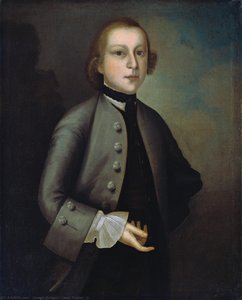
The true brilliance of Badger’s work lies in his ability to transcend simple likeness, imbuing his subjects with an unmistakable sense of presence and intellect. Influenced by the enduring traditions of European portraiture, particularly the subtle realism found in Dutch masters, he developed a technique characterized by an expressive handling of light and shadow. His portraits do not merely sit upon the canvas; they breathe with the dignity of their sitters. In his famous 1747 depiction of James Bowdoin, one can observe how Badger utilizes composition to convey status and curiosity, placing the subject against a backdrop that suggests both maritime prosperity and scholarly depth.
His subjects were often the architects of colonial society—wealthy merchants, influential clergymen, and prominent families who sought to immortalize their legacy. Through his brush, these figures are rendered with a realism that captures the texture of fine fabrics, the glint of light on polished surfaces, and the nuanced expressions of a class navigating a changing world. His work serves as a vital historical window, offering glimpses into the social fabric of Boston through the very clothing, posture, and gaze of its most notable citizens.
Historical Significance and Rediscovery
Though his talent was respected during his lifetime, the true magnitude of Joseph Badger’s contribution to American art underwent a period of quietude following his death in 1765. For many years, his name resided in the shadows of later, more famous American masters. It was not until the early twentieth century, through the scholarly efforts of historians like Lawrence Park, that the significance of his oeuvre was fully re-evaluated and brought back into the light of art historical discourse.
Today, Badger’s legacy is preserved in some of the most prestigious institutions in the United States, serving as a cornerstone for anyone studying the evolution of American portraiture. His works can be found in:
- The Museum of Fine Arts, Boston: Where his ability to capture the colonial spirit remains on permanent display.
- The Worcester Art Museum: Housing pieces that showcase his technical command and historical importance.
- Historic New England’s Phillips House: Preserving the connection between his art and the domestic history of Salem.
Ultimately, Joseph Badger remains a pivotal figure in the narrative of early American art. He represents the transition from the functional trades of the colonial era to the sophisticated artistic expressions of a maturing society. His life, marked by both the humble work of a glazier and the elevated pursuit of the portraitist, mirrors the very growth of the American identity itself—a journey from craftsmanship toward a distinct and enduring cultural voice.