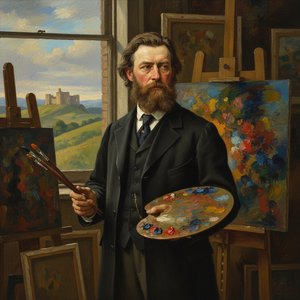
The Dawn of a Scottish Master
Born in the historic heart of Edinburgh in 1839, John Pettie emerged as one of the most captivating figures of the Victorian era. His journey toward artistic greatness began not in the grand galleries of Europe, but amidst the quiet, rural landscapes of East Linton. While his father, Alexander, initially harbored reservations about a professional life in the arts, the young Pettie’s talent was undeniable. A pivotal moment arrived with a humble yet profound portrait of a village carrier’s donkey, a work that demonstrated his innate ability to capture the very essence of life and character. This early mastery of observational truth would become the cornerstone of his later, more dramatic achievements.London Eminence and Artistic Kinship
The formal shaping of Pettie’s genius took place at the prestigious Trustees Academy in Edinburgh under the guidance of Robert Scott Lauder. Here, he absorbed the classical rigor and meticulous attention to detail that would define his legendary technique. In 1862, seeking broader horizons, Pettie moved to London, where he became a central figure within a vibrant community of expatriate Scottish painters. Sharing a studio in Fitzroy Square with contemporaries like William Quiller Orchardson, he fostered an environment of intense creativity and mutual support. His life was deeply intertwined with the musical arts as well; he famously championed the young composer Hamish MacCunn, organizing concerts in his own studio and even welcoming the composer into his family through marriage. This period of academic distinction saw him rise to become a full member of the Royal Academy, cementing his status among the elite of British art.A Legacy of Narrative and Light
Pettie’s true enduring legacy lies in his ability to transform historical chronicles into living, breathing dramas. Drawing deep inspiration from the sweeping romanticism of Sir Walter Scott’s novels, his canvases breathed life into tales of old, blending the tension of historical conflict with an almost Impressionistic vitality. His technique was a masterful marriage of classical principle and energetic brushwork, utilizing a vibrant color palette to evoke the atmospheric weight of the past. Whether capturing the chaotic intensity of a historical execution or the quiet dignity of a portrait, Pettie’s work remains a captivating window into the nineteenth century. His most celebrated contributions include:- An Arrest for Witchcraft in the Olden Time
- The Puritan
- The Rival Roses
问答详情
John Pettie 最常使用的色彩有哪些?
John Pettie 作品的色彩特征展示在艺术家的 色彩基因 页面上。
我可以通过艺术流派来浏览 John Pettie 的作品吗?
您可以在John Pettie的全部流派页面上,按艺术流派浏览其作品。
是否有关于 John Pettie 的生平年表?
您可以在艺术家的 艺术历程 页面上查阅 John Pettie 作品的编年史,其作品按创作顺序分章节依次呈现。