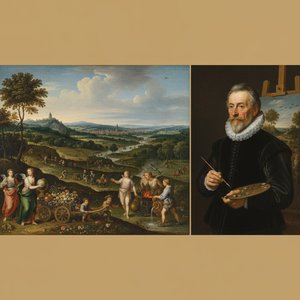
The Architect of the Antwerp Countryside
Jacob Grimmer stands as a pivotal figure in the evolution of Flemish landscape painting during the Renaissance, marking a decisive shift away from grandiose panoramas towards a more contemplative and authentic portrayal of the Antwerp countryside. His artistic vision championed simplicity and meticulous observation, profoundly impacting subsequent generations of painters and securing his place amongst the most celebrated artists of his era. Born around 1525 in the vibrant merchant city of Antwerp, Grimmer was the son of Nicolaas Cops and Elisabeth Loureiro. While biographical details remain somewhat elusive, his professional trajectory is well-documented through his registration in the Antwerp Guild of Saint Luke.
The early years of Grimmer’s life were steeped in the rich artistic milieu of the Low Countries. Although art historians debate the exact nature of his training, accounts suggest he may have honed his skills under masters such as Matthys Cock and Christian van den Corpen. The only definitive documentary evidence from this period is his 1539 registration as a student under Gabriel Bouwens. This formative era provided him with the technical foundation necessary to move beyond the world landscape tradition—a style characterized by fantastical, much larger-than-life panoramas and whimsical rock formations—toward a more grounded, realistic aesthetic that celebrated the subtle beauty of the local terrain.
A Mastery of Season and Light
Grimmer’s artistic legacy is most profoundly felt in his ability to capture the rhythmic pulse of nature. He was a painter of labor, light, and the passing seasons, often creating works that reflected the changing cycles of the year. One of his most enduring contributions to the Flemish tradition was his exploration of the Four Seasons and the Twelve Months. In these series, Grimmer masterfully blended landscape with genre painting, portraying villagers engaged in the seasonal rhythms of rural life—from the arduous labor of the harvest to the communal joy of winter festivals.
His technique was characterized by an unwavering commitment to plein air principles, working directly from nature to achieve a level of atmospheric accuracy that was rare for his time. As a capable colorist, Grimmer possessed the ability to create harmonic landscapes through the use of realistic tones and effective atmospheric values. His compositions often featured low horizons and broad views that allowed the viewer to feel immersed in the weather and light of the Antwerp region. Whether depicting the skeletal beauty of a winter frost or the lush, golden warmth of autumn, his work breathed life into the landscape, making the environment itself a central protagonist.
Legacy and Historical Significance
The influence of Jacob Grimmer extends far beyond the borders of 16th-century Flanders. By moving away from the stylized, imaginary vistas of his predecessors, he paved the way for a more naturalistic approach to landscape art that would define much of the Dutch and Flemish Golden Age. His work echoes the spirit of Pieter Bruegel the Elder, yet Grimmer carved out a distinct identity through his focus on atmospheric depth and the quiet dignity of the rural landscape. His son, Abel Grimmer, would also go on to achieve distinction as a painter and architect, continuing the family's artistic lineage.
Today, Grimmer’s paintings serve as vital historical windows into the social and natural world of the Renaissance. His ability to find profound beauty in the mundane—a ruined wall in a forest, a peasant walking along a dusty road, or the simple movement of horse-drawn carts—reminds us of his role as a pioneer of authenticity. Through his meticulous observation and emotional resonance, Jacob Grimmer transformed the landscape from a mere backdrop into a soulful reflection of human existence and the eternal cycles of the earth.