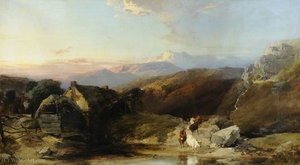
The Quiet Elegance of Henry Bright
In the heart of the nineteenth century, a period defined by rapid industrial transformation, the works of Henry Bright offered a sanctuary of stillness and pastoral grace. Born in 1812 in the tranquil town of Saxmundham, Suffolk, Bright was a child of the English countryside, a heritage that would later manifest in his profound ability to capture the soul of the landscape. His early life was not one of immediate artistic pursuit; rather, it was shaped by a practical apprenticeship to a chemist, first in Woodbridge and later in Norwich. It was during these formative years, amidst the measured rhythms of apothecary work, that his true passion began to emerge through the quiet habit of sketching, eventually leading him toward the prestigious Norwich School of painters.
Bright’s artistic evolution was deeply intertwined with the masters of his era. He found significant inspiration in the works of John Frederick Herring Sr., whose command over watercolor and animal subjects left an indelible mark on Bright’s technique. This influence is evident in the way Bright approached his subjects—not merely as static elements of a landscape, but as living components of a breathing ecosystem. His development was further enriched by his association with Alfred Stannard and his collaborative spirit with fellow artists like William Shayer. In these partnerships, Bright often took on the vital role of painting backgrounds, demonstrating a sophisticated understanding of atmospheric perspective and the structural depth required to make a scene feel truly immersive.
A Mastery of Atmosphere and Detail
The essence of Bright’s oeuvre lies in its understated beauty. While many of his contemporaries sought the dramatic or the monumental, Bright found greatness in the minute and the mundane. His compositions frequently feature the gentle movement of livestock, the weathered textures of old barns, and the soft light filtering through dense foliage. He possessed a rare talent for plein air observation, allowing him to translate the fleeting nuances of light and shadow onto canvas and paper with remarkable fidelity. Whether working in oil or watercolor, his palette remained rooted in the muted, earthy tones that define the English pastoral tradition.
His technical prowess is perhaps most notable in his ability to create depth through tonal variation. In works such as "Trees by a River with Cattle," one can observe how he utilizes atmospheric perspective to guide the viewer's eye from the detailed textures of the foreground into the hazy, ethereal distance. This mastery allowed him to elevate simple rural scenes into profound meditations on peace and permanence. His work often explores several key themes:
- The Dignity of Rural Life: A focus on the harmonious coexistence of humans, animals, and nature.
- Atmospheric Light: The use of subtle tonal shifts to capture specific times of day, from dawn to dusk.
- Textural Realism: Meticulous rendering of organic elements like bark, water, and stone.
Legacy and Historical Significance
Beyond the canvas, Bright lived a life of multifaceted engagement, serving as a respected merchant in London, which provided him with a unique perspective on the intersection of commerce and culture. His reputation grew steadily throughout the Victorian era, earning him recognition that extended beyond the local circles of East Anglia. The historical significance of his work lies in its role as a preservation of a vanishing way of life; through his eyes, we witness the English landscape before the full weight of the industrial revolution altered its character forever.
Today, the legacy of Henry Bright is preserved in esteemed institutions such as the Norwich Castle Museum, where his paintings continue to resonate with modern viewers. His ability to evoke nostalgia and a sense of profound tranquility ensures that his contribution to the Norwich School remains vital. He did not merely paint landscapes; he captured the quiet dignity of the natural world, leaving behind a body of work that serves as a timeless testament to the beauty of the English countryside.