


1

穹顶:朱庇特宝座周围的神灵集会
《穹顶:朱庇特宝座周围的神灵集会》是 朱利奥·罗曼诺 创作的一幅具有里程碑意义的 湿壁画。这件作品创作于1532年,坐落于意大利曼托瓦特宫(Palazzo del Tè)内的巨人厅(Sala dei Giganti)天花板之上。这部宏伟的装饰杰作见证了艺术家艺术风格的深刻转型——他逐渐背离了 盛期文艺复兴 时期那种追求古典和谐的理想,转而拥抱 风格主义 那种充满表现力与张力的美学表达。

更新于 November 2026 · 基于我们的流行度评分排名(每件作品的搜索量、访问量及订单量) · 114 件 朱利奧·羅馬諾 作品收录于我们的目录中
简而言之
穹顶:朱庇特宝座周围的神灵集会 (1532) 是朱利奧·羅馬諾最受瞩目的画作。 随后,目光会移向 View of the Sala dei Giganti (vault and south wall) (1526) 和 Tapestry with Playing Putti (1545)。 在 朱利奧·羅馬諾 的 114 件作品中,这 100 件最为闻名;每一件都是独一无二的原作,并附有创作年份、馆藏机构及其经久不衰的原因。
《穹顶:朱庇特宝座周围的神灵集会》是 朱利奥·罗曼诺 创作的一幅具有里程碑意义的 湿壁画。这件作品创作于1532年,坐落于意大利曼托瓦特宫(Palazzo del Tè)内的巨人厅(Sala dei Giganti)天花板之上。这部宏伟的装饰杰作见证了艺术家艺术风格的深刻转型——他逐渐背离了 盛期文艺复兴 时期那种追求古典和谐的理想,转而拥抱 风格主义 那种充满表现力与张力的美学表达。

To gaze upon this magnificent fresco, View of the Sala dei Giganti (vault and south wall), is to step directly into the vibrant heart of the High Renaissance. Painted in 1526 by the masterful hand of Giulio Romano, this work transcends mere decoration; it is a profound narrative tapestry woven from human drama, natural vitality, and divine symbolism. The scene explodes with life, drawing the viewer into a monumental gathering…

To gaze upon this depiction of a tapestry with playing putti is to step directly into an idealized moment plucked from the heart of the Italian Renaissance. It is more than just a painting; it is a captured breath of youthful exuberance, rendered with the masterful touch characteristic of Giulio Romano. The scene unfolds as a vibrant pastoral tableau, where several cherubic figures—the beloved putti—engage in playful revelry. Their presence…

To stand before an image like the Allegory of the Virtues of Federico II Gonzaga is to step directly into the vibrant, intellectual heart of the Italian High Renaissance transitioning into Mannerism. This monumental work, executed in 1531 by Giulio Romano, is far more than a mere depiction of figures; it is a carefully orchestrated philosophical statement rendered in pigment and plaster. The scene unfolds with an almost theatrical richness,…

Giulio Romano’s “The Lovers,” painted around 1525, isn't merely a depiction of intimacy; it’s a meticulously crafted tableau brimming with symbolism and echoing the complex currents of the High Renaissance. Born Giulio Pippi in Rome around 1499, Romano swiftly ascended through the ranks of Raphael’s studio, absorbing the master’s classical ideals while simultaneously forging his own distinctive Mannerist style – a style characterized by heightened emotion, distorted forms, and an…

This detail from 1535 captures a fragment of a larger religious narrative, focusing on the human response to a divine presence. A central figure, distinguished by a large staff topped with a cross, anchors the composition. The arrangement of figures creates a sense of depth through overlapping forms and varying scales, drawing the eye from the immediate foreground into a complex, crowded space. The composition avoids the static balance of…

Giulio Romano's "The Birth of Bacchus," a monumental charcoal and chalk drawing from 1533, isn’t merely a depiction of a mythological scene; it’s a visceral exploration of human drama, a raw sketch brimming with energy and symbolic weight. Born Giulio Pippi in Rome around 1499, Romano emerged as a pivotal figure within the waning embers of the High Renaissance, swiftly absorbing the influence of Raphael while forging his own distinctive…

Giulio Romano’s “Flaying of Marsyas” isn't merely a depiction of a mythological punishment; it’s a visceral embodiment of struggle, humiliation, and the brutal intersection of divine power and mortal defiance. Painted in 1525-35 during his tenure as court artist for Duke Federico Gonzaga of Mantua, this monumental fresco – now meticulously reproduced on canvas – plunges the viewer directly into the heart of Ovid’s *Metamorphoses*. The story itself is a…

A Tapestry of Time and Transformation: Giulio Romano’s “Victory, Janus, Chronos, and Gaea” Giulio Romano's "Victory, Janus, Chronos, and Gaea," painted in 1532-1534 during his illustrious tenure as court artist for Federico II Gonzaga of Mantua, is more than just a visually arresting fresco; it’s a profound meditation on the cyclical nature of time, the duality of existence, and the very essence of Roman mythology. Born Giulio Pippi in Rome…

A Vision of Renaissance Grandeur: Exploring Giulio Romano’s Palazzo del Té Giulio Romano's *View of the Palazzo del Té* stands as a testament to the zenith of Mannerist art and architectural ambition—a project conceived by Federico Gonzaga, Duke of Mantua, between 1526 and 1534. More than just a building, it embodies an entire worldview: a deliberate rejection of linear perspective and idealized beauty in favor of dramatic illusionism and psychological…
 Evangelist symbols1522 · 维也纳艺术史博物馆
12
 View of the Salone dei Cavalli1526
13
 The Old Woman and Vulcan, Tribute to Apollo1526
14
 Nude Child with Open Arms乌菲兹美术馆
15
 The Holy Family1520 · J·保罗·盖蒂博物馆
16
 An Allegory of Immortality1540 · 底特律艺术学院
17
 The Holy Family, St John with a small Bird in his Hand1530 · 斯泰恩斯博物馆艺术馆
18
 The Holy Family with the Infant Saint John the Baptist1520 · 苏格兰国家美术馆
19
 Madonna and Child with the Infant St. John1516
20
 The Virgin and Child1518 · Apsley House
21
 Tarquin and Lucretia1536 · 曼托瓦公爵府
22
 'The Horse ''Morel favorito'''1526
23
 St. John the Baptist in the Wilderness1520
24
 Nurture of Jupiter1533 · Blickling Hall
25
 Group of three lictors1530 · 华沙国家博物馆
26
 Tapestry Cartoon: Two Heads from the Massacre of the Innocents1522 · 苏格兰国家美术馆
27
 Bacchus and Ariadne1530 · 斯泰恩斯博物馆艺术馆
28
 Vertumnus and Pomona1530 · 斯泰恩斯博物馆艺术馆
29
 Female nude, half figure1527
30
 Vaulted ceiling (8)1526
31
 Fresco on the east wall (detail)1532
32
 View of the Sala di Psiche (west wall)1526
33
 Fresco on the south wall (detail) (9)1532
34
 Jupiter Seducing Olympias1526
35
 Self-portrait1540
36
 Tomb of Pietro Strozzi1529 · Sant'Andrea
37
 Virgin and Child with the Infant St John1523 · 博尔盖塞美术馆
38
 Façade1526 · 特宫 (Tè 宫)
39
 The Madonna and Child with Saint John the Baptist1522 · 沃尔特斯艺术博物馆
40
 The Fall of the Gigants from Mount Olympus
41
 Chariot of the Sun1526
42
 Frieze (detail)1532
43
 Hunting Scene1527
44
 Hunting Scene1527
45
 Polyphemus1526
46
 Ceiling decoration (detail) (12)1527
47
 View of the Sala di Psiche (north and east walls)1526
48
 View of the Sala di Psiche (south wall)1526
49
 Psyche's Second Task (River Deity)1526
50
 Vaulted ceiling (detail) (10)1526
51
 Vaulted ceiling (detail) (18)1526
52
 Psyche Appealing in Vain to Juno1526
53
 Portrait of a Woman (detail)1531 · 皇家收藏馆
54
 View of the Sala dei Giganti (south and west walls)1532
55
 View of the Sala dei Giganti (south wall)1532
56
 The Prisoners1527
57
 View of the Sala di Psiche (east wall)1526
58
 Vault: The Assembly of Gods around Jupiter's Throne (detail)1532
59
 Ceiling decoration (detail) (11)1527
60
 Fresco on the north wall (detail)1532
61
 Vaulted ceiling (detail) (17)1526
62
 Vaulted ceiling (detail) (19)1526
63
 Emperor Alexander1532
64
 Coat-of-arms1532
65
 View of the Sala dei Giganti (west wall)1532
66
 River Landscape with Springs1526
67
 View of the Salone dei Cavalli1526
68
 Fresco on the south wall (detail)1532
69
 Vaulted ceiling (detail) (16)1526
70
 Tribute to Apollo1526
71
 Vaulted ceiling1526
72
 View of the Sala dei Giganti (north wall)1532
73
 View of the Sala dei Giganti (east wall)1532
74
 Ceiling decoration1527
75
 Cupid and Psyche1526
76
 Design for a Saltcellar1524
77
 Fresco on the south wall (detail) (12)1532
78
 Fresco on the north wall (detail)1532
79
 Mars Chasing Adonis from Venus's Pavilion1526
80
 Vault: The Assembly of Gods around Jupiter's Throne (detail)1532
81
 Fresco on the south wall (detail) (10)1532
82
 The Old Woman and Vulcan1526
83
 Ceiling (detail)1526
84
 Tribute to Apollo1526
85
 Ajax Defends Patroclus's Corps1538 · 曼托瓦公爵府
86
 View of the Sala di Troia (10)1536
87
 View of the Sala di Troia (12)1538
88
 Ajax Defends Patroclus's Corps1538
89
 View of the Sala di Troia (11)1536
90
 Façade and courtyard view1526 · 特宫 (Tè 宫)
91
 Monteluce madonna
92
 Venus and Vulcan
93
 Satyr and Boy
94
 Copy after Giulio Romano1536 · 克利夫兰艺术博物馆
95
 Virgin with the Child1520 · 乌菲兹美术馆
96
 Triumph of Titus and Vespasian1537 · 卢浮宫
97
 Study for the Holy Family1518 · 卢浮宫
98
 Banquet of Cupid and Psyche特宫 (Tè 宫)
99
 Saint Mary Magdalene borne by Angels国家美术馆
100
 The Circumcision卢浮宫
这些原作中反复出现的四个主题,各有一个最杰出的范例。
收藏了本页中大部分画作的 8 家博物馆。
| 博物馆 | 城市 | 朱利奧·羅馬諾 的作品 | 此列表中的画作 |
|---|---|---|---|
 特宫 (Tè 宫) |
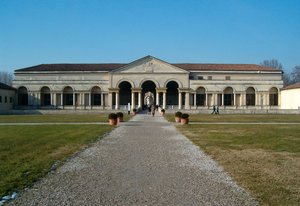
曼图亚 | 6 | View of the Sala dei Giganti (vault and south wall), View of the Palazzo del Tè, Façade |
 卢浮宫 |
巴黎 | 6 | Adoration of the Shepherds (detail), Flaying of Marsyas, Triumph of Titus and Vespasian |
 J·保罗·盖蒂博物馆 |
洛杉矶 | 5 | Allegory of the Virtues of Federico II Gonzaga, The Birth of Bacchus, Victory, Janus, Chronos, and Gaea |
 斯泰恩斯博物馆艺术馆 |
哥本哈根 | 3 | The Holy Family, St John with a small Bird in his Hand, Bacchus and Ariadne, Vertumnus and Pomona |
 乌菲兹美术馆 |
佛罗伦萨 | 2 | Nude Child with Open Arms, Virgin with the Child |
 苏格兰国家美术馆 |
爱丁堡 | 2 | The Holy Family with the Infant Saint John the Baptist, Tapestry Cartoon: Two Heads from the Massacre of the Innocents |
 曼托瓦公爵府 |
曼托瓦 | 2 | Tarquin and Lucretia, Ajax Defends Patroclus's Corps |
 皇家收藏馆 |
伦敦 | 2 | Portrait of a Woman (detail) |
选择一个年代,探索定义该时代的原创杰作。

In this intimate oil on panel, we find ourselves drawn into a private, shadowed space where the Madonna cradles her infant. The composition is centered on the tender connection between mother and child, while the young Infant St. John stands at her side, adding a sense of movement to the stillness. There is a profound sense of weight to the figures, achieved through a careful application of light that emerges…
To gaze upon this magnificent fresco, View of the Sala dei Giganti (vault and south wall), is to step directly into the vibrant heart of the High Renaissance. Painted in 1526 by the masterful hand of Giulio Romano, this work transcends mere decoration; it is a profound narrative tapestry woven from human drama, natural vitality, and divine symbolism. The scene explodes with life, drawing the viewer into a monumental gathering…
《穹顶:朱庇特宝座周围的神灵集会》是 朱利奥·罗曼诺 创作的一幅具有里程碑意义的 湿壁画。这件作品创作于1532年,坐落于意大利曼托瓦特宫(Palazzo del Tè)内的巨人厅(Sala dei Giganti)天花板之上。这部宏伟的装饰杰作见证了艺术家艺术风格的深刻转型——他逐渐背离了 盛期文艺复兴 时期那种追求古典和谐的理想,转而拥抱 风格主义 那种充满表现力与张力的美学表达。
To gaze upon this depiction of a tapestry with playing putti is to step directly into an idealized moment plucked from the heart of the Italian Renaissance. It is more than just a painting; it is a captured breath of youthful exuberance, rendered with the masterful touch characteristic of Giulio Romano. The scene unfolds as a vibrant pastoral tableau, where several cherubic figures—the beloved putti—engage in playful revelry. Their presence…
穹顶:朱庇特宝座周围的神灵集会 (1532)。紧随其后的是 View of the Sala dei Giganti (vault and south wall) (1526) 和 Tapestry with Playing Putti (1545)。
33岁:穹顶:朱庇特宝座周围的神灵集会创作于1532年,朱利奧·羅馬諾出生于1499年。
穹顶:朱庇特宝座周围的神灵集会, View of the Sala dei Giganti (vault and south wall), Tapestry with Playing Putti, Allegory of the Virtues of Federico II Gonzaga, The Lovers, Adoration of the Shepherds (detail), The Birth of Bacchus, Flaying of Marsyas, Victory, Janus, Chronos, and Gaea 及 View of the Palazzo del Tè。上方排名显示了每件作品的创作年份及馆藏机构。
我们的目录收录了 114 件 朱利奧·羅馬諾 的作品,创作年代从 1516 年至 1545 年。
多见于 特宫 (Tè 宫) (曼图亚), 卢浮宫 (巴黎) 及 J·保罗·盖蒂博物馆 (洛杉矶)。上方的博物馆列表列出了所有相关机构。
在 1520s 期间:本页 100 件作品中有 50 件创作于该时期,其中包含 View of the Sala dei Giganti (vault and south wall) 件作品。
在本页面中,最早的作品创作于 Madonna and Child with the Infant St. John (1516),最晚的创作于 Tapestry with Playing Putti (1545)。
Figures (28), People (23) 及 Woman (21),共计 100 件作品。
Fresco,共计 58 件(本页共有 100 件作品)。
根据本页面的原作,矫饰主义
View of the Sala dei Giganti (vault and south wall), View of the Palazzo del Tè 及 Façade:特宫 (Tè 宫), 曼图亚收藏了本页中 5 件作品。


