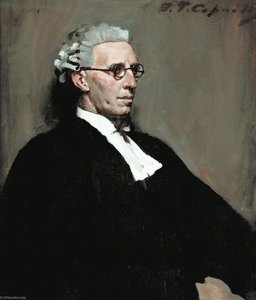
A Life Etched in Portraiture: The World of Frank Thomas Copnall
Frank Thomas Copnall, a name perhaps less immediately recognizable than some of his contemporaries, nevertheless occupies a significant niche within the British portrait tradition of the late 19th and early 20th centuries. Born in 1870, Copnall dedicated his life to capturing the essence of his sitters – primarily the burgeoning middle and upper classes of Liverpool society – with a refined technique and an observant eye for character. While biographical details remain somewhat sparse, the body of work he left behind speaks volumes about a man deeply attuned to the social currents and aesthetic sensibilities of his time. He wasn’t merely recording faces; he was documenting a world on the cusp of change, preserving its values and aspirations in oil and canvas. Copnall's artistic journey unfolded against a backdrop of Victorian formality gradually giving way to Edwardian elegance, and this transition is subtly reflected in his evolving style.
Early Influences and Artistic Development
Copnall’s formal training remains largely undocumented, but it’s reasonable to assume he benefited from the robust artistic environment prevalent in Liverpool during his formative years. The city was a thriving port and commercial hub, attracting artists and fostering a vibrant cultural scene. He likely studied at local art schools, absorbing the principles of academic realism that dominated the period. However, Copnall wasn't simply a mimic of established styles. His work reveals an early inclination towards capturing psychological depth, moving beyond mere physical likeness to suggest something of the inner life of his subjects. This sensitivity is perhaps his most defining characteristic. The influence of artists like John Singer Sargent – renowned for his masterful brushwork and ability to convey personality – can be detected in Copnall’s confident handling of paint and his focus on capturing fleeting expressions. He also exhibited at the Royal Academy, suggesting a connection to the broader London art world and an awareness of prevailing trends.
The Liverpool Portrait Circle
Copnall quickly established himself as a sought-after portraitist within Liverpool’s elite circles. His success wasn't accidental; he possessed a rare ability to put his sitters at ease, drawing out their personalities and translating them onto canvas with remarkable fidelity. He became particularly adept at portraying the wives and daughters of prominent merchants, shipowners, and industrialists – women who embodied the aspirations and social graces of the era. His portraits are not grandiose displays of wealth or power; rather, they offer intimate glimpses into the lives of a specific community. They are studies in refinement, elegance, and quiet dignity. Copnall’s studio became a hub for these individuals, a space where their identities were carefully constructed and preserved for posterity. His wife, Teresa Copnall, often served as a model herself, appearing in several of his works and embodying the ideal of feminine beauty he sought to capture.
Beyond Portraiture: Landscapes and Family Connections
While primarily known for his portraits, Copnall also produced a significant body of landscape paintings. These works reveal a different side of his artistic temperament – a love of nature and an appreciation for atmospheric effects. He often depicted scenes from the English countryside, employing a softer palette and a more impressionistic technique than his formal portraiture.
These landscapes weren’t merely studies of scenery; they were imbued with a sense of tranquility and emotional resonance.
His brother, Edward Bainbridge Copnall, was also an artist – a painter of genre scenes and historical subjects – suggesting a shared artistic heritage within the family.
The connection between the two brothers is evident in their similar attention to detail and their commitment to realistic representation. Edward’s work often focused on narrative storytelling, while Frank excelled at capturing individual character, but both artists shared a dedication to craftsmanship and a desire to create works that resonated with contemporary audiences.
Legacy and Historical Significance
Frank Thomas Copnall died in 1949, leaving behind a substantial body of work that continues to fascinate and intrigue art historians and collectors alike. While he may not be a household name, his paintings offer valuable insights into the social history and artistic sensibilities of late Victorian and Edwardian England. His portraits are more than just likenesses; they are windows into a bygone era. They capture the values, aspirations, and anxieties of a society on the cusp of profound change. Copnall’s ability to convey personality and his refined technique ensure that his work remains relevant today, offering a compelling glimpse into the lives of those who shaped Liverpool's cultural landscape – and beyond. His paintings serve as a testament to the enduring power of portraiture to capture not just what people looked like, but *who they were*.