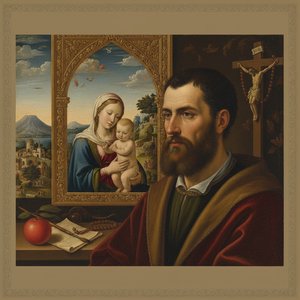
Piero di Cosimo: A Renaissance Visionary of Myth and Landscape
Born in Florence in 1462, Piero di Lorenzo, later known as Piero di Cosimo, stands as a singular figure within the Italian Renaissance. Unlike many of his contemporaries who rigidly adhered to established artistic lineages, Piero forged his own distinctive path—a journey marked by eccentric character, imaginative storytelling, and a profound engagement with both classical mythology and the burgeoning beauty of the natural world. He wasn’t a member of any specific school, but rather absorbed techniques from various masters, weaving them into a uniquely personal style that continues to fascinate art historians today.
Piero's early artistic development was inextricably linked to Cosimo Rosselli, a prominent painter and his teacher. From 1480, Piero worked alongside Rosselli in his workshop, gaining invaluable experience during the latter’s involvement in monumental frescoes like those adorning the Sistine Chapel in Rome—the *Sermon on the Mount* and possibly *Crossing of the Red Sea*. This immersion within the Vatican's artistic heart exposed Piero to the groundbreaking works of Sandro Botticelli and Domenico Ghirlandaio, whose vibrant colors and dynamic compositions would profoundly influence his own evolving style. The enamel-like surfaces and dramatic lighting observed in Botticelli’s work, particularly evident in *The Visitation*, became a crucial element in Piero’s early experimentation with color and form.
A Style Forged from Diverse Influences
Piero's mature artistic voice is most powerfully expressed through his mythological paintings. These aren’t simple reproductions of classical narratives; instead, they are vibrant, often fantastical interpretations brimming with a romantic sensibility. Drawing heavily on the writings of Vitruvius, particularly his account of human evolution and the interconnectedness of all things, Piero constructed elaborate scenes populated by hybrid creatures—a testament to his boundless imagination. Works like *The Misfortunes of Silenus*, *The Fight Between the Lapiths and the Centaurs*, and *Vulcan and Aeolus* depict a world where humans and animals coexist in a state of playful chaos, reflecting Piero’s fascination with the boundaries between the natural and the supernatural.
His early works demonstrate a clear debt to Hugo van der Goes' *Portinari Altarpiece*, evident in the use of rich, glossy skin tones. However, Piero quickly moved beyond mere imitation, developing his own distinctive approach. The *Liberation of Andromeda*, for example, showcases a masterful command of sfumato—the subtle blending of light and shadow pioneered by Leonardo da Vinci—creating an atmospheric depth previously unseen in Italian painting. This technique, combined with the soft modeling of figures, imbues Piero’s later works with a luminous quality that distinguishes them from the more rigid styles prevalent at the time.
Key Works and Notable Characteristics
Several paintings stand as particularly compelling examples of Piero's unique vision. *The Discovery of Honey by Bacchus* retains elements of Signorelli’s figure types, but introduces a softer modeling and warmer light—a clear indication of Piero’s mastery of the burgeoning oil painting technique. *Jason and Queen Hypsipyle with the Women of Lemnos* (1499) is a prime example of his mythological storytelling, depicting a scene of revelry and sensual abandon that reflects his interest in human nature and its potential for both beauty and excess. *The Forest Fire* (c. 1505), and *The Fight Between the Lapiths and the Centaurs* (c. 1500-15) further showcase his ability to depict dramatic action and complex narratives with a captivating sense of dynamism.
Legacy and Historical Significance
Piero di Cosimo’s legacy is one of innovation and individuality. He wasn't bound by the conventions of any particular school, instead drawing inspiration from a diverse range of sources—from the frescoes of Botticelli and Ghirlandaio to the techniques of Hugo van der Goes and Leonardo da Vinci. His willingness to experiment with color, composition, and technique paved the way for future generations of Renaissance artists. Giorgio Vasari, in his *Lives of the Most Excellent Painters, Sculptors, and Architects*, famously described Piero as an eccentric loner, a man who lived on hard-boiled eggs—a testament to his unconventional nature and unwavering commitment to his artistic vision. Piero di Cosimo’s paintings continue to be admired for their imaginative power, technical brilliance, and enduring appeal, solidifying his place as a pivotal figure in the development of Renaissance art.
问答详情
在哪里可以按关键词浏览 科内利斯·恩赫布雷赫茨 的作品?
您可以通过艺术家关键词分类页面,按关键词探索科内利斯·恩赫布雷赫茨的作品。每个关键词都汇集了相关的艺术品。
科内利斯·恩赫布雷赫茨 来自哪里?
科内利斯·恩赫布雷赫茨 出生于 荷兰。
科内利斯·恩赫布雷赫茨 的作品受欢迎程度如何?
科内利斯·恩赫布雷赫茨 拥有一个 统计数据 页面,其中展示了该艺术家在 本站 上的作品统计数据。
是否有科内利斯·恩赫布雷赫茨作品的时间线?
艺术家的 作品时间轴 页面按年份顺序展示了 科内利斯·恩赫布雷赫茨 的作品。