A Legacy of Light and Line: The Life of Constantin Netscher
In the grand tapestry of the Dutch Golden Age, few threads shine with as much meticulous brilliance as those woven by Constantin Netscher. Born in 1668 in The Hague, Netscher was a child of artistic royalty, emerging from a lineage defined by the mastery of light and texture. As the son of the renowned Caspar Netscher, his very existence was steeped in the traditions of the Dutch Baroque. His early years were not merely spent observing the world, but learning to translate its most delicate nuances onto canvas under the watchful eyes of his father and his elder brother, Anthonie Netscher. This foundational training instilled in him a profound respect for anatomical precision and an almost scientific devotion to the rendering of surfaces—from the shimmering sheen of silk to the soft warmth of human skin.
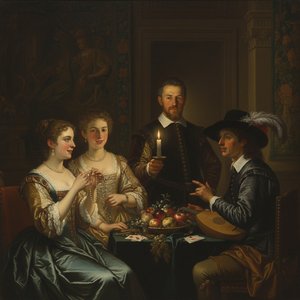
Netscher’s journey was one of continuous refinement, moving beyond the mere imitation of his predecessors to forge a signature style that balanced psychological depth with material splendor. While many of his contemporaries sought to capture the broad strokes of emotion, Netscher found power in the subtle. He possessed an uncanny ability to manipulate chiaroscuro, using dramatic contrasts between light and shadow to sculpt figures out of the darkness. This technique did more than just provide dimension; it breathed life into his subjects, allowing a viewer to sense the quiet breath of a sitter or the heavy stillness of a room. His work often transcended simple portraiture, venturing into historical allegories and Italianate landscapes that showcased a versatile command over diverse genres.
Mastery of the Human Form and Texture
To gaze upon a Netscher masterpiece is to enter a world where every detail is an invitation to linger. He was a painter who understood that true realism lies in the details that often go unnoticed by the casual observer. His commitment to anatomical accuracy allowed him to capture the subtle tension of a muscle or the graceful curve of a neck with astonishing fidelity. Yet, it was his treatment of texture that truly set him apart. In works such as "A Woman Playing a Lute," one can almost feel the tactile richness of the fabrics draped around the subject, rendered with a precision that borders on the miraculous.
This technical virtuosity served a higher purpose: the conveyance of character. Netscher did not merely paint faces; he painted souls. Through his masterful use of light, he could highlight a flicker of melancholy in an eye or the serene confidence of a noblewoman. His portraits, such as the "Portrait of Marie Mancini" or his evocative depictions of aristocratic children, serve as windows into the social hierarchies and emotional landscapes of the 17th and 18th centuries. He sought to capture not just the physical likeness of his patrons, but their very essence, creating an immersive visual experience that remains captivating centuries later.
Influence and Enduring Significance
The impact of Constantin Netscher extended far beyond the borders of The Hague, leaving an indelible mark on the trajectory of European portraiture. As a teacher, he passed his rigorous standards and technical secrets to a new generation of artists, including Hendrick Doorschodt and Mattheus Verheyden, ensuring that his dedication to realism would endure. His ability to blend the meticulousness of the Dutch tradition with the burgeoning elegance of the Rococo period made him a bridge between two eras of artistic splendor.
Even as art movements shifted toward different ideals, Netscher’s reputation remained steadfast. He stands today not merely as a follower of his father’s footsteps, but as a titan in his own right—a master who could command the shadows to reveal the light. His legacy is found in every brushstroke that seeks to find beauty in precision and every portrait that dares to look deeply into the human condition. Through his work, we continue to witness the golden glow of a vanished age, preserved forever in the exquisite textures of his canvas.